
The Easiest Way to Cut a Mango Without Making a Mess
To cut a mango neatly, slice the two broad cheeks away from its flat pit, score the flesh into a grid, and scoop out the pieces. Keep the fruit on a stable cutting board whenever a knife is involved. The trick is understanding the pit’s shape rather than trying to cut through the center.
Choose a mango that is ready to cut
A ripe mango yields slightly when gently pressed. Skin color depends on the variety and is not a reliable ripeness test by itself. Very firm fruit is harder to cut, while overripe fruit may collapse during scoring. Let firm mangoes ripen at room temperature, then refrigerate ripe fruit if you will not use it immediately.
What you need
Use a clean sharp knife, a non-slip cutting board, a spoon, and a bowl. Wash and dry the mango before slicing because the knife passes from the peel into the flesh. Place a damp towel beneath a sliding board.
1. Picture the flat pit
The pit is broad and flat, running lengthwise through the fruit. Stand the mango securely, stem end up, and identify the two broad sides. If the rounded base makes it unstable, trim a very thin slice from the bottom to give it a flat resting surface.
2. Slice off the cheeks
Cut down one side of the pit, then the other. Start a little away from the center and let the knife travel alongside the pit. If you meet hard resistance, withdraw carefully and move outward. Do not force the knife through the pit.
3. Score on the board
Rest a cheek skin-side down on the board. Make parallel cuts through the flesh, then cut across them to form cubes. Stop before the knife reaches the skin. Avoid holding the cheek in your palm while scoring; your hand should not be beneath the blade.
4. Scoop out the flesh
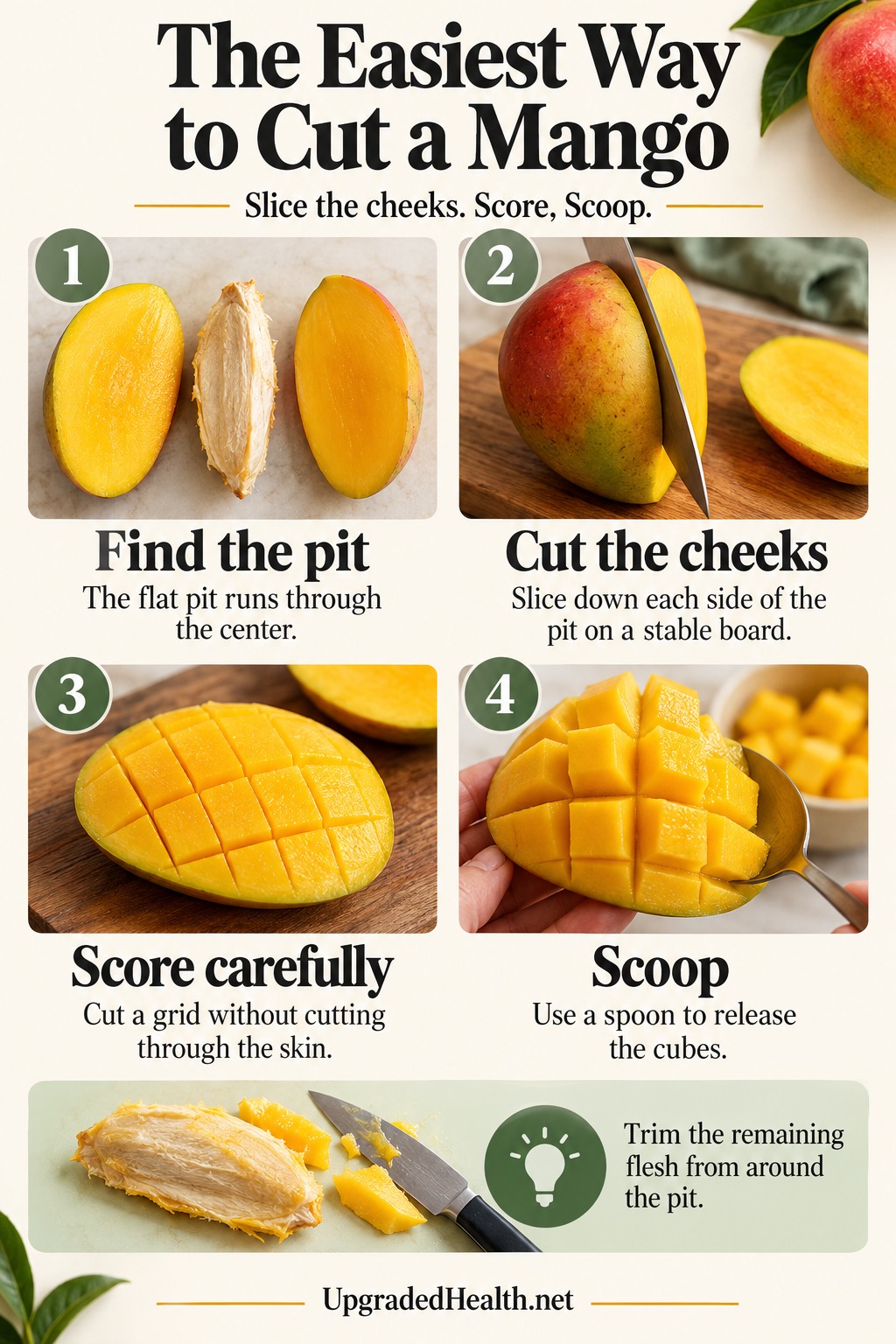
Slide a spoon between the flesh and peel and scoop the pieces into the bowl. You can also scoop the cheek out whole, then cut it on the board. That alternative is useful when a very ripe mango is too soft to score cleanly.
5. Trim around the pit
Place the remaining center section securely on the board. Trim the peel and cut away the usable flesh around the pit. These irregular pieces are perfect for smoothies, salsa, or snacking. You do not need to make every piece a cube.
Troubleshooting
If cuts will not pass through the flesh easily, the mango may be underripe or the knife too dull. If cubes fall apart, use the softer fruit in purée instead. A lot of flesh left on the pit means the cheek cuts were too far from the center; recover what you can with careful trimming.
Serving ideas
Add cubes to fruit bowls, fold into a lime-and-cilantro salsa, or serve with plain yogurt. For a savory meal, combine mango with cucumber and a little lime juice, then serve alongside cooked fish. Keep cut fruit separate from raw proteins during preparation.
Storage and freezing
Refrigerate cut mango promptly in a covered container and use within a few days. For freezing, arrange pieces on a lined tray until firm, then transfer to a freezer bag. Thawed mango is softer, so it is best in smoothies, sauces, and purées.
Can I peel it first?
Yes, but a peeled mango is slippery. The cheek-and-scoop method lets the skin support the flesh until the cutting is finished.
Do mangoes all have the same shape?
No. Varieties differ in size, fiber, and pit shape. Adjust your cuts to the actual fruit and use gentle pressure rather than a fixed distance from the center.


