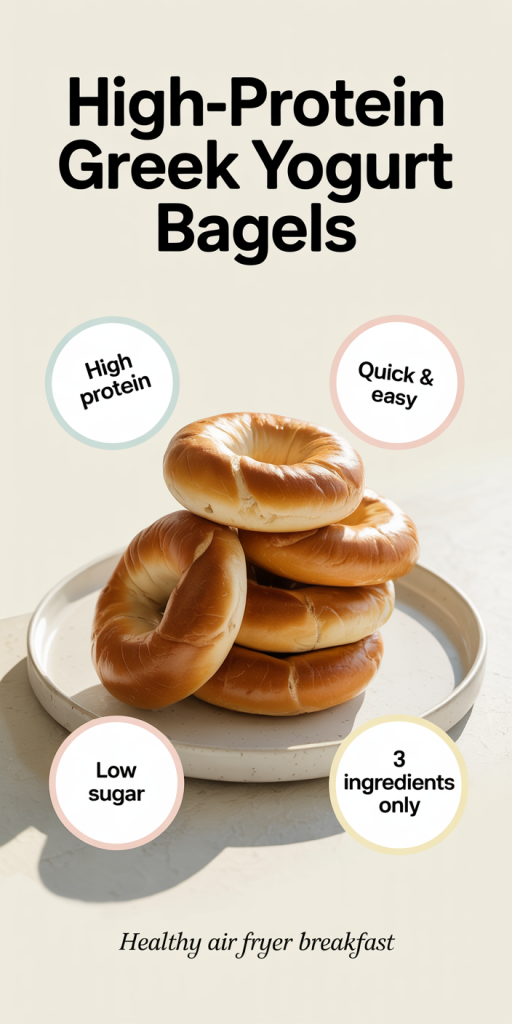
3-Ingredient High-Protein Greek Yogurt Air Fryer Bagels
We love a recipe that’s fast, forgiving, and actually tastes like something worth getting out of bed for. These 3-ingredient high-protein Greek yogurt air fryer bagels check all those boxes. Using just Greek yogurt, self-rising flour, and an egg (plus a little optional topping flair), we get chewy, golden bagels in under 30 minutes from start to finish. They’re higher in protein than traditional bagels, portable, and perfect for sandwiching smoked salmon, avocado, or a smear of nut butter. In this text we’ll explain why this simple method works, break down the protein math, cover equipment and air fryer tips, walk through the recipe step-by-step, offer flavor variations, troubleshoot common issues, and give storage and reheating advice so you can keep a batch on hand.
Why These Bagels Work: Benefits And What To Expect
These bagels are a riff on the popular Greek yogurt dough trend: combine thick Greek yogurt with flour and an egg, and you get a soft, slightly chewy dough that browns nicely. Here’s why the approach is effective and what we can realistically expect.
- High protein, simple ingredients: Greek yogurt is dense in protein and moisture: paired with flour and an egg, it gives structure without needing yeast, long rising times, or complicated technique. That’s attractive for busy mornings.
- No-yeast convenience: Because there’s no yeast, we skip proofing. We also avoid the unpredictability of active dry yeast (temperature, freshness). The texture won’t perfectly replicate a classic chewy, aerated bagel made with boiling and long fermentation, but it will deliver a satisfyingly dense, tender interior and a golden exterior.
- Speed and reliability: From mixing to finished bagel in roughly 20–30 minutes in an air fryer. The air fryer gives quick, even browning and a slightly crisp exterior without frying in oil.
- Versatility: These bagels act like a blank canvas, savory seeds, dried fruit and cinnamon, or everything seasoning are all fair game. Because the base is simple, it’s easy to tailor macros by choosing full-fat or low-fat Greek yogurt and by adding mix-ins.
What to expect on first try:
- Texture: Denser than a traditional NYC bagel, more akin to a kettle‑less, brioche-like mini bagel, moist interior, crisp exterior.
- Flavor: Tangy notes from the yogurt: mild egg flavor from the wash. Seasonings and toppings can shift the profile quickly to savory or sweet.
- Consistency: This method is forgiving. Small adjustments in dough hydration or flour type may change chewiness, but you’ll quickly dial it in.
In short, these are realistic, high-protein, speedy bagels for everyday use, not a baker’s project for an exact traditional replica. And that’s okay, we’ll show how to make them taste and perform like something special.
Key Ingredients And Protein Breakdown
Let’s look at the three core ingredients and why each matters, plus a helpful protein estimate so you can plan meals around these bagels.
Core ingredients
- Greek yogurt (preferably thick/plain): We recommend full-fat or 2% for the best mouthfeel, but 0% works if you want fewer calories. Greek yogurt brings most of the protein and moisture that binds the dough.
- Self-rising flour: This is all-purpose flour pre-mixed with baking powder and salt. The baking powder provides lift and keeps the crumb light enough even though the absence of yeast. If you don’t have self-rising flour, we’ll show the simple swap in the recipe: combine all-purpose flour with baking powder and salt.
- Egg: One egg is used both in the dough (if your variation includes it) and commonly as an egg wash. The egg helps with structure and browning. Some recipes omit the egg in the dough and rely on yogurt + flour: we find including one egg (in the dough) gives a slightly firmer crumb and easier shaping.
Protein breakdown (approximate, per batch and per bagel)
We’ll give a realistic estimate for a standard batch that yields 6 medium bagels. Exact numbers depend on the Greek yogurt brand and portion size, but this is a practical baseline:
- Greek yogurt, 2 cups (approx. 490g): about 40–46 g protein (plain nonfat Greek yogurt ~23–24 g per cup: full-fat slightly less per cup by weight but similar protein). We often use 1 1/2–2 cups depending on dough hydration, this batch math assumes 2 cups for simplicity.
- Self-rising flour, 2 cups: about 16 g protein (around 8 g protein per cup of all-purpose flour).
- Egg, 1 large: about 6–7 g protein.
Total protein per batch (approx.): 62–69 g.
If the batch yields 6 bagels: protein per bagel ~10–11.5 g.
If the batch yields 8 small bagels: protein per bagel ~7.75–8.6 g.
Compare that to a typical store-bought bagel that often contains 8–11 g protein but with far more refined carbs and calories. Our Greek yogurt bagels give a comparable or higher protein density with fewer calories (depending on yogurt choice) and less refined processing.
Recipe flexibility for macros
- To increase protein: Use high-protein Greek yogurt (some brands fortify or have naturally higher protein), or add a scoop of unflavored protein powder (we’ll explain how briefly in the variations section). You can also use whole wheat self-rising flour, protein goes up slightly and fiber increases.
- To reduce carbs: Make mini bagels or halve the serving. Replacing part of the flour with almond flour is possible but will change texture and requires recipe adjustments.
Small labeling note: we provide macro estimates so you can plan meals, but exact nutrition will depend on your brands and portion sizes, use a nutrition calculator for precise tracking.
Must-Have Equipment And Air Fryer Tips
You don’t need a full bakery setup, just a few kitchen basics plus the air fryer. Here’s what we recommend and some air-frying essentials to get consistent results.
Essential equipment
- Air fryer: Any basket-style or oven-style air fryer that reaches 375–400°F will work. If you have a compact model, plan for smaller batches.
- Mixing bowl and spatula: For combining the yogurt and flour.
- Measuring cups and spoons: For consistent results, baking is part art, part science.
- Parchment paper or reusable air fryer liners: Prevents sticking and makes cleanup easier. If using parchment, cut to fit and avoid blocking airflow.
- Pastry brush (optional): For egg wash. A silicone brush works fine.
- Kitchen scale (recommended): For the most consistent dough, if you have it, weigh the flour and yogurt.
Air fryer tips for perfect bagels
- Don’t overcrowd: Give each bagel at least 1/2 inch of space so hot air circulates. If your air fryer is small, cook in batches.
- Use the right temperature: We generally air fry at 360–375°F. Higher temps brown faster but can dry the interior. Lower temps extend time and can make crust less crisp. We’ll share exact times in the recipe.
- Preheat the air fryer briefly: 2–3 minutes is enough for most models. A preheated basket gives immediate contact heat that helps set the exterior.
- Protect airflow with parchment: If you use parchment, cut it to leave a small channel for air if your model requires it. Avoid placing large sheets that curl and touch heating elements.
- Rotate or flip if needed: Some air fryers have hotspots, flip or rotate the basket halfway through the cook for even color.
- Check by touch and color: These bagels will be golden brown and firm to the touch. Because they’re denser than classic bagels, rely more on color and a gentle press to check doneness rather than an internal temperature.
- Batch timing: If you make multiple batches and keep earlier ones warm, place them on a wire rack loosely tented with foil. Avoid stacking, which traps steam and softens the crust.
- Clean promptly: Greek yogurt can brown and stick: cleaning soon after cooking prevents lingering smells and residue.
Air fryer model notes
- For smaller, single-basket units: Make 3–4 bagels per batch depending on size.
- For oven-style air fryers or convection ovens: Use the same temperatures but watch closely, larger units can circulate air more aggressively, sometimes reducing cook time by a minute or two.
Step-By-Step Recipe
Below is our reliable method for making 3-ingredient high-protein Greek yogurt air fryer bagels. We aim for clarity so you get consistent results every time.
Dough Preparation And Consistency Checks
Ingredients (yields ~6 medium bagels):
- 2 cups plain Greek yogurt (use thick-style: 2% or full-fat recommended)
- 2 cups self-rising flour (or 2 cups all-purpose + 2 tsp baking powder + 1/2 tsp salt)
- 1 large egg (for dough)
Optional for egg wash/toppings:
- 1 egg yolk + 1 tsp water (for egg wash) or just milk for a lighter wash
- Everything bagel seasoning, sesame seeds, poppy seeds, coarse salt, or dried fruit/sugar mix for sweet versions
Method:
- Combine dry and wet: In a large bowl, whisk the egg lightly. Add the Greek yogurt and stir until combined. Mix in the egg thoroughly so the mixture is uniform.
- Add flour: Add 1 cup of self-rising flour to the yogurt mixture and fold with a spatula. It will be sticky at first. Add the second cup and continue folding. When dough starts to come together, use your hands (lightly floured) to work the dough into a soft, slightly tacky ball.
- Consistency checks and adjustments: The dough should be soft but not slimy or overly wet. If it’s too wet and sticks excessively to your hands, sprinkle in a tablespoon of flour at a time until manageable. If it’s too dry and cracks, smear a teaspoon of yogurt on your hands and lightly knead until it becomes cohesive. We aim for a pliable dough that holds shape.
- Rest briefly (optional): A 5–10 minute rest (covered loosely) lets the baking powder begin working and hydrates the flour evenly. This isn’t mandatory, but we often do it for smoother shaping.
Shaping, Egg Wash, And Topping Options
- Divide the dough: Divide into 6 equal portions for medium bagels or 8 for smaller ones. Weighing portions (around 85–95g for medium) helps uniformity.
- Shape into bagels: Roll each portion into a tight ball, then use your thumb to poke a hole through the center and rotate to widen, about 1–1.5 inches for a typical bagel. Because these don’t expand like yeast bagels, make the hole fairly generous so it remains after cooking.
- Prepare the egg wash: Beat the egg yolk with 1 tsp water (or use milk). Brush the tops of each shaped bagel lightly, this gives deeper color and helps toppings adhere.
- Add toppings: Sprinkle everything bagel seasoning, sesame, poppy seeds, or a light dusting of coarse salt. For sweet versions: gently press in a few raisins, cinnamon + sugar, or chopped dried apricot pieces before the wash.
Air Frying Times, Temperatures, And Batch Notes
- Preheat: Preheat your air fryer to 360°F (182°C) for 2–3 minutes.
- Bake: Place 3–4 bagels (depending on fryer size) on parchment or a lightly oiled basket. Air fry at 360°F for 9–12 minutes, checking at 8 minutes. We look for a deep golden brown and firm exterior. If you like a slightly crisper exterior, increase to 375°F for the last 1–2 minutes.
- Rotate if necessary: Halfway through (around 5–6 minutes), open and rotate the basket or flip bagels if your model shows uneven browning.
- Cool briefly: Transfer bagels to a wire rack for 5–10 minutes to prevent steam buildup on the bottom.
- Repeat: Cook remaining bagels in batches, keeping earlier ones on a rack (not stacked) while finishing the rest.
Batch notes and timing:
- Small air fryers: Expect the longer end of the range (10–12 minutes).
- Larger convection air fryers: Start checking at 8 minutes, total time may be 9–10 minutes.
- If topping with sugar or dried fruit, watch for accelerated browning and reduce temperature by 10–20°F if needed to avoid burning.
Serving suggestions: Slice and toast lightly, spread with cream cheese and smoked salmon, top with avocado and hot honey, or use as sandwich bread for a high-protein lunch.
Flavor Variations And Mix-In Ideas
These bagels adapt well to both sweet and savory directions. Here are ideas we use regularly, plus guidance on how add-ins affect consistency.
Savory variations
- Everything Bagel: Brush with egg wash and liberally sprinkle everything bagel seasoning (garlic, onion, sesame, poppy, salt). This is our go-to for savory breakfasts and deli-style sandwiches.
- Garlic Herb & Parmesan: Mix 1–2 tbsp of finely grated Parmesan into the dough, fold in 1 tsp dried oregano or Italian seasoning, and top with extra Parmesan.
- Scallion-Cheddar: Fold 1/4–1/2 cup finely shredded sharp cheddar and 2–3 tbsp finely chopped scallions into the dough. Keep the add-in quantity moderate to avoid a greasy or heavy dough.
Sweet variations
- Cinnamon Raisin: Stir 1 tsp ground cinnamon into the dough and fold in 1/3 cup raisins. Brush with a light milk wash and sprinkle a pinch of cinnamon sugar on top.
- Blueberry-Lemon: Fold in 1/3 cup fresh or frozen blueberries (toss with a dusting of flour to prevent bleeding) and 1 tsp lemon zest.
Protein-boosted variations
- Protein powder boost: Replace up to 1/4 cup of the flour with an unflavored whey or plant protein powder. Because protein powder absorbs liquid differently, reduce yogurt by 1–2 tbsp if dough becomes too wet, and expect a slightly drier, firmer crumb.
- Seeds and nuts: Add 2 tbsp chia or hemp seeds directly to the dough for extra protein and healthy fats. Finely chopped nuts (almonds, walnuts) can be used sparingly.
Notes on add-ins
- Keep add-ins to about 15–20% of the total dough weight to maintain structure. Too much fruit, cheese, or nuts can break the balance and result in spreading or sogginess.
- For wet add-ins (fresh fruit, tomatoes), pat dry and toss with a teaspoon of flour to reduce excess moisture.
We recommend experimenting with one variation at a time until you understand how it affects dough hydration and baking time.
Troubleshooting Common Problems
Even with a simple recipe, things can go sideways. Here’s our troubleshooting guide for common issues and what to adjust.
Problem: Dough too sticky and unworkable
- Likely cause: Too much yogurt or too warm ingredients.
- Fix: Sprinkle in flour 1 tbsp at a time until the dough firms up. Chill dough for 10 minutes, cooler dough is easier to handle. Use lightly floured hands and a bench scraper.
Problem: Bagels are dry or crumbly
- Likely cause: Too much flour, overcooking, or using very dry protein powder replacement.
- Fix: Reduce flour slightly next time, shorten cook time by 1–2 minutes, or add 1–2 teaspoons of yogurt to the dough. If using protein powder, reduce its amount and adjust yogurt accordingly.
Problem: Bagels aren’t browning evenly
- Likely cause: Air fryer hotspots, overcrowding, or lack of egg wash.
- Fix: Space bagels further apart, rotate the basket halfway through, and use egg wash for more consistent color.
Problem: Interior is undercooked while exterior is done
- Likely cause: Too-high temperature or too-large bagels.
- Fix: Lower the temperature by 10–15°F and increase time slightly. Make smaller bagels or gently press to check size.
Problem: Toppings fall off after cooking
- Likely cause: Toppings applied too lightly or no egg wash.
- Fix: Press toppings gently into the dough before applying wash: use egg wash to help adherence.
Problem: Bagels collapse or spread
- Likely cause: Over-hydrated dough, too much fat (from cheese add-ins), or under-measurement of flour.
- Fix: Add a touch more flour to reach recommended dough consistency, chill briefly, and avoid overly greasy mix-ins.
If something still feels off after adjustments, retrace measurements and ingredient substitutions, we often find that a small deviation (like using 3 cups yogurt instead of 2) is the culprit. Baking is forgiving at this scale, so small tweaks will get you consistent results quickly.
Storage, Freezing, And Reheating Best Practices
One of the best things about making a batch of these bagels is how well they store. Follow our tips to keep texture and flavor intact.
Storing short-term
- Room temperature: Keep bagels in a paper bag or a loosely sealed container for up to 24 hours. Paper helps maintain crust while preventing sogginess.
- Refrigerator: For up to 5 days, store in an airtight container. Refrigeration can dry products: we recommend reheating or toasting before eating to revive texture.
Freezing for longer storage
- Freeze cool bagels on a baking sheet for 1–2 hours until firm, then transfer to a freezer bag or airtight container. This prevents them from sticking together.
- Frozen bagels keep well for up to 3 months.
Thawing and reheating
- Thawing: Thaw at room temperature for 20–30 minutes, or place frozen bagels directly in a toaster or air fryer.
- Reheating in air fryer: Preheat air fryer to 320–330°F and reheat for 3–5 minutes from thawed, or 6–8 minutes from frozen. This crisps the exterior while warming the interior.
- Toaster or oven: Slice in half and toast in a toaster for 2–3 minutes (thawed) or bake at 325°F for 6–8 minutes.
Reviving texture
- If bagels become slightly dry, a light brush of water before reheating in the air fryer or oven helps steam the interior and restore softness.
Make-ahead tips
- Par-bake and finish later: Air fry at a slightly lower temperature for 6–7 minutes to set crust, then finish at serving time to get freshest texture, adding 2–3 minutes at higher temp.
- Freeze dough portions: Shape bagels, flash freeze on a tray, then bag. Air fry from frozen, add a couple minutes to cook time and check for even heating.
Nutrition Per Serving And High-Protein Meal Ideas
Nutrition estimate (per medium bagel, recipe yields ~6):
- Calories: ~180–230 kcal
- Protein: ~10–11.5 g
- Carbohydrates: ~20–26 g
- Fat: ~3–6 g (varies with yogurt fat percentage)
- Fiber: ~1–2 g
Notes on the estimate:
- These are approximate values based on 2 cups plain Greek yogurt, 2 cups self-rising flour, and 1 egg divided by 6. Using nonfat yogurt will lower fat but keep protein similar: full-fat yogurt increases calories and fat. Add-ins like cheese or nuts will alter macros significantly.
- For precise tracking, plug your exact brands and weights into a nutrition app.
High-protein meal ideas using these bagels
- Smoked salmon & herbed cream cheese: Layer 3–4 oz smoked salmon, cucumber slices, dill, capers, and 2 tbsp full-fat or light cream cheese. Protein: roughly 25–30 g depending on salmon portion, great for brunch.
- Turkey, spinach, & hummus sandwich: Spread 2 tbsp hummus, add 3–4 oz sliced turkey breast, baby spinach, and tomato. Protein: ~25–28 g.
- Greek-style breakfast: Top with 2 tbsp labneh or Greek yogurt, chopped cucumber, cherry tomatoes, olives, and a sprinkle of za’atar. Add a hard-boiled egg on the side for extra protein, total meal protein ~20–25 g.
- Sweet protein boost: Split and toast, spread with 2 tbsp nut butter and sliced banana, plus a dusting of chia seeds. Nut butter adds healthy fats and 6–8 g protein depending on the type.
- Open-faced veggie melt: Top with a thin layer of pesto, tomato slices, and 1/4 cup shredded mozzarella, air fry 2–3 minutes until cheese melts. Add sliced grilled chicken for a protein-rich dinner.
Pairing and portion control
- These bagels are satisfying enough to be a single serving with a protein-rich topping. If you’re tracking macros, using lean proteins (turkey, chicken, smoked salmon) and nonfat toppings keeps calories in check while maximizing protein.
We often keep a batch in the freezer and rotate toppings through the week, this makes weekday breakfasts fast, varied, and protein-forward.
Conclusion
We’ve found these 3-ingredient high-protein Greek yogurt air fryer bagels to be one of the most practical, delicious ways to get a homemade bagel without the time commitment. They’re forgiving, adaptable, and pack a protein punch that makes them useful for breakfasts, lunches, and quick dinners. Play with toppings and small ingredient swaps to match your macro goals or flavor preferences, and rely on the troubleshooting tips if something goes sideways. Keep a few frozen for weekday mornings: with a brief reheat in the air fryer you’ll have a fresh, crisp bagel in minutes. Give the recipe a try, and tweak it until it becomes your go-to, ours certainly is.