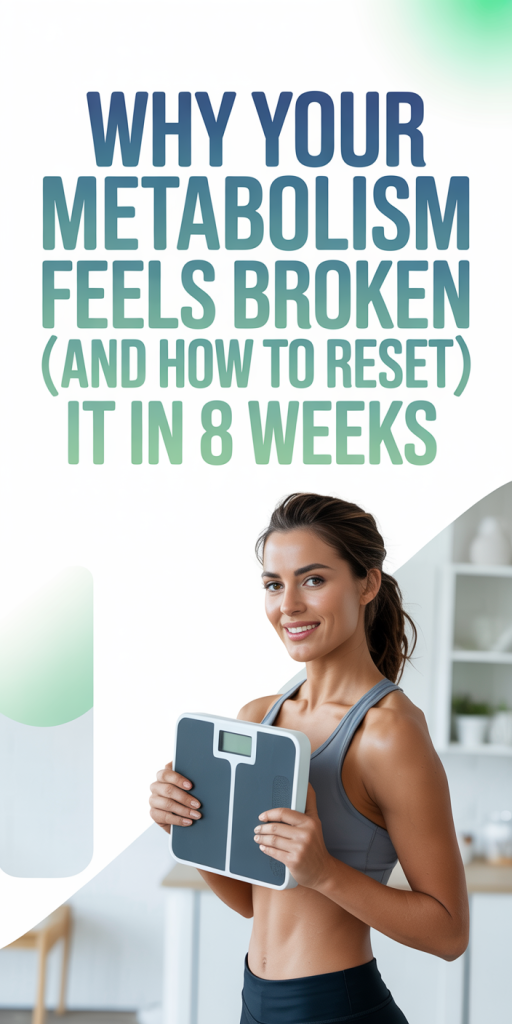
Why Your Metabolism Feels Broken (And How to Reset It in 8 Weeks)
If you’ve ever felt like your metabolism is working against you, you’re not alone.
You eat clean. You try to stay consistent. You push through workouts. And yet… nothing changes. The scale stalls, your energy crashes, and cravings seem to take over.
It’s frustrating. It makes you question everything.
But here’s the truth most people never hear:
Your metabolism isn’t broken. It’s adapted.
And once you understand why that happens, you can start fixing it the right way.
The Real Problem With Most Weight Loss Advice
For years, we’ve been told the same thing:
“Eat less. Move more.”
On paper, it sounds logical. In reality, it’s the exact reason so many people feel stuck.
When you constantly restrict calories, your body doesn’t see “dieting.”
It sees survival mode.
So it responds by:
- Slowing down your metabolism
- Increasing hunger hormones
- Holding onto fat more efficiently
This is called metabolic adaptation.
It’s not a failure. It’s your body doing its job.
Does This Sound Familiar?
- You’ve tried multiple diets, but each one works less than the last
- You hit a plateau no matter how little you eat
- You feel tired even when you’re “doing everything right”
- You crave sugar, carbs, or salt constantly
That’s not a discipline problem.
That’s a signal.
Your body is telling you it needs a different approach.
What Metabolism Actually Is (It’s Not Just Calories)
Most people think metabolism is just calories in vs. calories out.
It’s not.
It’s a system made up of four key parts:
1. Muscle (Your Metabolic Engine)
The more lean muscle you have, the more calories you burn at rest.
2. Hormones
Hormones like leptin, ghrelin, and growth hormone control hunger, fat storage, and energy.
3. Thyroid (Your Metabolic Thermostat)
Your thyroid regulates how fast or slow your body operates at a cellular level.
4. Insulin (The Gatekeeper)
When insulin is high, fat gets stored. When it’s balanced, fat can be burned.
When even one of these is off, your metabolism slows down.
When multiple are off? That’s when things feel “broken.”
The 5 Biggest Reasons Your Metabolism Slowed Down
Most people dealing with stubborn weight or low energy are unknowingly doing these.
1. Chronic Dieting
Every time you cut calories too low, your body adapts.
- Thyroid output drops
- Leptin decreases
- Fat storage increases
That’s why weight regain happens so fast after dieting.
Your body got better at storing energy.
2. Low Protein Intake
Protein isn’t optional.
It’s what preserves muscle.
Without enough protein:
- You lose muscle mass
- Your metabolism slows
- Your body becomes more efficient at storing fat
Less muscle = lower calorie burn, even at rest.
3. Blood Sugar Swings
Refined carbs and sugar create a cycle:
Spike → crash → cravings → repeat
This leads to:
- Energy crashes
- Constant hunger
- Increased fat storage
Over time, it can lead to insulin resistance, making fat loss even harder.
4. Poor Sleep
Sleep is where your metabolism resets.
Even one bad night can:
- Increase cravings
- Disrupt hunger hormones
- Raise cortisol
And when this becomes a pattern, fat loss becomes an uphill battle.
5. Chronic Stress (High Cortisol)
Stress isn’t just mental. It’s chemical.
High cortisol:
- Promotes fat storage (especially belly fat)
- Breaks down muscle
- Disrupts thyroid function
Combine high cortisol with high insulin, and you create a perfect storm for fat gain.
Signs Your Metabolism Has Adapted
Your body is always communicating. You just have to listen.
Common signs include:
- You’re eating less, but not losing weight
- You feel tired all the time
- Cravings feel uncontrollable
- Fat loss only happens with extreme restriction
- You regain weight quickly after dieting
These are not signs of failure.
They’re signs your metabolism needs a reset.
Why Most Diet Plans Don’t Work
Most programs focus on one thing: calories.
But your metabolism isn’t just about calories.
It’s about:
- Hormones
- Muscle mass
- Stress
- Sleep
- Behavior
You can’t fix a complex system with a single lever.
That’s why restriction alone almost always fails long term.
The Right Approach: A Structured Metabolic Rebuild
If your metabolism has adapted, you don’t need another diet.
You need a rebuild.
And that requires structure.
Not random tips. Not guesswork.
A coordinated approach that works with your body.
The 3 Pillars of Metabolic Repair
A real reset comes down to three things working together:
1. Nutrition for Repair
This isn’t about eating less.
It’s about:
- Increasing protein
- Stabilizing blood sugar
- Supporting your thyroid
You’re sending your body the message:
“You’re safe. You can burn again.”
2. Lifestyle & Behavior
You can’t out-diet poor sleep and high stress.
This pillar focuses on:
- Sleep quality
- Stress reduction
- Sustainable habits
Because your metabolism responds to your lifestyle, not just your food.
3. Muscle as Medicine
If there’s one long-term fix, this is it.
Resistance training:
- Builds muscle
- Increases resting metabolism
- Improves insulin sensitivity
Muscle isn’t just for aesthetics.
It’s your metabolic engine.
What Happens When Your Metabolism Starts Working Again
This is where everything changes.
- Fat loss becomes easier (without extreme restriction)
- Energy stays stable throughout the day
- Cravings drop dramatically
- Hormones begin to rebalance
- You stop feeling like you’re “fighting your body”
It’s not just weight loss.
It’s freedom from dieting.
A Smarter Way to Reset: The 8-Week Approach
Real metabolic change doesn’t happen overnight.
But it also doesn’t take forever.
An effective reset follows a simple progression:
Weeks 1–2: Stabilize blood sugar, improve sleep, increase protein
Weeks 3–4: Support hormones (cortisol, thyroid, leptin)
Weeks 5–6: Build muscle and increase metabolic output
Weeks 7–8: Lock in habits and make it sustainable
This step-by-step approach mirrors how your body actually heals.
The Bottom Line
If your metabolism feels broken, it’s not because you failed.
It’s because your body adapted to the signals you gave it.
And the good news?
Adaptation works both ways.
When you change the signals—through better nutrition, smarter training, and improved lifestyle—your metabolism responds.
It rebuilds.
Final Thought
You don’t need more restriction.
You don’t need more cardio.
You don’t need more willpower.
You need a better strategy.
Because your metabolism isn’t broken.
It’s ready to be rebuilt.