This Is What 150g of Protein Actually Looks Like for Women
Reaching 150 grams of protein in a day feels like a big, intimidating number — especially if you’re used to eyeballing protein at meals or following a “few bites of chicken” approach. But for many active women — those building muscle, recovering from injury, in a calorie surplus, or carrying a larger body mass — 150g can be an appropriate, realistic target. In this article you’ll find science-backed context for why someone might aim for 150g, practical strategies to hit that number, multiple full-day sample menus that add up to ~150g, and several easy recipes (with ingredients and step-by-step instructions) you can use to build your own high-protein day.
This is actionable, encouraging guidance — no calorie-counting stress required — just clear ways to visualize and implement 150 grams of protein for busy lives.
Why 150g of protein might be right for you
Protein needs depend on body weight, activity level, and goals. General ranges:
- Sedentary adults: ~0.8 g/kg body weight (not typically 150g for most women).
- Active adults and recreational athletes: 1.2–1.6 g/kg.
- Serious strength athletes, people aiming for muscle gain, or those in calorie deficits: 1.6–2.2 g/kg.
For a woman weighing 68 kg (150 lb), 1.6–2.2 g/kg is about 109–150 g. So 150g is near the top of that range and appropriate for women with heavier body weight or high training demands.
Important notes:
– Hitting 150g is safe for most healthy people. The “high protein harms kidneys” idea is largely a myth unless you already have kidney disease. Still, check with your doctor if you have existing kidney issues.
– Spreading protein across meals improves muscle protein synthesis and fullness. Aim for 3–5 protein-containing meals/snacks across the day.
– Protein quality matters: combine animal and plant proteins or pair complementary plant proteins to ensure adequate essential amino acids.
How to think about 150 grams in real food terms
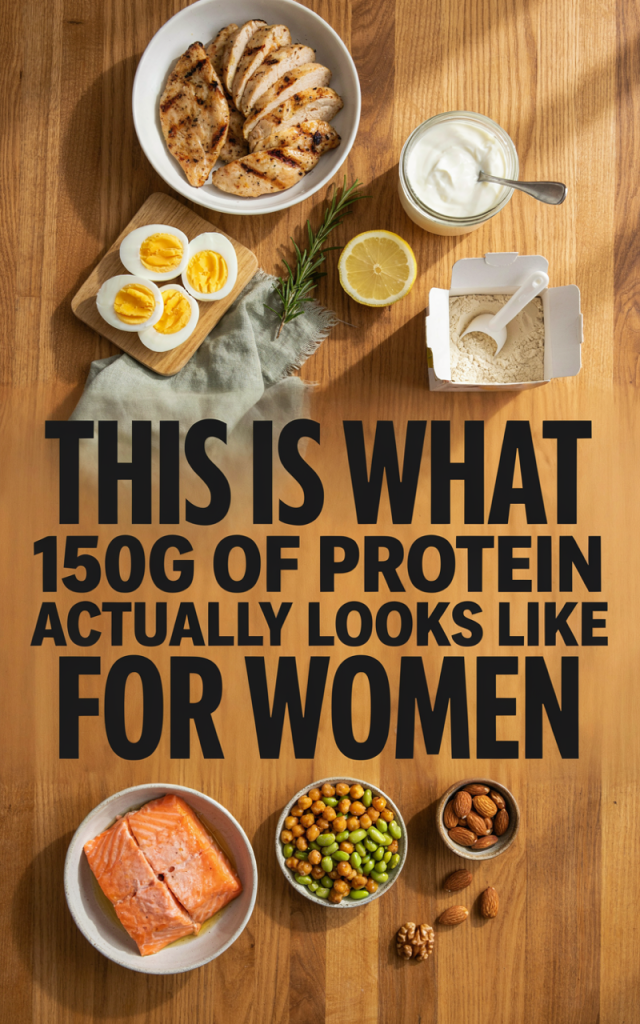
Instead of numbers on a label, here’s how protein actually appears across commonly eaten portions:
- 1 large egg = ~6 g
- 3 large eggs = ~18 g
- 1 cup (245 g) Greek yogurt = ~20–24 g (varies by brand and fat)
- 1 scoop whey protein powder = ~20–25 g
- 100 g cooked chicken breast = ~31 g
- 100 g cooked salmon = ~22–25 g
- 1 cup cooked lentils = ~18 g
- 1 cup cooked quinoa = ~8 g
- 1 cup cottage cheese = ~25–28 g
- 1 oz (28 g) almonds = ~6 g
- 2 tbsp peanut butter = ~7–8 g
- 1 cup milk = ~8 g
- 1 can (165 g) tuna (drained) ≈ ~40 g (varies)
Those familiar portions let you mix and match. For example: 1 large chicken breast (150 g) + 1 cup Greek yogurt + 1 cup lentils ≈ 150g depending on exact weights.
How to distribute 150g across a day
A sensible distribution looks like:
- Breakfast: 30–40 g
- Lunch: 35–45 g
- Snack(s): 10–25 g
- Dinner: 30–40 g
This keeps each meal protein-rich to preserve muscle and satiety.
Below are three sample full-day menus that each reach roughly 150 grams of protein (numbers are approximate). After the menus you’ll find several full recipes with ingredient lists and step-by-step instructions so you can reproduce these meals easily.
Sample Day 1 — “Strength Training Day” (approx. 150–155 g)
- Breakfast — Greek Yogurt Power Parfait (approx. 45 g)
- 1 cup (245 g) plain Greek yogurt — ~22 g
- 1 scoop whey protein — ~24 g
- 2 tbsp chopped almonds — ~4 g
- Berries — negligible
- Lunch — Grilled Chicken + Quinoa Salad (approx. 45 g)
- 5 oz (140 g) cooked chicken breast — ~43 g
- 1/2 cup cooked quinoa — ~4 g
- Veggies, olive oil — negligible
- Snack — Cottage Cheese + Fruit (approx. 25 g)
- 1 cup cottage cheese — ~25 g
- Dinner — Baked Salmon + Lentils (approx. 35 g)
- 4 oz (115 g) salmon — ~25 g
- 1/2 cup cooked lentils — ~9 g
Daily total ≈ 150–155 g
Sample Day 2 — “Busy Day, Grab-and-Drink” (approx. 148–152 g)
- Breakfast — Protein Oat Smoothie (approx. 40 g)
- 1 scoop whey — 24 g
- 1/2 cup oats — 5 g
- 1 cup milk — 8 g
- 1 tbsp peanut butter — 4 g
- Lunch — Tuna Wrap + Salad (approx. 45 g)
- 1 can tuna (165 g drained) — ~40 g
- Whole grain wrap — ~5 g
- Snack — Greek Yogurt + Berries (approx. 20 g)
- 3/4 cup Greek yogurt — ~17–18 g
- 1 tbsp chia seeds — ~2 g
- Dinner — Turkey Stir-Fry with Veggies (approx. 45 g)
- 6 oz (170 g) lean ground turkey — ~42–45 g
Daily total ≈ 150 g
Sample Day 3 — “Plant-forward High-Protein” (approx. 145–155 g)
- Breakfast — Tofu Scramble + Toast (approx. 30 g)
- 150 g firm tofu (~15–18 g)
- 2 eggs (~12 g) — optional if ovo-vegetarian
- Whole grain toast — ~4 g
- Lunch — Lentil & Quinoa Buddha Bowl (approx. 45 g)
- 1 cup cooked lentils — ~18 g
- 1 cup cooked quinoa — ~8 g
- 1 cup edamame — ~17 g
- Snack — Protein Shake (approx. 25 g)
- 1 scoop plant or whey protein — ~20–25 g
- Dinner — Tempeh Stir-Fry (approx. 30 g)
- 200 g tempeh — ~30–34 g
Daily total ≈ 150 g
Recipes you can use (ingredients + instructions)
Below are several recipes used (or similar to items) in the sample days. Each recipe lists ingredients as bullets and the steps as numbered lists so you can cook them easily.
Greek Yogurt Power Parfait (serves 1) — ~45 g protein
Ingredients
– 1 cup (245 g) plain Greek yogurt (2% or 0% depending on preference)
– 1 scoop whey protein powder (vanilla recommended)
– 2 tbsp sliced almonds
– 1/2 cup mixed berries (fresh or frozen)
– Optional: 1 tsp honey or a few drops of vanilla
Instructions
1. Spoon the Greek yogurt into a bowl.
2. Stir in the whey protein powder until fully combined and smooth.
3. Top with berries and sliced almonds.
4. Drizzle honey if using and enjoy immediately.
Protein estimate: Greek yogurt ~22 g + whey ~24 g + almonds ~4 g = ~50 g (varies by brand/portion sizes — adjust scoop/yogurt volume if you want a precise 45 g).
Grilled Chicken + Quinoa Salad (serves 1–2)
Ingredients
– 5–6 oz (140–170 g) cooked chicken breast, sliced
– 1/2 cup cooked quinoa
– 2 cups mixed salad greens
– 1/4 cup chopped cucumber and cherry tomatoes
– 1 tbsp olive oil + 1 tbsp lemon juice
– Salt and pepper to taste
Instructions
1. Cook quinoa according to package directions (1 part quinoa to 2 parts water), set aside.
2. Grill or pan-sear seasoned chicken breast until internal temp reaches 74°C (165°F); rest 5 minutes and slice.
3. Toss mixed greens, cucumber, and tomatoes in a bowl with olive oil and lemon juice.
4. Add quinoa and top with sliced chicken. Season to taste and serve.
Protein estimate: chicken 140 g ≈ 43 g + quinoa 1/2 cup ≈ 4 g = ~47 g.
Protein Oat Smoothie (serves 1) — ~40 g protein
Ingredients
– 1 scoop whey protein (vanilla or unflavored)
– 1/2 cup rolled oats
– 1 cup milk (dairy or fortified plant milk with high protein)
– 1 tbsp peanut butter
– 1/2 banana or 1/2 cup frozen berries
– Ice as needed
Instructions
1. Add all ingredients to a blender.
2. Blend on high until smooth and creamy, adding more milk if too thick.
3. Pour into a glass and enjoy immediately.
Protein estimate: whey ~24 g + oats ~5 g + milk ~8 g + peanut butter ~3–4 g = ~40 g.
Tuna Wrap (serves 1) — ~45 g protein
Ingredients
– 1 can tuna in water (165 g drained)
– 1 tbsp Greek yogurt or mayo
– 1 tbsp Dijon mustard
– 1 whole-grain wrap or large tortilla
– Lettuce, tomato, and red onion slices
Instructions
1. Drain tuna and place in a bowl.
2. Stir in Greek yogurt/mayo and mustard; season with salt and pepper.
3. Lay the wrap flat, add lettuce, tomato, and onion, and spoon tuna mixture in the center.
4. Fold and roll tightly; slice in half and serve.
Protein estimate: tuna ~40 g + wrap ~5 g = ~45 g.
Lentil & Quinoa Buddha Bowl (serves 1) — ~45 g protein
Ingredients
– 1 cup cooked lentils
– 1 cup cooked quinoa
– 1 cup shelled edamame (cooked)
– 1 cup mixed roasted vegetables (e.g., sweet potato, broccoli)
– 2 tbsp tahini dressing or olive oil
Instructions
1. Combine cooked lentils, quinoa, and edamame in a bowl.
2. Add roasted vegetables.
3. Drizzle with tahini dressing or olive oil, toss gently.
4. Season with salt, pepper, and a squeeze of lemon.
Protein estimate: lentils 18 g + quinoa 8 g + edamame 17 g = ~43 g.
Simple Turkey Stir-Fry (serves 2) — ~45 g per serving if using 6 oz turkey per person
Ingredients
– 12 oz (340 g) lean ground turkey (split between 2 servings)
– 3 cups mixed stir-fry vegetables (bell pepper, snap peas, carrots)
– 2 tbsp low-sodium soy sauce or tamari
– 1 tbsp sesame oil
– 1 tsp grated ginger, 1 clove garlic minced
– Optional: cooked brown rice or cauliflower rice
Instructions
1. Heat sesame oil in a large skillet over medium-high heat.
2. Add garlic and ginger and cook 30 seconds until fragrant.
3. Add ground turkey and cook, breaking up with a spatula, until no pink remains.
4. Add vegetables and soy sauce, and stir-fry 4–6 minutes until vegetables are tender-crisp.
5. Serve over rice if desired.
Protein estimate per 6 oz (170 g) cooked turkey ≈ 42–45 g.
Practical tips to hit 150g without feeling deprived
- Use protein powders strategically: a scoop in a smoothie or yogurt is an easy 20–25 g boost.
- Prioritize a protein source at each meal and snack: yogurt, eggs, lean meat, beans, or a shake.
- Double up on higher-protein dairy: cottage cheese or Greek yogurt are quick, portable, and high-protein.
- Snack smart: beef jerky, edamame, cottage cheese, or a protein bar can add 10–20 g in minutes.
- Meal prep: cook a large batch of chicken, turkey, or lentils and portion them into containers for easy assembly.
- Use legumes and grains together for plant-based days (e.g., lentils + quinoa) — they’re complementary proteins.
- Watch your fats and carbs if your goal is body composition — protein is filling, so pair it with veggies and healthy fats.
Common concerns and troubleshooting
- “I can’t eat that much food.” Spread protein across more meals and include concentrated sources like Greek yogurt, cottage cheese, eggs, and protein powders.
- “I’m vegetarian.” Combine dairy, eggs, legumes, tofu, tempeh, seitan, and protein powder. A plant-forward day above shows it’s doable.
- “What about calories?” 150g protein contributes 600 calories from protein alone (1 g = 4 kcal). Factor this into your total daily calorie target — adjust carbs/fats accordingly.
When to consult a professional
If you have kidney disease, specific metabolic conditions, or are pregnant/breastfeeding, consult your healthcare provider or registered dietitian before targeting higher protein intakes. A registered dietitian can personalize protein goals and meal plans based on weight, training load, and health status.
Quick grocery list for a 150g day
- Greek yogurt (large tub)
- Cottage cheese
- Whey or plant protein powder
- Chicken breast
- Canned tuna
- Salmon fillets
- Eggs
- Tofu/tempeh (if vegetarian)
- Lentils, quinoa
- Whole grain wraps/bread
- Nuts, peanut butter, seeds
- Fresh or frozen veggies and fruit
Conclusion
150 grams of protein a day is absolutely attainable with a little planning and smart food choices. Whether your goal is building strength, preserving lean mass while dieting, or supporting intense training, the key is to spread protein across the day, include concentrated protein sources (Greek yogurt, cottage cheese, lean meats, protein powders), and use meal prep to make execution simple.
Use the sample days and recipes above as a starting blueprint — tweak the portions to match your caloric needs, swap proteins you prefer, and build a rhythm that fits your schedule. Remember: consistency beats perfection. A few high-protein meals each day add up fast and will support your performance, recovery, and hunger control. You’ve got this — one protein-packed meal at a time.