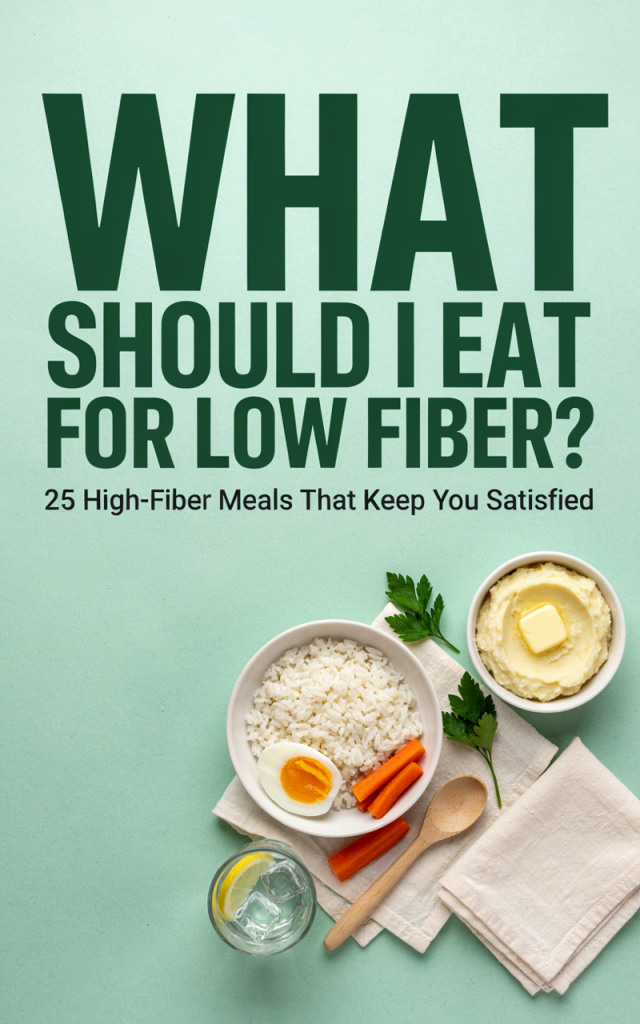
What Should I Eat for Low Fiber? 25 High-Fiber Meals That Keep You Satisfied
Introduction
If you’ve been told to eat low fiber temporarily (post-surgery, during a flare of inflammatory bowel disease, or before/after certain procedures), you may be wondering when — and how — to return to a higher-fiber routine. Fiber is one of the most important nutrients for long-term gut health, weight management, and blood sugar control, but reintroducing it gradually is key for comfort and success.
This article answers the question “What should I eat for low fiber?” by explaining when low-fiber eating is appropriate and, importantly, giving you 25 high-fiber meal ideas you can use once your healthcare team clears you to increase fiber. Each meal below is satisfying, nourishing, and intentionally fiber-rich so you can make the transition confidently.
Who needs a low-fiber diet — and why it’s temporary
A low-fiber (low-residue) diet may be prescribed for:
– After bowel surgery to reduce stool volume.
– During a flare of Crohn’s disease or ulcerative colitis.
– Before a colonoscopy or other bowel procedures.
A low-fiber plan is typically short-term. Long-term low fiber can deprive your gut microbiome and increase constipation risk. Always follow your clinician’s timeline and instructions. When you’re ready to resume higher fiber, do it gradually to avoid gas, bloating, or discomfort.
How to reintroduce fiber safely
- Start slow: add 5–7 grams of fiber per day extra for 1–2 weeks and monitor symptoms.
- Choose soluble fiber first (oats, apples, barley, lentils) — easier to tolerate than large amounts of insoluble fiber.
- Drink plenty of water to help fiber move through the digestive tract.
- Chew thoroughly and introduce a variety (fruits, vegetables, whole grains, legumes) over time.
- Keep a food diary to notice which foods trigger symptoms so you can tailor your plan.
25 High-Fiber Meals That Keep You Satisfied
Below are 25 clearly labeled, fiber-rich meals. Each entry includes ingredients and step-by-step instructions so you can prepare them easily. Note: estimated fiber per serving is offered as a general guide; actual values depend on exact portions and specific brands.
- Overnight Oats with Berries & Chia (≈10–12 g fiber)
Ingredients
- 1/2 cup rolled oats
- 1 cup unsweetened milk or dairy-free alternative
- 1/2 cup mixed berries (fresh or frozen)
- 1 tbsp chia seeds
- 1 tsp honey or maple syrup (optional)
- Pinch of cinnamon
Instructions
- Combine oats, milk, chia seeds, cinnamon, and sweetener in a jar.
- Stir in berries (reserve a few for topping).
- Cover and refrigerate overnight (or at least 4 hours).
- Stir and top with reserved berries before serving.
- Black Bean and Sweet Potato Breakfast Burrito Bowl (≈12–15 g fiber)
Ingredients
- 1 small sweet potato, diced and roasted
- 1/2 cup canned black beans, rinsed and drained
- 1/4 avocado, sliced
- 2 cups fresh spinach
- 1 tbsp salsa
- 1 tbsp olive oil
- Salt and pepper to taste
Instructions
- Roast diced sweet potato with olive oil, salt, and pepper at 400°F (200°C) for 20–25 minutes.
- Warm black beans in a small saucepan.
- Assemble bowl: spinach, roasted sweet potato, black beans, avocado slices.
- Top with salsa and enjoy.
- Lentil and Vegetable Soup (≈12–14 g fiber)
Ingredients
- 1 cup dried brown or green lentils, rinsed
- 1 carrot, diced
- 1 celery stalk, diced
- 1 small onion, chopped
- 2 cups chopped tomatoes (canned or fresh)
- 4 cups low-sodium vegetable broth
- 1 tsp dried thyme
- 1 tbsp olive oil
- Salt and pepper
Instructions
- Sauté onion, carrot, and celery in olive oil until softened.
- Add lentils, tomatoes, broth, and thyme.
- Bring to a boil, then simmer 25–30 minutes until lentils are tender.
- Season with salt and pepper and serve hot.
- Quinoa, Chickpea & Roasted Veg Bowl (≈15–18 g fiber)
Ingredients
- 1 cup cooked quinoa
- 1 cup roasted mixed vegetables (bell pepper, zucchini, eggplant)
- 1/2 cup canned chickpeas, rinsed
- 2 tbsp tahini dressing (or olive oil + lemon juice)
- Fresh parsley for garnish
Instructions
- Roast vegetables at 425°F (220°C) for 20–25 minutes.
- Warm or fluff cooked quinoa.
- Assemble bowl: quinoa, roasted veggies, chickpeas.
- Drizzle with tahini dressing and garnish with parsley.
- Salmon with Farro and Broccoli (≈8–12 g fiber)
Ingredients
- 4–6 oz salmon fillet
- 1/2 cup cooked farro
- 1 cup steamed broccoli florets
- 1 tbsp olive oil
- Lemon wedge, salt, and pepper
Instructions
- Cook farro according to package directions.
- Season salmon, then pan-sear or bake until cooked through.
- Steam broccoli until tender.
- Plate salmon over farro with broccoli on the side and a squeeze of lemon.
- Mixed Bean Chili (≈16–20 g fiber)
Ingredients
- 1 cup kidney beans (canned or cooked)
- 1 cup black beans
- 1 cup pinto beans
- 1 can diced tomatoes
- 1 onion, chopped
- 2 cloves garlic, minced
- 1 tbsp chili powder
- 2 cups vegetable broth
Instructions
- Sauté onion and garlic until soft.
- Add beans, tomatoes, broth, and chili powder.
- Simmer 20–30 minutes to meld flavors.
- Adjust seasoning and serve with a sprinkle of cilantro or yogurt.
- Whole Wheat Pasta Primavera with White Beans (≈10–13 g fiber)
Ingredients
- 2 cups whole wheat pasta
- 1 cup mixed spring vegetables (peas, asparagus, cherry tomatoes)
- 1/2 cup cannellini (white) beans
- 2 tbsp olive oil
- 1 clove garlic, minced
- Grated Parmesan (optional)
Instructions
- Cook whole wheat pasta according to package.
- Sauté garlic and vegetables in olive oil until crisp-tender.
- Add beans to warm through.
- Toss drained pasta with vegetables and top with Parmesan.
- Chickpea “Tuna” Salad on Whole Grain Toast (≈8–10 g fiber)
Ingredients
- 1 cup canned chickpeas, mashed slightly
- 2 tbsp plain Greek yogurt or vegan mayo
- 1 tsp Dijon mustard
- 1/4 cup celery, finely chopped
- 1 tbsp chopped red onion
- 2 slices whole grain bread
- Salt and pepper
Instructions
- Mix chickpeas, yogurt/mayo, mustard, celery, and onion.
- Season with salt and pepper.
- Toast whole grain bread and top with chickpea salad.
- Berry, Spinach & Flaxseed Smoothie Bowl (≈8–12 g fiber)
Ingredients
- 1 cup frozen mixed berries
- 1 cup fresh spinach
- 1/2 banana
- 1 tbsp ground flaxseed
- 1/2–1 cup almond milk
- Optional toppings: sliced almonds, pumpkin seeds
Instructions
- Blend berries, spinach, banana, flaxseed, and almond milk until smooth.
- Pour into a bowl and top with nuts and seeds.
- Roasted Brussels Sprouts & Kale Grain Salad with Walnuts (≈10–13 g fiber)
Ingredients
- 2 cups cooked barley or farro
- 1 cup roasted Brussels sprouts
- 1 cup chopped kale, massaged
- 1/4 cup chopped walnuts
- 2 tbsp olive oil + lemon juice dressing
Instructions
- Roast Brussels sprouts at 425°F (220°C) until browned.
- Massage kale with a little olive oil and salt to soften.
- Combine grains, kale, roasted Brussels, and walnuts.
- Toss with dressing and serve.
- Stuffed Bell Peppers with Brown Rice and Black Beans (≈12–16 g fiber)
Ingredients
- 2 large bell peppers, halved and seeded
- 1 cup cooked brown rice
- 1 cup black beans
- 1/2 cup corn kernels
- 1/2 cup shredded cheese (optional)
- 1 tsp cumin, salt, and pepper
Instructions
- Preheat oven to 375°F (190°C).
- Mix rice, beans, corn, and spices.
- Fill pepper halves with mixture and top with cheese if using.
- Bake 25–30 minutes until peppers are tender.
- Hearty Split Pea Soup (≈12–18 g fiber)
Ingredients
- 1 cup dried split peas, rinsed
- 1 carrot, diced
- 1 onion, chopped
- 2 cloves garlic, minced
- 4 cups vegetable or chicken broth
- 1 bay leaf, salt, and pepper
Instructions
- Sauté onion, carrot, and garlic until fragrant.
- Add split peas, broth, and bay leaf.
- Simmer 30–40 minutes until peas are soft.
- Remove bay leaf, season, and blend partially for texture if desired.
- Muesli with Yogurt, Apples, and Nuts (≈8–10 g fiber)
Ingredients
- 1/2 cup muesli or rolled oats with dried fruit
- 3/4 cup plain yogurt
- 1 small apple, diced
- 2 tbsp chopped almonds or walnuts
- 1 tsp honey (optional)
Instructions
- Combine muesli and yogurt in a bowl.
- Stir in diced apple and nuts.
- Drizzle honey if desired and serve.
- Spicy Lentil Tacos with Avocado (≈12–14 g fiber)
Ingredients
- 1 cup cooked red or brown lentils
- 1 tsp chili powder
- 1/2 tsp cumin
- 6 small corn tortillas (or whole wheat)
- Sliced avocado, shredded lettuce, and salsa
Instructions
- Warm lentils and season with chili powder and cumin.
- Heat tortillas briefly.
- Fill tortillas with lentils, avocado slices, lettuce, and salsa.
- Oat and Banana Pancakes with Ground Flax (≈6–9 g fiber)
Ingredients
- 1 cup rolled oats, blended into flour
- 1 ripe banana, mashed
- 1 egg (or flax egg)
- 1 tbsp ground flaxseed
- 1/2 tsp baking powder
- 1/2 cup milk of choice
Instructions
- Blend oats into a flour, then combine with banana, egg, flaxseed, baking powder, and milk.
- Cook pancakes on a nonstick skillet until bubbles form and flip.
- Serve with fresh fruit or a drizzle of maple syrup.
- Mediterranean Farro Salad with Lentils & Feta (≈12–15 g fiber)
Ingredients
- 1 cup cooked farro
- 1/2 cup cooked lentils
- 1/2 cup cherry tomatoes, halved
- 1/4 cup diced cucumber
- 2 tbsp crumbled feta
- 2 tbsp olive oil + lemon dressing
Instructions
- Mix farro, lentils, tomatoes, cucumber, and feta in a bowl.
- Toss with dressing and chill briefly before serving.
- Baked Eggplant Parmesan with Whole-Wheat Breadcrumbs (≈6–9 g fiber)
Ingredients
- 1 medium eggplant, sliced into rounds
- 1 cup whole-wheat breadcrumbs
- 1 cup marinara sauce
- 1/2 cup shredded mozzarella or vegan cheese
- 1 egg (or milk for dredging)
- Olive oil spray
Instructions
- Dredge eggplant slices in egg/milk, then coat with breadcrumbs.
- Arrange on a baking sheet, spray lightly with oil, and bake at 400°F (200°C) for 20 minutes, flipping halfway.
- Top with marinara and cheese, then bake until cheese melts.
- Turkey & White Bean Stew (≈10–12 g fiber)
Ingredients
- 8 oz lean ground turkey
- 1 can cannellini beans, drained
- 1 carrot, diced
- 1 onion, chopped
- 2 cups low-sodium chicken broth
- 1 tsp rosemary or thyme
Instructions
- Brown turkey and set aside.
- Sauté onion and carrot, then return turkey to the pot.
- Add beans, broth, and herbs; simmer 15–20 minutes.
- Season and serve.
- Smashed Chickpea & Avocado Wrap (≈8–11 g fiber)
Ingredients
- 1 cup canned chickpeas, lightly mashed
- 1/2 avocado, mashed
- 1 tbsp lemon juice
- 1 whole grain tortilla or wrap
- Handful of mixed greens
Instructions
- Combine mashed chickpeas, avocado, and lemon juice.
- Spread mixture on tortilla, add greens, and roll tightly.
- Slice in half and enjoy.
- Brown Rice Sushi Bowl with Edamame & Seaweed (≈7–10 g fiber)
Ingredients
- 1 cup cooked brown rice
- 1/2 cup shelled edamame
- 1/4 cup sliced cucumber
- 1 sheet nori, torn
- 1 tbsp soy sauce or tamari
- 1 tsp rice vinegar
Instructions
- Assemble brown rice in a bowl.
- Top with edamame, cucumber, and torn nori.
- Drizzle with soy sauce and rice vinegar and eat with chopsticks or fork.
- Roasted Carrot & Red Lentil Dhal (≈10–14 g fiber)
Ingredients
- 1 cup red lentils, rinsed
- 2 cups vegetable broth or water
- 2 large carrots, roasted and sliced
- 1 tsp turmeric, 1/2 tsp cumin
- 1 tbsp coconut oil or olive oil
Instructions
- Cook lentils with broth and spices until soft (15–20 minutes).
- Roast carrots at 425°F (220°C) until caramelized.
- Stir roasted carrots into the cooked lentils and serve with rice or naan.
- Pear, Walnut & Arugula Salad with Farro (≈7–10 g fiber)
Ingredients
- 1 cup cooked farro
- 2 cups arugula
- 1 ripe pear, sliced
- 1/4 cup chopped walnuts
- 2 tbsp balsamic vinaigrette
Instructions
- Toss farro, arugula, pear slices, and walnuts together.
- Drizzle with vinaigrette and serve immediately.
- Black Bean Burgers on Whole Grain Buns (≈10–14 g fiber)
Ingredients
- 1 can black beans, mashed
- 1/2 cup rolled oats, ground slightly
- 1/4 cup finely chopped onion
- 1 tsp chili powder
- Whole grain buns and toppings (lettuce, tomato, avocado)
Instructions
- Mix mashed beans, oats, onion, and spices into a dough-like mixture.
- Form into patties and pan-fry or bake until firm and browned.
- Serve on whole grain buns with desired toppings.
- Miso Soup with Tofu, Seaweed, and Soba Noodles (≈6–9 g fiber)
Ingredients
- 4 cups dashi or vegetable broth
- 2 tbsp miso paste
- 1/2 cup cubed firm tofu
- 1/2 cup cooked soba noodles
- 1 tbsp dried wakame (seaweed), rehydrated
- 1 green onion, sliced
Instructions
- Heat broth and dissolve miso paste (off heat to preserve probiotics).
- Add tofu, soba noodles, and rehydrated wakame.
- Warm gently and serve garnished with green onion.
- Overnight Chia Pudding with Kiwi and Almonds (≈10–12 g fiber)
Ingredients
- 3 tbsp chia seeds
- 1 cup almond milk
- 1 tsp vanilla extract
- 1 kiwi, peeled and sliced
- 2 tbsp slivered almonds
Instructions
- Mix chia seeds, almond milk, and vanilla in a jar.
- Refrigerate overnight until pudding sets.
- Top with kiwi slices and almonds before serving.
Practical tips to make high-fiber meals comfortable
- Pair fiber with a bit of fat and protein to slow digestion and reduce gas (e.g., nuts, olive oil, yogurt).
- Cook some vegetables until tender (steaming, roasting) to ease digestion while still getting fiber.
- Use ground seeds (flax, chia) which are often better tolerated than whole seeds at first.
- Monitor portion size: start with half-portions of legumes and increase gradually.
- Keep a consistent intake each day rather than loading all fiber in one meal.
When to speak with your healthcare provider
- If you’re on a prescribed low-fiber diet, consult your clinician before reintroducing fiber.
- If you notice severe bloating, pain, blood in stool, or other concerning symptoms when increasing fiber, contact your healthcare team.
- A registered dietitian can create a tailored reintroduction plan optimizing tolerability and nutrient intake.
Conclusion
A temporary low-fiber diet can be necessary in certain medical situations, but fiber is vital for long-term gut health and overall wellbeing. When it’s time to reintroduce fiber, do so gradually and choose nourishing, balanced meals. The 25 high-fiber meals above are designed to be satisfying, varied, and realistic — from comforting soups and stews to lively bowls and creative plant-based options. Use them as a roadmap to rebuild fiber tolerance and enjoy the many health benefits fiber brings. You’ve got this — small steps, consistent hydration, and mindful portions will help you return to a fiber-rich diet with confidence.