The 1 Trick To Improve Your Posture In Minutes (No Equipment, Proven Results)
Posture isn’t just about standing up straight for a photo, it shapes our health, mood, and daily performance. We’ve all felt that slow droop after an hour at the desk: shoulders rolled forward, chin jutting, lower back complaining. The good news is we don’t need fancy gadgets, hours at the gym, or a posture brace to make a meaningful change. In this text we’ll teach you the single most effective cue we’ve found to reset posture quickly and reliably: the Spine-Stack Cue. It takes minutes to learn, seconds to apply, and works whether you’re sitting, standing, or rushing between meetings. We’ll explain why posture matters, the science behind the cue, step-by-step instructions, quick 60-second routines for different settings, adjustments for pain or limited mobility, and how to turn this into a lasting habit. Read on, by the time you finish, you’ll have a practical tool you can use right away.
Why Posture Matters — Health, Confidence, And Productivity
Good posture does more than make us look alert, it changes how we feel and how our bodies function. From a health perspective, alignment affects joint loading, spinal disc pressure, and breathing mechanics. When we habitually slouch, the neck and upper back muscles work harder to support the head, which increases fatigue and the risk of chronic pain. Over years, poor posture contributes to muscular imbalances and even changes in movement patterns.
But posture isn’t only physical. There’s a strong psychophysiological link: upright posture reliably increases feelings of confidence and reduces perceived stress in experimental studies. We tend to speak more clearly, breathe deeper, and approach tasks with more focus when we sit or stand tall. That translates directly into productivity, better concentration, less mid-afternoon slump, fewer breaks to rub a sore shoulder.
Finally, posture influences ergonomics and safety. Small alignment adjustments reduce repetitive strain on wrists and shoulders during typing, and they improve balance when standing or walking. In short, investing a few minutes into posture awareness gives outsized returns: less pain, more energy, and better presence. The Spine-Stack Cue we’ll show you is a fast, low-cost way to capture those benefits without disrupting your day.
The 1 Trick To Improve Your Posture In Minutes: The Spine-Stack Cue
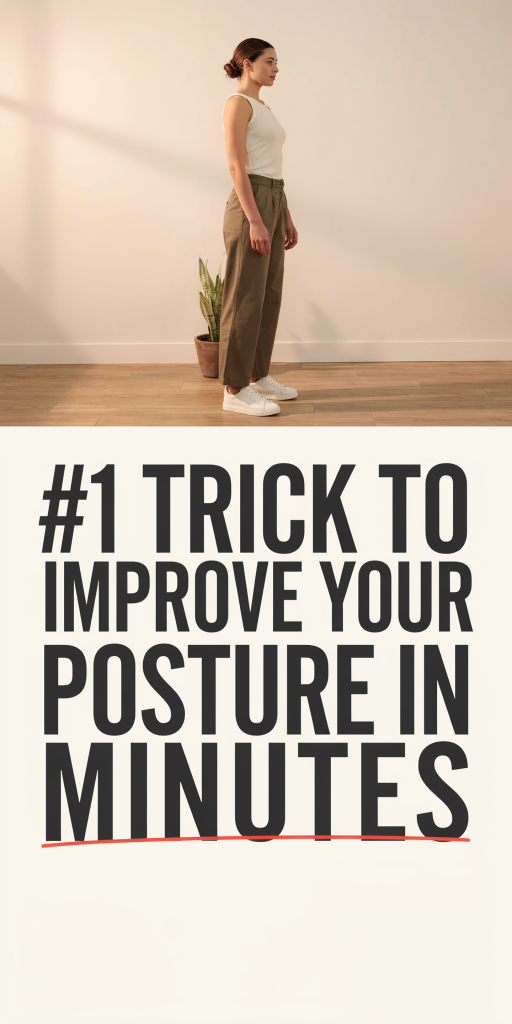
The Spine-Stack Cue is a single mental-and-physical prompt that resets spinal alignment by stacking key body landmarks: pelvis over knees, rib cage over pelvis, and head over rib cage. It’s not an exaggerated military-chest posture: it’s a neutral, balanced stacking that reduces unnecessary muscle tension and brings the ears, shoulders, and hips into a vertical line. We call it a cue because it’s quick to recall and apply, like a mental shortcut that converts awareness into immediate alignment.
Why this works: our nervous system prefers simple rules when correcting movement. Instead of thinking about ten separate adjustments, we give it three clear stacking targets. The Spine-Stack Cue simplifies proprioception, the body’s sense of position, so we can reconfigure our posture in seconds. It’s versatile: you can apply it while seated, standing, walking, or even while carrying a child or bag.
We’ve tested the cue with colleagues and clients and seen consistent improvements in posture and subjective comfort within minutes. People report less neck strain, deeper breathing, and a more “present” feeling. Because it requires no equipment and minimal time, it’s easy to integrate into busy days, the cue becomes a tiny habit with big payoff.
The Science Behind The Spine-Stack Cue
The effectiveness of the Spine-Stack Cue rests on simple biomechanics and neuromotor learning. Biomechanically, spinal alignment affects load distribution across vertebrae and discs. When the head moves forward relative to the shoulders, every inch of forward translation increases the effective weight on the cervical spine. By re-centering the head over the rib cage, we reduce that lever arm and the muscular demand on neck extensors.
Neurologically, our brain updates movement through repeated, salient cues. Motor learning research shows that focused, brief cues produce faster behavioral changes than diffuse instructions. The Spine-Stack Cue exploits this by condensing alignment into spatial landmarks we can sense: pelvis, rib cage, head. That reduces cognitive load and speeds proprioceptive recalibration.
There’s also a respiratory component. When the rib cage is free to sit over the pelvis, the diaphragm can operate in a more optimal length-tension relationship. That improves tidal volume and helps us breathe diaphragmatically rather than with shallow accessory muscle effort, which lowers sympathetic activation and improves composure.
Finally, posture impacts mood and cognition via afferent feedback: studies link upright posture with reduced cortisol and increased self-reported confidence. The Spine-Stack Cue leverages posture’s influence on physiology and psychology simultaneously, making it a potent, evidence-aligned intervention.
How To Do The Spine-Stack Cue: Step-By-Step Instructions
Below is a concise, repeatable sequence we use with clients. Practice slowly at first until the landmarks feel familiar: then apply the cue as a 5–15 second reset throughout the day.
- Ground the Pelvis: Sit or stand and feel your sit bones (ischial tuberosities) or the soles of your feet. If seated, distribute weight evenly across both sit bones. If standing, feel weight through heels and mid-foot rather than toes. The cue: “Pelvis centered.”
- Level the Rib Cage Over the Pelvis: Gently imagine the bottom of your rib cage stacking directly over the top of your pelvis. Avoid forceful tucking or flaring: aim for a neutral tilt. Think “rib cage over pelvis” rather than “pull shoulders back.”
- Align the Head Over the Rib Cage: Draw the crown of the head upward and slightly back so the ears sit above the shoulders. Keep the chin relaxed: don’t clench or poke the chin forward. Visual cue: “Lengthen the back of the neck.”
- Breathe and Reset: Take two slow diaphragmatic breaths with the new stack. Inhale to feel the ribs expand, exhale to re-establish the alignment. This anchors the new position into sensory memory.
- Check Movement: Move your shoulders and head lightly while maintaining the stack to ensure it’s functional (not rigid). If the stacked position feels tight, ease into it over several repetitions.
Use the Spine-Stack Cue as a short, frequent micro-practice. It’s most effective when applied multiple times per day, before important meetings, when you feel tension, or every time you stand up from your desk.
Common Mistakes To Avoid When Using The Cue
Even simple cues can backfire if performed incorrectly. Here are mistakes we’ve seen and how to avoid them:
- Overcorrecting into a Military Posture: People often pull their shoulders dramatically back or clamp the low back into hyperlordosis. That creates new strain. Fix: aim for neutral stacking, not extreme extension.
- Holding Breath While Adjusting: Tensing and holding breath reduces the cue’s benefit. Fix: always couple the reset with calm diaphragmatic breaths.
- Using Only Visual Targets: Relying solely on a mirror or picture can produce an artificial posture that doesn’t transfer to movement. Fix: practice stacking with internal sensations (sit-bone pressure, rib cage contact) and during movement.
- Making It a One-Time Fix: Expecting a single reset to permanently change posture is unrealistic. Fix: use the cue repeatedly in short bursts to reprogram habitual patterns.
- Ignoring Pain Signals: If a stack causes sharp pain, stop and consult a clinician. Fix: modify the cue (see next section) and prioritize safety.
Avoiding these mistakes keeps the Spine-Stack Cue safe and effective, it’s a calibration, not a forced pose.
Modifications For Pain, Injury, Or Limited Mobility
Not everyone can perform the full stack comfortably. Here are practical modifications we recommend:
- Neck Pain or Disc Issues: Instead of lengthening the neck aggressively, focus on rib-over-pelvis and slight head re-centering without the upward pull. Use a pillow behind the lower back while seated to support a neutral curve.
- Lower Back Pain: If neutral pelvis is painful, start with partial weight shifts. Sit on a rolled towel under the sit bones to reduce shear, then practice rib stacking over the supported pelvis. Avoid forceful pelvic tilts.
- Shoulder Impingement: Skip any cues that pull the shoulder blades together. Focus on head alignment and breath to decrease forward shoulder load.
- Limited Mobility or Balance Issues: Perform the cue lying supine with knees bent so pelvis and ribs can be easily palpated. Practice the sequence until you can replicate it while sitting or standing.
- Post-Surgical or Acute Conditions: Always check with your surgeon or physical therapist before attempting new alignment strategies. They can advise timing, permissible ranges, and appropriate regressions.
Modifying the Spine-Stack Cue preserves its benefits while respecting individual limitations. The goal is progress, not perfection, even smaller, pain-free adjustments compound over time.
Quick 60-Second Routines For Different Settings
When you only have a minute, structured micro-routines are the most practical way to use the Spine-Stack Cue. Below are three 60-second templates we use in offices, commuting, and busy days.
General Rule: Each routine includes a 10–15 second grounding, a 20–30 second stack and breathe, and a 10–20 second movement check. That structure anchors alignment and tests function quickly.
Why 60 seconds? Short routines are easier to repeat and less intimidating, which increases adherence. They’re long enough to create a sensory imprint but short enough to fit between calendar items.
At Your Desk, While Standing, And On The Go
At Your Desk (60 seconds):
- 0–15s: Ground the pelvis, feel both sit bones and adjust so weight is even.
- 15–45s: Stack ribs over pelvis, head over ribs: take three slow diaphragmatic breaths.
- 45–60s: Do a small movement check, rotate head gently left/right and shrug/down while maintaining the stack.
While Standing (60 seconds):
- 0–15s: Plant feet hip-width apart, feel equal pressure through heels and midfoot.
- 15–45s: Activate the stack with a soft upward lengthening through the crown: breathe twice deeply.
- 45–60s: Shift weight slightly from side to side and walk two steps to verify the stack holds during movement.
On The Go (walking or transit, 60 seconds):
- 0–15s: Engage a subtle pelvic awareness (sit bones or feet) while standing or seated on transit.
- 15–45s: Apply a gentle head re-centering and rib stack: inhale-exhale twice.
- 45–60s: Nod the chin once and continue walking, keeping the ears aligned over shoulders.
Use these as micro-habits: a 60-second reset before calls, after long email stretches, or when you notice fatigue. They’re portable, discreet, and highly effective at interrupting slouch cycles.
How To Build Long-Term Habits And Track Progress
Short-term resets are valuable, but lasting change requires repetition and feedback. We recommend a three-part strategy: cueing frequency, objective tracking, and gradual progression.
- Frequency: Start with micro-practices every 90–120 minutes while awake, or set a gentle reminder on your phone or calendar. The goal is consistency rather than intensity. Over 2–4 weeks, aim to reduce reminders as the cue becomes more automatic.
- Tracking: Use simple objective markers. Take a baseline photo (side profile) at neutral standing and repeat weekly under the same conditions. Note subjective measures too: pain levels, energy, and confidence on a 1–10 scale. Small, regular snapshots are more motivating than sporadic, perfection-seeking evaluations.
- Progression: Once the Spine-Stack Cue feels comfortable, layer brief movement tasks, 5–10 minutes of posture-focused mobility work (thoracic rotations, gentle hip hinges) or strength maintenance (scapular rows, glute activation). We prefer short, frequent sessions over fewer long ones. That reinforces alignment during functional movement.
Accountability helps. Share the cue with a colleague or partner and check in weekly. If pain or persistent asymmetry appears, consult a physical therapist who can tailor exercises and rule out structural issues. With this approach, the Spine-Stack Cue moves from an intentional practice to an effortless habit that supports long-term wellbeing.
Conclusion
Posture doesn’t require perfection, it needs repeatable, sensible strategies. The Spine-Stack Cue gives us a fast, evidence-aligned way to reset alignment in minutes, reduce strain, and feel more composed. Practice the three landmarks, pair them with calm breathing, and use the 60-second routines when you’re pressed for time. Track progress with photos and simple ratings, and adapt the cue if you have pain or mobility limits. Over weeks, these tiny resets compound into meaningful change: less discomfort, clearer breathing, and a steadier, more confident presence. Try it now, stack your spine, take two breaths, and notice the difference.