
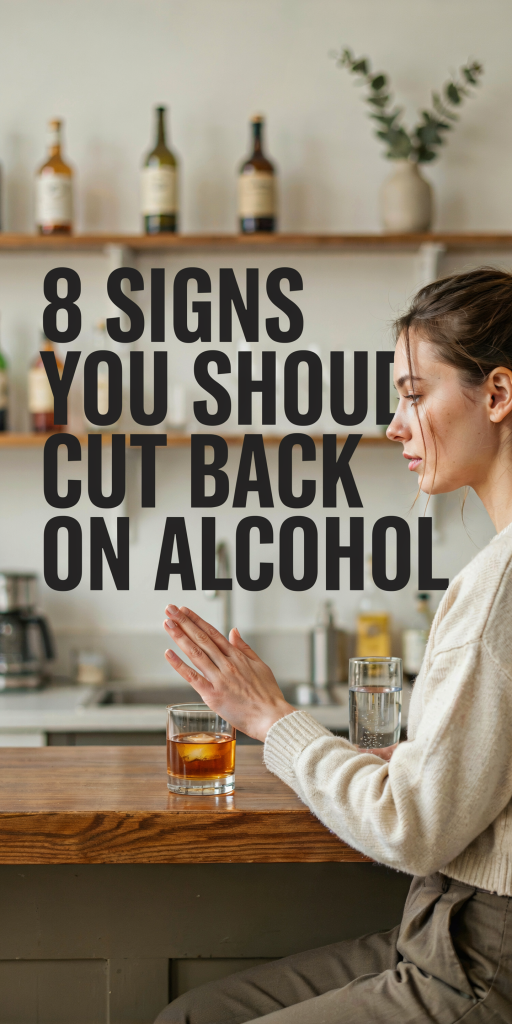
8 Clear Signs You Should Cut Back On Alcohol (How To Know — And What To Do Next)
Most people who drink too much don’t look like the stereotype. There’s no rock bottom moment, no missed work, no dramatic scene. Just a slow drift where a glass of wine with dinner becomes two, where “I’ll skip it this week” never quite happens, and where alcohol starts occupying more mental real estate than it used to.
That drift is worth paying attention to. You don’t need a diagnosis to decide that alcohol is costing you more than it’s giving back. Here are eight signs worth taking seriously, and what to actually do about them.
1. You think about drinking before the day even calls for it
Maybe it’s a rough meeting at 10 a.m. and by 11 you’re already picturing the glass of wine waiting for you at 6 p.m. Occasional anticipation is normal. But when alcohol becomes a mental anchor point you return to throughout the day, that’s a shift from “something I enjoy” to “something I’m managing my mood around.”
The body catches on to this pattern too. Repeated use as a stress reliever trains your nervous system to expect alcohol as the resolution to tension, which makes the craving feel more urgent over time, not less.
2. Your tolerance has quietly gone up
If the amount that used to relax you now barely registers, your body has adapted. Tolerance builds because the liver becomes more efficient at metabolizing alcohol and the brain adjusts its own chemistry to compensate for alcohol’s effects. That adjustment is exactly why people find themselves drinking more over time just to reach the same effect. Rising tolerance isn’t a sign of a strong constitution. It’s a sign your body is working harder to keep up.
3. You’ve started hiding or minimizing how much you drink
This one shows up in small ways. Pouring a second glass in the kitchen instead of at the table. Rounding down when someone asks how much you had. Timing drinks so nobody notices the pace. None of this means something is catastrophically wrong, but it does mean part of you already suspects the honest number wouldn’t sit well with the people around you, or with yourself.
4. Sleep isn’t what it used to be
Alcohol might help you fall asleep faster, but it disrupts the second half of the night. As it’s metabolized, it interferes with REM sleep and can trigger early waking, night sweats, and a racing mind at 3 a.m. If you’re waking up tired despite going to bed at a decent hour, and evening drinks are a regular habit, that’s likely not a coincidence.
5. Mornings come with more than a hangover
A pounding head and dry mouth are the obvious signs. Less obvious: irritability, anxiety that wasn’t there the day before, or a low mood that lifts a few hours after you’re up. These can be early signs of your nervous system rebounding from alcohol’s depressant effect overnight, sometimes called “hangxiety.” If this is showing up regularly rather than after the occasional big night out, it’s worth noting.
6. You’ve made rules for yourself, and you keep breaking them
“Just on weekends.” “Only two drinks.” “Not on weeknights.” Setting these rules isn’t a problem. Breaking them repeatedly, and feeling a small jolt of guilt or self-negotiation each time, is worth paying attention to. It usually means the habit has more pull than the intention does, and willpower alone isn’t going to close that gap.
7. It’s affecting your body in ways you can measure
This is where the evidence gets hard to argue with. Regular drinking is linked to elevated blood pressure, disrupted blood sugar regulation, weight gain concentrated around the midsection, and elevated liver enzymes on routine bloodwork. Even moderate regular intake has been associated with increased risk for several cancers, including breast cancer, and there’s no fully “safe” threshold according to current research. If your last physical showed anything trending in the wrong direction and you drink regularly, alcohol is worth putting on the list of possible contributors.
8. You feel relief at the idea of stopping, and dread at the idea of trying
This is often the clearest signal of all. If the thought of cutting back brings a flicker of relief, some part of you already knows this isn’t serving you well. And if the thought of actually doing it brings dread or resistance, that gap between wanting to and being able to is worth exploring rather than ignoring.
What to do next
Start by getting honest with the numbers. Track what you actually drink for two weeks, not what you think you drink. Most people underestimate by a significant margin. A simple notes app entry after each drink is enough.
Set a defined trial period, not a vague intention. “I’ll cut back” rarely works. “I’m not drinking for the next 30 days” gives you a clear finish line and a real data point about how you feel without it.
Replace the ritual, not just the drink. If wine at 6 p.m. is your wind-down cue, find another cue that hits the same need: a walk, a specific tea, a call with a friend. Removing the habit without replacing the function behind it usually doesn’t stick.
Pay attention to what changes. Sleep quality, morning mood, weight, skin, focus, patience with your kids or partner. Most people who cut back are surprised by how many things improve that they didn’t even connect to drinking in the first place.
Loop in a professional if you’re not sure you can do it alone. If you’ve tried to cut back before and couldn’t, or if stopping brings on physical symptoms like shaking, sweating, or a racing heart, talk to a doctor before quitting on your own. Withdrawal from regular heavy drinking can be medically serious, and a doctor can help you do it safely.
Consider whether moderation or elimination is the real goal. Some people can settle into a genuinely moderate pattern. Others find that any drinking reopens the same slow drift described above. Neither answer is a moral failure. The goal is figuring out which one is true for you, honestly, rather than which one sounds better.
None of these signs on their own mean you have a serious problem. But if several of them are landing close to home, that’s not something to explain away. It’s information. What you do with it is the part that actually matters.
This article is for informational purposes and isn’t a substitute for medical advice. If you’re concerned about your drinking or experience withdrawal symptoms when you stop, talk to a doctor or reach out to SAMHSA’s National Helpline at 1-800-662-4357 for free, confidential support.
