
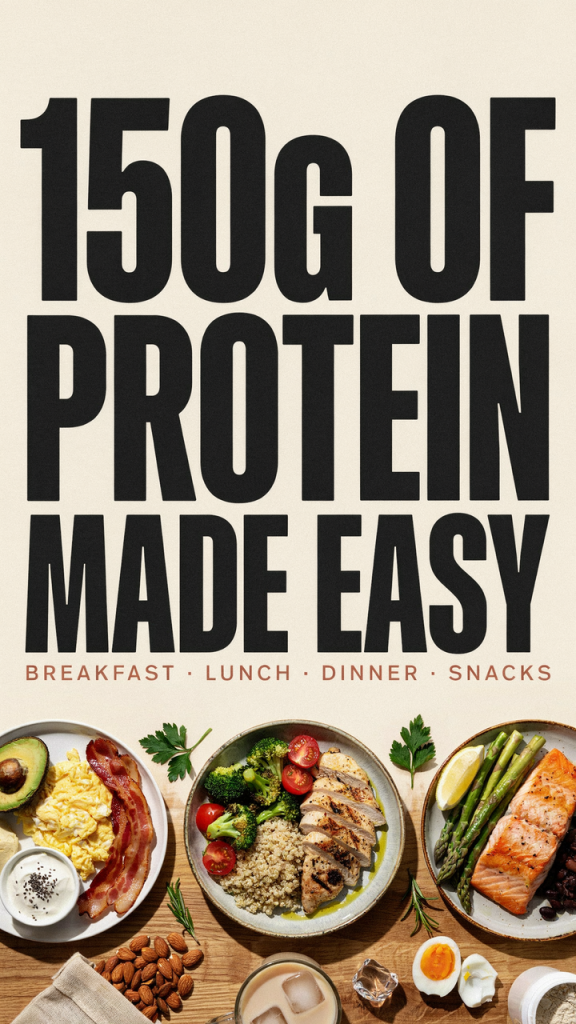
150g of Protein Made Easy: Breakfast, Lunch, Dinner, and Snacks
Eating enough protein each day doesn’t have to be complicated, expensive, or joyless. Whether you’re building muscle, recovering from workouts, managing weight, or just aiming for balanced energy, hitting a goal like 150 grams of protein can be straightforward with the right meals and snacks. This guide gives you a complete, practical day of high-protein meals (breakfast, lunch, dinner) plus snack ideas and recipes — all laid out with clear ingredients, step-by-step instructions, and protein counts so you can easily hit ~150 g of protein daily.
Below you’ll find an easy-to-follow sample day that totals roughly 150 g of protein, plus swaps, tips, and a shopping list to set you up for success.
Why 150 grams of protein?
Hitting 150 g of protein can be the right target for active people, strength trainees, and many people trying to preserve lean mass while losing fat. It’s not one-size-fits-all — factors like body weight, goals, and activity level matter — but 150 g is a useful benchmark for many adults working at moderate to high intensity. This post shows how to distribute that protein across the day to maximize satiety, muscle protein synthesis, and sustainable eating.
How this guide is structured
- A practical sample day with exact recipes for breakfast, lunch, and dinner.
- Snack recipes and quick ideas so you can adjust up or down.
- Protein counts for each recipe so you can track the day’s total.
- Preparation tips and swaps to fit dietary preferences.
Sample day at a glance (protein targets)
- Breakfast — Power Breakfast Scramble: ~52 g protein
- Lunch — Grilled Chicken, Quinoa & Edamame Salad: ~44 g protein
- Dinner — Seared Salmon with Lentils & Arugula: ~47 g protein
- Snacks — flexible options to top off protein and energy: variable
Estimated daily protein: ~143–160 g depending on exact portions and specific brands. The recipes below are purposely protein-forward and easy to scale.
Breakfast
Power Breakfast Scramble (approx. 52 g protein)
A nutrient-dense, savory scramble that pairs eggs, egg whites, smoked salmon, and cottage cheese for a satisfying morning that fuels you until lunch.
Ingredients
– 3 large whole eggs
– 3 large egg whites (or 6 tablespoons liquid egg whites)
– 2 oz (56 g) smoked salmon, chopped
– 1/2 cup (113 g) low-fat cottage cheese
– 1 cup fresh baby spinach
– 1 small shallot or 1/4 medium onion, finely chopped
– 1 tsp olive oil or cooking spray
– Salt and black pepper, to taste
– Optional: chopped chives or fresh dill for garnish
Instructions
1. Heat the oil in a nonstick skillet over medium heat. Sauté the shallot for 1–2 minutes until soft.
2. Add the spinach and cook until just wilted, about 30–60 seconds.
3. In a bowl, whisk the whole eggs and egg whites with a pinch of salt and pepper.
4. Pour the eggs into the pan with the spinach and scramble gently until mostly set, 2–3 minutes.
5. Stir in the smoked salmon and cottage cheese, fold gently, and cook for another 30–60 seconds until warmed through.
6. Plate and garnish with chives or dill. Serve immediately.
Protein breakdown (approx.)
– Whole eggs (3): 18 g
– Egg whites (3): 10.8 g
– Smoked salmon (2 oz): 11 g
– Cottage cheese (1/2 cup): 12 g
Total ≈ 52 g
Why this works: Combining whole eggs and egg whites gives you extra protein without too much added fat, while smoked salmon and cottage cheese pack in high-quality protein and omega-3s.
Lunch
Grilled Chicken, Quinoa & Edamame Salad (approx. 44 g protein)
A colorful, fiber-rich salad that stays fresh and portable. Prepare the chicken and quinoa ahead and toss together for a fast lunchtime win.
Ingredients
– 5 oz (140 g) boneless skinless chicken breast
– 1/2 cup cooked quinoa (about 90 g)
– 1/2 cup shelled edamame (cooked)
– 2 cups mixed salad greens (lettuce, spinach, arugula)
– 1/4 cup chopped cucumber
– 1/4 cup cherry tomatoes, halved
– 1 tbsp olive oil
– 1 tbsp lemon juice or apple cider vinegar
– Salt, pepper, and optional paprika or garlic powder
Instructions
1. Season the chicken breast with salt, pepper, and a pinch of paprika or garlic powder.
2. Grill or pan-sear the chicken over medium heat for 5–7 minutes per side, or until internal temperature reaches 165°F (74°C). Let rest 5 minutes, then slice.
3. While the chicken cooks, cook quinoa according to package directions (or use leftover quinoa).
4. In a large bowl, combine the greens, cucumber, tomatoes, cooked quinoa, and edamame.
5. Toss with olive oil and lemon juice. Top with sliced chicken and serve.
Protein breakdown (approx.)
– Chicken (5 oz): ~31 g
– Quinoa (1/2 cup cooked): ~4 g
– Edamame (1/2 cup): ~9 g
Total ≈ 44 g
Why this works: Lean grilled chicken is protein-rich and satiating; quinoa and edamame provide extra protein plus fiber and micronutrients.
Dinner
Seared Salmon with Lentils & Arugula (approx. 47 g protein)
A simple, elegant dinner that’s fast to prepare and full of omega-3s and plant protein from lentils.
Ingredients
– 6 oz (170 g) salmon fillet
– 1/2 cup cooked green or brown lentils
– 2 cups arugula (or mixed greens)
– 1/2 small red onion, thinly sliced
– 1 tbsp olive oil
– 1 tbsp lemon juice
– Salt and pepper
– Optional: 1 tsp Dijon mustard mixed into the dressing
Instructions
1. Season the salmon with salt and pepper.
2. Heat a nonstick skillet over medium-high heat with 1 tsp olive oil. Place salmon skin side down and sear for 4–5 minutes, then flip and cook another 3–4 minutes until done to your liking.
3. While salmon cooks, warm lentils in a small saucepan or microwave.
4. Assemble the salad: toss arugula with olive oil, lemon juice, salt, and pepper. Add sliced red onion and lentils.
5. Plate the salad and top with the seared salmon. Serve immediately.
Protein breakdown (approx.)
– Salmon (6 oz): ~38 g
– Lentils (1/2 cup cooked): ~9 g
Total ≈ 47 g
Why this works: Salmon is a dense protein source with healthy fats; lentils add fiber and plant protein to round out the meal.
Snacks (mix-and-match ideas)
You don’t need a long list of snacks to reach 150 g — pick 1–3 of these depending on how your meals stack up. Each snack includes a quick recipe and protein estimate.
Snack 1: Greek Yogurt & Berry Bowl (approx. 17 g protein)
Ingredients
– 1 cup plain nonfat Greek yogurt
– 1/2 cup mixed berries
– 1 tsp honey or a sprinkle of cinnamon (optional)
Instructions
1. Spoon Greek yogurt into a bowl.
2. Top with berries and optional honey or cinnamon.
3. Stir and enjoy.
Protein ≈ 17 g
Snack 2: Classic Tuna & Crackers (approx. 20 g protein)
Ingredients
– 1 can (3–4 oz) tuna in water, drained
– 1 tbsp plain Greek yogurt or 1 tsp olive oil
– Salt, pepper, and a squeeze of lemon
– 6 whole-grain crackers
Instructions
1. Mix drained tuna with Greek yogurt or olive oil, lemon, salt, and pepper.
2. Serve with crackers.
Protein ≈ 20 g
Snack 3: Cottage Cheese & Pineapple (approx. 12 g protein)
Ingredients
– 1/2 cup low-fat cottage cheese
– 1/4 cup pineapple chunks (fresh or canned in juice)
– A sprinkle of chia seeds (optional)
Instructions
1. Combine cottage cheese and pineapple in a bowl.
2. Sprinkle with chia seeds if using and serve.
Protein ≈ 12 g
Snack 4: Protein Shake (approx. 20–30 g depending on powder)
Ingredients
– 1 scoop whey or plant protein powder (20–25 g protein per scoop)
– 8–12 oz water or unsweetened almond milk
– Optional: 1/2 banana or a handful of spinach
Instructions
1. Add liquid and protein powder (and optional ingredients) to a shaker or blender.
2. Shake or blend until smooth and enjoy.
Protein ≈ 20–30 g (depends on powder)
Snack 5: Hard-Boiled Eggs with Everything Seasoning (approx. 12 g protein)
Ingredients
– 2 large hard-boiled eggs
– Everything bagel seasoning or salt and pepper
Instructions
1. Peel hard-boiled eggs and sprinkle with seasoning.
2. Eat whole or slice onto a rice cake.
Protein ≈ 12 g
Snack 6: Roasted Chickpeas (approx. 7–10 g protein per 1/2 cup)
Ingredients
– 1/2 cup canned chickpeas, drained and patted dry
– 1 tsp olive oil
– Salt, pepper, and spices (cumin, paprika)
Instructions
1. Toss chickpeas with oil and spices.
2. Roast at 400°F (200°C) for 20–30 minutes until crunchy.
Protein ≈ 7–10 g
Putting it together: total protein example
- Breakfast: 52 g
- Lunch: 44 g
- Dinner: 47 g
- Snack (e.g., Greek yogurt): 17 g
Daily total ≈ 160 g
You can easily adjust portion sizes (smaller/larger chicken or salmon portions, different snacks) to dial the total closer to 150 g. If you need exactly 150 g, slightly reduce one of the protein portions (e.g., use 5 oz salmon instead of 6 oz, or half-scoop protein powder).
Meal prep tips to make hitting 150 g easy
- Batch-cook proteins: Grill several chicken breasts, roast a tray of salmon, or make a big pot of lentils/quinoa on Sunday.
- Use protein-dense ingredients as condiments: Greek yogurt, cottage cheese, and low-fat cheeses are easy protein add-ons.
- Carry a protein powder or a can of tuna for emergencies — they’re compact and reliable.
- Keep easy snacks on hand: hard-boiled eggs, roasted chickpeas, and edamame are fridge-friendly and portable.
- Use accurate food scales and labels to track protein precisely, especially if you’re training.
Substitutions and dietary considerations
- Vegetarian: Replace chicken and salmon with tofu, tempeh, seitan, or larger portions of lentils and edamame. Swap the salmon for marinated tempeh (6 oz tempeh ≈ 30 g protein).
- Vegan: Use plant-based protein powders, chickpeas, lentils, tofu/tempeh, edamame, and nut/seed butters. Combine grains and legumes for complete amino acid profiles.
- Dairy-free: Use dairy-free yogurts that are fortified with protein or rely more on legumes, tofu, and protein powders.
Shopping list (basic, for the sample day)
- Eggs (1 dozen)
- Liquid egg whites (optional)
- Smoked salmon (small pack)
- Low-fat cottage cheese
- Chicken breasts (2 or more)
- Salmon fillets
- Quinoa
- Lentils (dried or canned)
- Edamame (frozen shelled)
- Mixed greens, arugula, spinach
- Cherry tomatoes, cucumber, onion
- Greek yogurt (plain)
- Tuna cans
- Crackers, or rice cakes
- Protein powder (your choice)
- Olive oil, lemon, salt, pepper, spices
Common questions
Q: Will eating this much protein strain my kidneys?
A: For healthy people, higher protein diets are generally safe. If you have kidney disease or other medical conditions, check with your healthcare provider before making major diet changes.
Q: Is timing important?
A: Distributing protein across meals (20–40 g per meal) supports muscle protein synthesis better than very lopsided days. That’s why this plan spreads protein across breakfast, lunch, and dinner.
Q: What about calories?
A: Hitting 150 g protein will increase daily calories compared to low-protein diets. If weight loss is the goal, you can adjust portion sizes and choose leaner sources.
Final tips for success
- Start by tracking for a few days so you know how many grams you typically eat. Small, consistent increases are sustainable.
- Make protein fun: different spices, sauces, and textures keep meals interesting. Try citrus and herbs with fish, smoky paprika with chicken, or tangy yogurt dressings.
- Prioritize whole foods first (eggs, fish, lean meats, dairy, legumes) and use powders for convenience or top-ups.
- Be flexible — if one day is lower, you can make up protein across the next day or two.
Conclusion
Reaching 150 grams of protein a day is very achievable with some planning, a handful of simple recipes, and a few snack strategies. The sample day above gives you a practical framework — a high-protein breakfast scramble, a balanced chicken-and-quinoa lunch, a nutrient-dense salmon dinner, and snacks to plug any gaps. Track your portions, prepare staples in advance, and adjust to taste and dietary needs. With these recipes and tips, hitting your protein goal becomes not only realistic but enjoyable. You’ve got this — start with one day of batch cooking and see how much easier the rest follows.

