
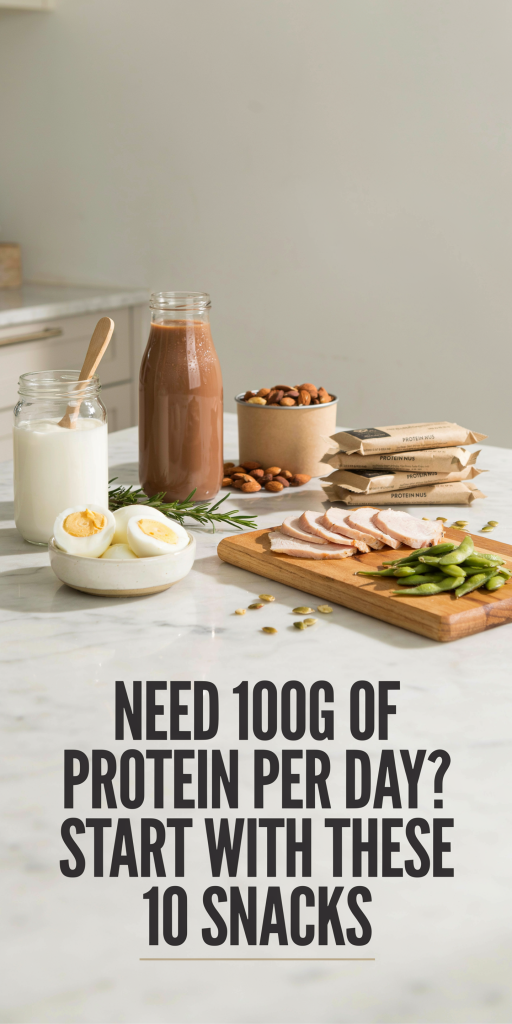
Need 100G Of Protein Per Day? Start With These 10 Snacks
Snacks are where protein targets get quietly rescued or quietly abandoned.
If breakfast, lunch, and dinner are each delivering 30 grams, the day total is 90 grams — close, but 10 short. A single high-protein snack closes that gap with no changes to the meal structure at all. If breakfast was low and lunch was rushed, a strategic snack at 3pm can add 25 grams and make an otherwise-failing protein day recoverable by dinner. If dinner was excellent but the day started slowly, an evening snack with 20 grams of protein converts a 75-gram day into a 95-gram day.
The 10 snacks in this list are not meal replacements and they’re not supplements dressed up as food. They are real food, most requiring no preparation beyond opening a container or spending 2 minutes in the kitchen. Each delivers 15 to 30 grams of protein. Eaten once per day, any of them add 15 to 30 grams to a daily total — the equivalent of adding half a serving of chicken to the day without adding another full meal.
Every snack here is GF or clearly specified. All are available at mainstream grocery stores. None require special equipment, advance preparation, or willpower beyond keeping the ingredient in the refrigerator or pantry.
The Snack Protein Case
Most snacks are not designed with protein in mind. A granola bar: 3 to 5 grams. A piece of fruit: 1 gram. Rice cakes: 1 gram each. A handful of crackers: 2 grams. These are fine foods that don’t move the protein needle at all. A day of eating three meals and two of these snacks produces the same protein total as a day with no snacks.
The strategic snack delivers 15 to 25 grams of protein in the same caloric range as a standard snack, keeps hunger controlled for 2 to 3 additional hours, and moves the daily protein total in a meaningful direction. The difference between a 3-gram snack and a 20-gram snack, two times per day, is 34 grams — more than a full serving of chicken added to daily totals without touching any meal.
The 3pm window matters most. Hunger peaks in the mid-afternoon for most people because cortisol drops and blood sugar dips after the lunch-to-dinner interval. A 20-gram protein snack at 3pm prevents the late-afternoon energy crash, reduces the severity of dinner hunger, and often reduces how much food is consumed at dinner. The snack is not extra food — it’s food that replaces food that would otherwise be eaten compulsively at 6pm standing in front of the refrigerator.
Snack 1: The Cottage Cheese Bowl
The highest-protein snack that requires no cooking and no preparation beyond opening a container and adding toppings. One cup of 2% cottage cheese delivers 28 grams of protein — more protein than a 4-ounce chicken breast — in a food that most people find genuinely satisfying as a snack.
Protein: 35 to 42 grams | Time: 2 minutes
What to do
Sweet version:
- 1 cup 2% cottage cheese (Daisy or Good Culture): 28g protein
- 2 tbsp hemp seeds: 7g protein
- 1/2 cup fresh or frozen blueberries
- 1 tsp honey
- 1/2 tsp cinnamon
- Total protein: 35g
Savory version:
- 1 cup 2% cottage cheese: 28g protein
- 2 tbsp hemp seeds: 7g protein
- 1/4 cup cherry tomatoes, halved
- 1 tbsp capers
- Drizzle of extra virgin olive oil
- Everything bagel seasoning
- Cracked black pepper
- Total protein: 35g
High-protein version (add protein powder):
- 1 cup cottage cheese: 28g protein
- 1/2 scoop vanilla protein powder stirred in: 12g protein
- Fresh berries
- Total protein: 40g
Why this works
Cottage cheese is the most underutilized high-protein food available. It’s also one of the slowest-digesting — the casein protein in cottage cheese digests over 5 to 7 hours, making it the most effective snack for controlling hunger in the hours following consumption. It is less trendy than Greek yogurt and more protein-dense by volume.
Snack 2: Greek Yogurt with Hemp Seeds and Nut Butter
Plain full-fat or 2% Greek yogurt with hemp seeds and a drizzle of almond or peanut butter. Three minutes, no cooking, 32 grams of protein, and a flavor combination that most people find genuinely preferable to flavored yogurt once they’ve had it.
Protein: 32 grams | Time: 2 minutes
What to do
- 200g plain 2% Greek yogurt (Fage, Chobani): 20g protein
- 3 tbsp hemp seeds: 10g protein
- 1 tbsp natural peanut or almond butter: 4g protein
- 1/2 cup berries or sliced banana
- 1 tsp honey
- Total protein: 34g
Instructions
- Spoon yogurt into a bowl or wide container if eating at a desk.
- Add hemp seeds and a drizzle of nut butter.
- Add fruit and honey.
Why this works
Plain Greek yogurt provides 20 grams of protein from whey and casein — the combination of fast and slow-digesting proteins that makes it more effective for satiety than whey-only sources. Hemp seeds add 10 grams of complete protein (all nine essential amino acids) without changing the texture significantly. The fat from the nut butter slows digestion further and rounds out the flavor in a way that makes this snack feel complete rather than provisional.
Snack 3: The Hard-Boiled Egg and Cheese Plate
Three hard-boiled eggs with two slices of good cheese and cucumber — the snack that requires zero prep time when the eggs are pre-boiled. Assembly time: 90 seconds. Protein: 28 grams.
Protein: 28 grams | Time: 90 seconds (with pre-boiled eggs)
What to do
- 3 large hard-boiled eggs: 18g protein
- 2 slices sharp cheddar or Swiss (about 1.5 oz): 10g protein
- 1/2 English cucumber, sliced
- Dijon mustard for dipping
- Salt, cracked black pepper, and optional hot sauce
Hard-boiling method that works every time
- Place eggs in a single layer in a pot. Cover with cold water by 1 inch.
- Bring to a full boil over high heat.
- Remove from heat. Cover. Let sit 10 to 12 minutes.
- Ice bath 5 minutes. Peel or refrigerate unpeeled up to 7 days.
Why this works
Hard-boiled eggs are the most convenient high-protein food that requires advance preparation — but that preparation (boiling a dozen eggs) takes 15 minutes on Sunday and produces protein that’s accessible in seconds for the entire week. An egg delivers 6 grams of complete protein with the highest biological value of any food, meaning the body uses a higher percentage of egg protein for muscle protein synthesis than any other protein source.
Snack 4: Canned Tuna with Mustard and Crackers
One can of tuna with Dijon mustard and a small serving of GF crackers or cucumber rounds — the pantry snack that requires no refrigeration beyond opening day and delivers 25 grams of protein in 2 minutes.
Protein: 25 to 28 grams | Time: 2 minutes
What to do
- 1 can (5 oz) tuna in olive oil, drained: 25g protein
- 1 tbsp Dijon mustard
- 1 tbsp fresh lemon juice
- Cracked black pepper and optional capers or dill
- GF crackers, rice cakes, or sliced cucumber for scooping
- Total protein: 25g
Instructions
- Drain tuna. Flake into a small bowl or eat directly from the can.
- Add Dijon, lemon juice, pepper, and any additions. Mix.
- Eat with crackers or cucumber.
Variations that add protein
- Add 2 tbsp hemp seeds: +7g protein (total 32g)
- Add 1 hard-boiled egg on the side: +6g (total 31g)
- Mix with 1/4 cup white beans: +4g (total 29g)
Why this works
Tuna in olive oil is a self-contained protein delivery system — the olive oil provides the fat that makes it satisfying, the tuna provides 25 grams of complete protein, and it requires no refrigeration until opened. This is the snack for a desk drawer, a car, a travel bag, or anywhere else protein access is uncertain. Tuna pouches (single-serve, no draining required) are even more convenient and typically GF.
Snack 5: The Protein Smoothie
When a snack needs to double as something more substantial — post-workout, between a light breakfast and a late lunch, or as a late-evening protein addition — a protein smoothie delivers 40 to 55 grams of protein in 90 seconds of blending. This is the highest-protein snack in the list.
Protein: 40 to 55 grams | Time: 2 minutes
Base recipe
- 1 scoop vanilla or unflavored protein powder (whey or plant-based, GF): 20 to 25g protein
- 1/2 cup plain Greek yogurt: 10g protein
- 1 tbsp peanut or almond butter: 4g protein
- 2 tbsp hemp seeds: 7g protein
- 1 cup frozen berries
- 1 cup unsweetened almond or oat milk
- 1 tsp honey (optional)
Total protein: 41 to 46g
Instructions
- Combine all ingredients in a blender.
- Blend 45 seconds until smooth.
- Drink immediately or pour into a travel cup.
Prep the night before
Measure protein powder, seeds, and frozen fruit into the blender jar and refrigerate. In the morning or before a workout, add milk and blend. This removes all measuring from the moment of use and makes the smoothie genuinely faster to make than a protein bar is to unwrap.
Why this works
A protein smoothie is the most efficient calorie-to-protein delivery system available short of pure protein powder in water. The combination of Greek yogurt (slow-digesting casein and whey), protein powder (fast-digesting whey if using whey), and nut butter (fat that slows absorption) produces a sustained protein delivery profile that sustains satiety for 3 to 4 hours — more like a light meal than a typical snack.
Snack 6: Beef Jerky or Turkey Jerky
The shelf-stable, no-refrigeration, no-preparation snack for people on the move. Two ounces of quality GF beef or turkey jerky delivers 18 to 22 grams of protein in a form that keeps in a desk drawer, gym bag, or carry-on for weeks.
Protein: 18 to 22 grams per 2 oz serving | Time: 0 minutes
What to look for
- Brands: Chomps, Epic, Krave, Country Archer (all GF — verify on the label)
- Avoid jerky with: wheat, soy sauce (contains wheat unless GF-specified), malt, or barley
- Target: at least 9g protein per 1 oz serving, minimal added sugars
Best pairings to increase protein
- 2 oz jerky (18g) + 1 string cheese (7g) = 25g
- 2 oz jerky (18g) + 1/4 cup roasted edamame (8g) = 26g
- 2 oz jerky (18g) + small container Greek yogurt (15g) = 33g
Why this works
Jerky is the highest-protein food available that requires no refrigeration and no preparation. For people whose protein gaps occur during work hours, travel, or any context where food access is limited, keeping jerky available eliminates the low-protein snack problem entirely. The main caveat is sodium — most jerky is high in sodium, which matters for people monitoring blood pressure. In the context of an otherwise balanced diet with adequate hydration, the sodium in 2 oz of jerky is not typically problematic.
Snack 7: The Smoked Salmon Cucumber Stack
Smoked salmon on cucumber rounds with cream cheese or blended cottage cheese and fresh herbs — a no-cooking snack that tastes like something from a catered event and delivers 26 grams of protein in 3 minutes.
Protein: 26 grams | Time: 3 minutes
What to do
- 1 English cucumber, cut into 1/2-inch rounds (about 20 rounds)
- 3 oz wild smoked salmon: 16g protein
- 1/3 cup 2% cottage cheese, blended smooth (or cream cheese): 9g protein
- 2 tbsp capers
- Fresh dill and chives
- Lemon juice and cracked black pepper
- Total protein: 25 to 28g
Instructions
- Blend cottage cheese smooth — 20 seconds in a small blender or with an immersion blender.
- Lay cucumber rounds on a plate or cutting board.
- Add a small dollop of blended cottage cheese to each round.
- Tear small pieces of smoked salmon and place on top.
- Add a caper, a pinch of fresh dill, and a tiny squeeze of lemon juice to each.
- Finish with cracked black pepper.
Why this works
This snack takes 3 minutes and produces something that looks and tastes far more deliberate than a snack. The smoked salmon provides 16 grams of complete protein along with omega-3 fatty acids and vitamin D. The cottage cheese adds 9 grams of casein protein. The cucumber provides crunch and hydration without adding carbohydrates that would trigger an insulin response. The entire snack is low-carb, naturally GF, and genuinely enjoyable.
Snack 8: The Edamame and Hummus Plate
Edamame is one of the highest-protein plant foods available — 17 grams of complete protein per cup — and it eats like a satisfying snack in a way that most protein-dense plant foods don’t. Combined with hummus, which adds another 4 grams, the total is 21 grams from entirely plant-based sources.
Protein: 21 grams | Time: 2 minutes (frozen edamame microwaved)
What to do
- 1 cup frozen edamame in pods, microwaved 3 minutes (or 1/2 cup shelled edamame): 17g protein
- 4 tbsp hummus (homemade or store-bought, check GF): 4g protein
- Cherry tomatoes and cucumber alongside
- Everything bagel seasoning or smoked paprika dusted over the hummus
- Lemon juice and olive oil drizzle
- Total protein: 21g
Instructions
- Microwave edamame in pods 3 minutes. (Shelled edamame microwaves in 2 minutes.)
- Sprinkle edamame with flaky salt.
- Plate hummus and dust with seasoning and olive oil.
- Arrange cherry tomatoes and cucumber alongside.
- Eat edamame as a pop-and-eat snack, dipping the contents into hummus if desired.
Why this works
Edamame is the most convenient high-protein plant snack. It requires minimal preparation (3 minutes in the microwave), comes in a form that slows eating (pods need to be opened individually), and provides complete protein — all nine essential amino acids — something most plant foods don’t do. The pods function as a natural portion control mechanism and the repetitive motion of eating pod by pod makes the snack feel more substantial than the quantity consumed.
Snack 9: The Protein Bar (When to Use It and What to Look For)
A protein bar is not the ideal protein snack — it’s a processed food with varying quality and often significant added sugar. But it is the snack that requires the least friction in specific contexts: long commutes, travel, gym bags, airports. Used appropriately — as a convenient protein delivery tool when nothing else is accessible — a good protein bar adds 15 to 25 grams of protein to the day.
Protein: 15 to 25 grams | Time: 0 minutes
What to look for in a GF protein bar
- Protein content: At least 15g per bar. Bars with 10g or fewer are effectively candy bars with protein marketing.
- Sugar content: Under 10g of added sugar per bar. Many “protein bars” contain 20 to 25g of sugar.
- GF certification: Not all protein bars are GF — check for wheat, barley, and malt on the label. Many use oats that may or may not be certified GF.
- Ingredient list: Should be relatively short. If you can’t identify the majority of ingredients as food, it’s a processed food bar dressed as a supplement.
GF protein bar brands worth using (verify current formulations)
- RXBAR: 12g protein, dates and egg whites as primary ingredients, GF certified
- Larabar Protein: 11 to 12g protein, mostly nuts and dates, GF
- Kind Protein: 12g protein, mostly nuts, GF verified
- Perfect Bar: 11 to 15g protein, peanut butter based, GF
- Quest Bar: 20 to 21g protein, GF certified on most flavors
The honest case
A protein bar at 20 grams of protein is still only getting you 20 grams of protein. It’s not equivalent to 3 hard-boiled eggs (18g) in terms of satiety or nutritional quality, but it is equivalent in protein content and dramatically more convenient when real food isn’t accessible. Use protein bars as a backup, not a primary snack strategy.
Snack 10: The Cottage Cheese and Protein Powder Mousse
Blended cottage cheese with protein powder, vanilla, and a small amount of nut butter produces a thick, mousse-like dessert-snack that delivers 40 grams of protein in 3 minutes. This is the snack for evenings when dinner was protein-light and the daily total needs significant supplementation.
Protein: 40 grams | Time: 3 minutes
What to do
- 1 cup 2% cottage cheese: 28g protein
- 1 scoop vanilla protein powder (GF): 20 to 25g protein
- 1 tbsp natural peanut butter: 4g protein
- 1 tsp vanilla extract
- 1 tsp honey or 1 packet sweetener
- Pinch of salt
- Optional: 1 tbsp cocoa powder for a chocolate version
- Optional toppings: fresh berries, dark chocolate chips, crushed nuts
Instructions
- Combine all ingredients in a blender or food processor.
- Blend 30 to 45 seconds until completely smooth and mousse-like in texture. If the mixture is too thick, add 1 to 2 tablespoons of milk.
- Transfer to a bowl or container.
- Top with berries, dark chocolate chips, or crushed nuts if desired.
- Eat immediately or refrigerate up to 2 days.
Why this works
This is the highest-protein snack in the list that can be made from ingredients that almost always live in the refrigerator and pantry of anyone eating high-protein. The cottage cheese provides slow-digesting casein that sustains amino acid delivery through the night. The protein powder provides fast-digesting whey that immediately elevates blood amino acid levels. Together they produce a complete protein profile from two sources in a form that most people find genuinely enjoyable rather than medicinal.
Quick Reference: All 10 Snacks
| Snack | Protein | Time | Needs Prep? | Portable? |
|---|---|---|---|---|
| 1. Cottage Cheese Bowl | 35 to 42g | 2 min | No | In a container |
| 2. Greek Yogurt with Hemp Seeds | 32 to 34g | 2 min | No | Yes |
| 3. Hard-Boiled Eggs and Cheese | 28g | 90 sec | Eggs pre-boiled | Yes |
| 4. Canned Tuna with Mustard | 25 to 32g | 2 min | No | Yes |
| 5. Protein Smoothie | 40 to 55g | 2 min | Optional night-before | Travel cup |
| 6. Beef or Turkey Jerky | 18 to 22g | 0 min | No | Highly portable |
| 7. Smoked Salmon Cucumber Stack | 26g | 3 min | Cottage cheese blend | Not ideal |
| 8. Edamame and Hummus Plate | 21g | 2 min | Microwave | Somewhat |
| 9. Protein Bar | 15 to 25g | 0 min | No | Most portable |
| 10. Cottage Cheese Protein Mousse | 40g | 3 min | No | In a container |
How to Choose
The highest protein per serving: Snacks 5 (smoothie, 40 to 55g) and 10 (protein mousse, 40g). Both are most useful for evenings when the day’s total is significantly short.
The most portable snack with no refrigeration required: Snack 6 (jerky) and Snack 9 (protein bar). For travel, commutes, or any context where refrigeration isn’t available, these are the only options in the list.
The snack that requires the least thought: Snack 3 (hard-boiled eggs and cheese) with pre-boiled eggs. Once the eggs are boiled Sunday, this snack has zero decision-making involved.
The best snack for 3pm hunger: Snack 1 (cottage cheese bowl) or Snack 2 (Greek yogurt with hemp seeds). Both provide slow-digesting casein protein that manages hunger for 3 to 4 hours without requiring a subsequent pre-dinner snack.
The snack for someone who doesn’t think of themselves as a “snack person”: Snack 4 (canned tuna with mustard and crackers). It eats more like a small light meal than a snack, takes 2 minutes, and delivers a significant protein hit without requiring any planning beyond keeping a can of tuna accessible.
Building Snacks Into the Day
One snack, well-chosen, is enough. Most people don’t need two protein snacks per day if meals are reasonably high in protein. A single 20 to 25-gram protein snack at 3pm typically converts a 75-gram protein day into a 95 to 100-gram day. Adding a second 20-gram snack is appropriate if earlier meals were low, if training volume is high, or if the body weight-based protein target exceeds 120 grams per day.
Keep the snack accessible before you’re hungry. The snack decision is made when hunger is acute — which is exactly when convenience wins over quality. If the cottage cheese is at home and the protein bar is in the desk drawer, you will eat the protein bar. If the cottage cheese is in a container in a lunch bag at the desk, you will eat the cottage cheese. Accessibility at the moment of hunger is the entire game.
The snack that closes the daily gap is the right snack. There is no nutritionally superior snack between two options that deliver the same protein at similar calorie levels. The right snack is the one that fits the context, the time available, and the protein gap that needs closing. This list covers that range from 18 to 55 grams of protein and from 0 minutes to 3 minutes of preparation. One of these 10 snacks fits any context in which a protein snack might be needed.

