10 Nail Clues That Could Mean Low Iron — What Your Nails Are Trying To Tell You
Our nails often say more about our health than we realize. When iron levels dip, the changes can show up subtly at first, brittle edges, pale beds, slower growth, and progress if left untreated. We’ll walk through the science behind iron and nail biology, show the ten most telling nail signs that may indicate low iron, explain how to tell iron-related nail changes apart from other causes, and outline how to check and treat iron deficiency. This isn’t medical advice, but a practical, evidence-informed guide to help you notice changes sooner and talk to your clinician with clearer questions. If you’ve been wondering whether your nails are signaling something more than cosmetic wear and tear, read on: nails can be a surprisingly useful early clue to low iron, and catching it early makes recovery easier.
Why Iron Matters For Nail Health
Iron is a core mineral our bodies use to build hemoglobin, support oxygen delivery, and drive enzymes involved in cell division and repair. Nails are made of keratin, a fibrous protein, and although keratin itself doesn’t contain iron, the cells that make keratin depend on healthy blood flow, oxygen, and metabolic support to divide and mature properly. When iron is low, those supporting systems falter.
There are several physiological reasons iron status affects nails. First, reduced hemoglobin and oxygen delivery slow growth and weaken the structural integrity of the nail matrix, the tissue at the base that generates the nail plate. Second, iron is a cofactor for enzymes involved in collagen synthesis, mitochondrial function, and cellular energy production: deficits impair the proliferation of nail-forming cells. Third, chronic iron deficiency shifts the body’s priorities toward vital organs, so nonessential structures like nails and hair receive fewer resources.
Clinically, iron deficiency can range from mild to severe. Mild reductions might cause subtle slowing of nail growth, while prolonged deficiency can produce more distinct morphologic changes. Importantly, iron deficiency anemia and iron deficiency without anemia can both affect nails, meaning blood counts alone don’t tell the whole story. That’s why we pay attention to the nails as a window into iron-dependent processes.
Understanding these mechanisms helps explain why restoration of iron often leads to progressive improvement in nail texture, color, and strength, but it also clarifies why recovery takes time. Nails don’t change overnight: they reflect weeks to months of underlying physiology.
How Iron Deficiency Alters Nail Appearance And Growth
Iron deficiency affects nails in a few consistent ways: by slowing growth, changing color, altering shape, and weakening the nail plate. Each of these changes maps to the biological disruptions we discussed earlier.
Slowed growth: Reduced oxygen and energy in the nail matrix slow keratinocyte proliferation. Healthy fingernails typically grow about 3 mm per month: when iron is low, that rate can drop noticeably. That’s why we might see longer intervals between trims, or nails that take months to reach a desired length.
Color and pallor: Nails with low iron often appear paler than usual. Nail bed pallor reflects systemic anemia: when hemoglobin is low, the usual pinkish tint fades because less oxygenated blood fills the capillaries under the nail. This is one of the easier visual clues but not specific, pale nail beds can result from several systemic issues.
Shape changes: Iron deficiency can alter the curvature and surface of the nail plate. Spoon-shaped nails (koilonychia) form when the nail becomes soft and thinned at the center, curving upward at the edges. Longitudinal ridging, vertical lines running from base to tip, can become more pronounced because the matrix produces nails irregularly when stressed.
Brittleness and splitting: Nail plate cohesion depends on well-formed keratin layers. Iron-deficient nails may split (onychorrhexis), delaminate, or crumble because the cells aren’t forming robust layers.
These changes often appear gradually and can be subtle at first. We should also point out that the fingernails and toenails differ: fingernails typically show signs sooner because they grow faster and reflect more recent systemic changes, while toenails may remain unchanged for longer.
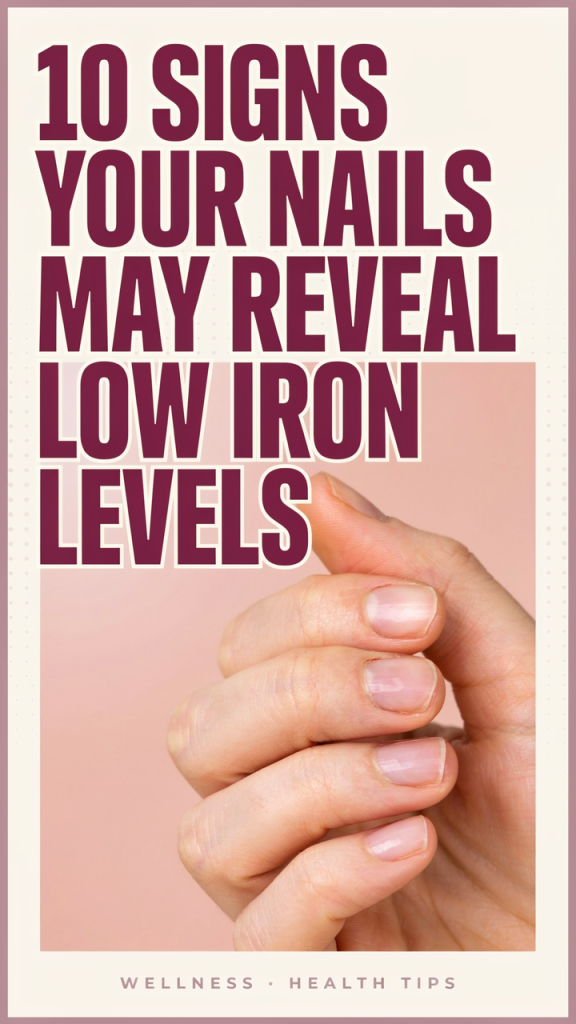
10 Nail Signs That May Indicate Low Iron (What To Look For)
Below are ten nail findings that commonly point toward iron deficiency. No single sign proves low iron, they’re clues that should prompt further assessment, especially if several appear together or you have other symptoms like fatigue or heavy menstrual bleeding.
- Pale nail beds
Pallor of the nail bed is an easy-to-see sign when hemoglobin is low. Press the fingertip to blanch the nail: if the normal pink color is very faint or absent when blood returns, it suggests diminished red cell mass.
- Spoon-shaped nails (koilonychia)
This classic sign shows central thinning with upward curving edges, often described as a spoon. Koilonychia is strongly associated with chronic iron deficiency, particularly when it appears across multiple nails.
- Brittleness and splitting (onychorrhexis)
Nails that split easily, peel, or crumble can reflect impaired nail plate formation due to nutrient deficits, including iron.
- Thin, soft nails
When the nail plate lacks structural integrity it may feel soft or paper-like. Iron-deficient nails often lose their firmness and resist holding shape.
- Longitudinal ridging
Vertical ridges are common with age but become more prominent in iron deficiency because the matrix produces keratin irregularly. When ridges deepen across many nails, we take note.
- Slow nail growth
If your nails consistently take longer than usual to grow back after trimming or clipping, low iron could be contributing. Track growth over a month to notice changes.
- Fragility at the free edge
In iron deficiency the nail tip often chips or peels while the proximal nail appears relatively intact. This selective weakness is a subtle but useful clue.
- White spots or bands (leukonychia)
True leukonychia (white spots) often comes from trauma, but diffuse or transverse white bands can appear with systemic disturbances including nutritional deficiencies like low iron.
- Nail bed texture changes
A fine granular or rough texture of the nail bed and plate, not explained by infection or environmental exposure, can suggest chronic alterations in nail-forming tissue.
- Recurrent paronychia or increased fragility around cuticles
While infections are a separate issue, persistent vulnerability to small tears and inflammation around the cuticle may occur when nails are chronically weakened.
If you notice multiple signs from this list, particularly pallor plus structural changes like koilonychia and brittleness, it’s reasonable to explore iron status with your healthcare provider. We pay attention to patterns: one isolated white spot after a manicure is different from widespread spooning and slow growth over months.
Differentiating Iron-Related Nail Changes From Other Causes
Nail abnormalities have many causes, so we need to separate iron-related findings from other common conditions to avoid misattribution.
Fungal infections (onychomycosis): Thickened, discolored toenails and sometimes fingernails often result from fungus. Fungal nails frequently show yellow-brown discoloration, crumbly debris under the nail, and uneven thickening, not the generalized pallor or spooning typical of iron deficiency. A simple lab test (KOH prep or fungal culture) can confirm infection.
Trauma and manicure damage: Repeated mechanical trauma or aggressive nail treatments produce transverse ridges, splits, and white spots. A history of injury or cosmetic procedures makes trauma more likely than systemic deficiency.
Aging and genetics: Vertical ridging often increases with age and may be familial. Distinguishing age-related ridging from iron-related changes means looking for accompanying signs like pallor or koilonychia.
Other systemic causes: Thyroid disease, psoriasis, connective tissue disorders, and chronic kidney disease can all alter nails. For example, thyroid dysfunction may cause brittle nails, while psoriasis causes pitting and oil-drop discoloration. A full clinical picture and basic screening tests help differentiate these causes.
Nutritional deficiencies besides iron: Biotin, zinc, protein, and essential fatty acid deficiencies can weaken nails. Dietary history and targeted labs can reveal multiple concurrent deficiencies.
Medications and chemical exposures: Certain drugs (chemotherapy agents, retinoids) and chronic exposure to solvents can damage nails. Review medications when evaluating changes.
Pattern and symmetry help: Iron-related nail changes often appear across multiple nails and progress gradually. Localized issues or abrupt changes usually suggest trauma or infection. We combine history, physical exam, and relevant tests to reach a probable cause before starting treatment.
How To Check Your Iron Status: Symptoms, Screening, And Tests
If nail clues raise concern, the next step is assessing iron status both clinically and with targeted lab tests. We recommend discussing symptoms with a clinician, who can order appropriate screening.
Symptoms to mention: Fatigue, pallor, shortness of breath on exertion, palpitations, dizziness, restless legs, craving non-food items (pica), heavy or prolonged menstrual bleeding, and new or worsening nail changes. Bring photos of your nails, they help track progression.
Initial lab tests: A basic iron workup typically includes complete blood count (CBC) with hemoglobin and mean corpuscular volume (MCV), serum ferritin, serum iron, total iron-binding capacity (TIBC), and transferrin saturation. Each test offers different insights:
- Hemoglobin (Hb): Low in iron deficiency anemia. Normal Hb doesn’t rule out iron deficiency.
- MCV: Low MCV (microcytosis) suggests long-standing iron deficit.
- Ferritin: The best single test for iron stores: low ferritin reliably indicates depleted stores. Note ferritin is an acute-phase reactant and can be falsely normal or high during inflammation or infection.
- Transferrin saturation and serum iron: Can be low in deficiency but fluctuate.
Interpreting borderline results: Iron deficiency without anemia shows low ferritin but normal Hb. Inflammatory states (infection, autoimmune disease) can obscure ferritin: in those cases, clinicians may use tests like soluble transferrin receptor or assess trends over time.
When to refer: If results are abnormal or if there’s significant blood loss (GI bleeding, heavy menses) or a nonobvious source, referral to a hematologist or gastroenterologist may be warranted for further workup, including endoscopy or colonoscopy when indicated.
Practical tips: Don’t start iron supplements before getting baseline labs unless advised by a clinician, supplements can alter test results. If you’re already on iron, tell the clinician so they can interpret tests correctly.
Treatment Options And Typical Nail Recovery Timeline
Treating iron deficiency involves replacing iron stores and addressing the cause of deficiency. Nail recovery follows, but it’s gradual because nails grow slowly.
Treatment basics:
- Oral iron supplements: First-line for most people. Ferrous sulfate (usually 65 mg elemental iron per tablet) is common. Other forms include ferrous gluconate and ferrous fumarate: newer formulations and lower-dose daily or alternate-day dosing can improve tolerability and absorption. We often recommend taking iron on an empty stomach with vitamin C (orange juice) to enhance absorption, but if GI upset occurs, taking with food is acceptable.
- Intravenous iron: Reserved for those who can’t tolerate oral iron, have malabsorption (e.g., celiac disease), or need rapid repletion (severe anemia, ongoing blood loss). IV iron quickly restores stores but requires clinical supervision.
- Addressing the cause: Treating heavy menses, gastrointestinal bleeding, or dietary insufficiency is essential to prevent recurrence.
Monitoring and expected timeline:
- Hemoglobin usually starts to rise within 1–3 weeks of effective therapy: many patients notice improved energy in that timeframe.
- Ferritin and iron stores take longer to rebuild: clinicians typically continue oral iron for 3–6 months after hemoglobin normalizes to replenish stores.
- Nail changes lag behind blood parameter improvements because nails reflect months of growth. We typically expect early improvements in nail strength and reduced splitting within 2–3 months, with more visible cosmetic restoration (length, smoother surface) over 6–12 months depending on baseline severity. Fingernails generally recover faster than toenails.
Realistic expectations: If koilonychia or severe deformity has developed over years, nails may not return to a pristine state immediately, but progressive improvement is common once iron is repleted. Combining iron therapy with good nail care speeds functional and cosmetic recovery.
Safety considerations: Don’t exceed recommended doses without supervision. Iron overdose can be dangerous. If oral iron causes persistent GI distress, consult a clinician, dose adjustments or IV therapy may be appropriate.
Prevention And Practical Nail Care While Repleting Iron
While we’re actively correcting iron deficiency, practical nail care and lifestyle strategies help protect fragile nails and support recovery.
Dietary steps to prevent recurrence:
- Prioritize iron-rich foods: Lean red meat, poultry, fish, shellfish, and organ meats provide heme iron, which is well absorbed. Plant sources like lentils, beans, tofu, spinach, and fortified grains provide nonheme iron: combine them with vitamin C sources (citrus, bell peppers) to boost absorption.
- Avoid inhibitors around iron intake: Tea, coffee, and calcium-rich foods reduce nonheme iron absorption, so we advise not pairing them with iron-rich meals or supplements.
- Ensure adequate overall nutrition: Protein, biotin, zinc, and essential fatty acids all support nail health.
Practical nail care tips while nails are weak:
- Keep nails short and smooth: Trim regularly and file gently to reduce catching and tearing. Short nails break less and are easier to protect.
- Use protective gloves: During cleaning, dishwashing, or gardening, gloves prevent mechanical trauma and chemical exposure.
- Moisturize: Apply a nail/hand cream focusing on the nail folds and cuticles to reduce splits: use oils (like jojoba or almond) to condition brittle nails.
- Avoid harsh manicures and acrylics: Give nails a break from gels, acrylics, and aggressive buffing while they rebuild. If you get salon services, ask for gentle techniques.
- Gentle filing vs clipping: When nails are very soft, gentle filing is less likely to cause jagged tears than clipping.
- Biotin supplementation: Some people find biotin (2.5–5 mg/day) helpful for brittle nails: evidence is modest but suggests benefit in select cases. Discuss with a clinician before starting supplements.
Monitoring progress:
- Photograph nails monthly to objectively track improvements.
- Pair nail care with ongoing iron therapy and follow-up labs as recommended.
- If nails worsen even though corrected iron or if new symptoms appear (pain, pus, severe deformity), seek dermatology or primary care evaluation to rule out other causes.
Small lifestyle adjustments combined with proper iron repletion go a long way. While we wait for nails to grow out, preventing further trauma keeps emerging nail plate healthier and improves cosmetic outcomes.
Conclusion
Our nails are subtle messengers. When we spot a pattern, pallor, spooning, brittleness, slow growth, it’s worth asking whether iron could be the underlying cause. Early recognition, appropriate testing (especially ferritin), and targeted treatment not only improve systemic symptoms like fatigue but also allow nails to recover over months. We encourage anyone noticing multiple nail changes or accompanying symptoms to talk to their clinician, bring photos, and get the right labs before starting supplements. With proper care and iron repletion, most people see meaningful nail improvement, but patience is essential: nails reflect long-term health, and they take time to heal.