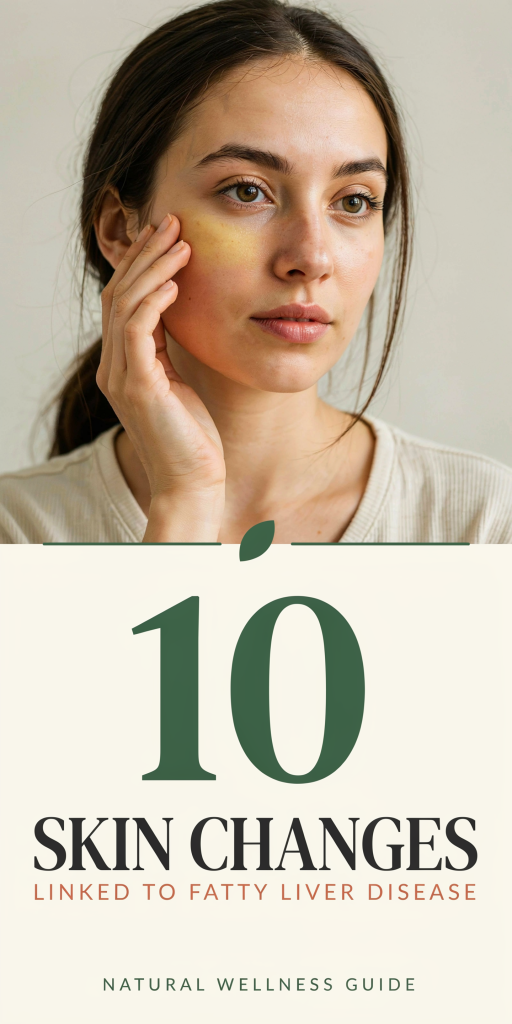
10 Skin Changes Linked to Fatty Liver Disease: What To Watch For And When To See A Doctor
Fatty liver disease, particularly nonalcoholic fatty liver disease (NAFLD), affects roughly one in four adults worldwide and often develops quietly, without pain or obvious symptoms. Yet the liver’s role in metabolism, detoxification, and protein synthesis means that when it’s stressed, the effects can ripple outward, including onto the skin. We’ll walk through the ten skin changes most commonly linked to fatty liver disease, explaining the biology behind each sign, how to tell when a change warrants urgent evaluation, and what interventions can help. Our goal is practical: to help you recognize visible clues early so you and your healthcare team can act before complications arise.
How Fatty Liver Disease Affects The Skin — The Biology Behind Visible Signs
Liver dysfunction can produce skin changes through several overlapping mechanisms: altered hormone and pigment metabolism, impaired production of proteins (including clotting factors), disrupted lipid handling, and accumulation of waste products or toxins that the liver normally clears. When we talk about fatty liver disease, we’re usually referring to two broad categories: alcoholic fatty liver disease and nonalcoholic fatty liver disease (NAFLD). NAFLD is increasingly common and often associates with obesity, type 2 diabetes, and metabolic syndrome.
Three physiologic pathways explain most dermatologic manifestations:
- Metabolic disturbance and lipid deposition. When the liver’s handling of fats is impaired, cholesterol-rich deposits can form in the skin and around the eyes (xanthelasma, xanthomas). These are visible signs of altered lipid metabolism.
- Accumulation of bile pigments and bilirubin. When bile flow or bilirubin processing is affected, we see jaundice, yellowing of skin and sclerae, and sometimes darker or yellowish skin deposits.
- Altered protein synthesis and circulation. The liver makes clotting factors and albumin: insufficiency leads to easy bruising, poor wound healing, and vascular changes like spider angiomas. Estrogen metabolism also changes in chronic liver disease, explaining palmar erythema and vascular dilation.
Inflammation and immune activation in advanced nonalcoholic steatohepatitis (NASH) or cirrhosis can further disrupt skin integrity, increase itching (pruritus), and slow healing. Finally, associated conditions, obesity, insulin resistance, and diabetes, bring their own dermatologic manifestations, which often overlap with liver-related signs. We’ll unpack the specific skin changes next, how they look, and what they tell us about underlying liver health.
Yellowing Of The Skin And Eyes (Jaundice)
Jaundice is among the most recognizable signs suggesting impaired liver function. It develops when bilirubin, a breakdown product of hemoglobin, accumulates in the blood and tissues. In healthy livers, bilirubin is taken up, conjugated, and excreted in bile. When the liver’s processing capacity is overwhelmed, or bile flow is obstructed, unconjugated or conjugated bilirubin builds up and stains tissues yellow.
How it looks: Jaundice typically presents first in the sclerae (white of the eyes) and then becomes visible in the skin, especially in lighter skin tones. The yellow may be subtle at first and become more pronounced as bilirubin rises.
Why it matters: In fatty liver disease, jaundice usually indicates advanced dysfunction, significant hepatocellular injury, or cholestasis (reduced bile flow). It’s not a common early feature of uncomplicated NAFLD but becomes more likely with progression to NASH, fibrosis, or cirrhosis.
When to see a doctor: Any new yellowing of the eyes or skin should prompt urgent evaluation. We want to measure liver enzymes, bilirubin fractions, and perform imaging (ultrasound) to look for obstruction, inflammation, or structural disease. Jaundice can also reflect hemolysis or other nonhepatic causes, so a full assessment is needed.
Spider Angiomas And Other Visible Blood Vessel Changes
Spider angiomas (spider naevi) are small, central red spots with radiating vessels, often found on the face, neck, chest, and shoulders. They’re caused by localized dilation of superficial arterioles and increased estrogen activity, which the liver normally helps metabolize. In liver disease, circulating estrogens can rise, producing vascular changes.
Other vessel-related signs include telangiectasias and vascular purpura. These marks blanch when pressed and may increase in number as liver dysfunction advances.
Clinical clues and context: Isolated spider angiomas can occur in otherwise healthy people, especially children or pregnant women. But multiple spider angiomas in an adult, particularly with other signs (palmar erythema, bruising, ascites), should raise concern for chronic liver disease.
What we do: Finding multiple spider angiomas is a prompt for broader hepatic evaluation. We’d check liver function tests, assess for portal hypertension, and consider referral to hepatology. For cosmetic concerns, dermatologic treatments (laser therapy, electrocautery) can reduce visible lesions, but treating the underlying liver disease remains the priority to prevent recurrence.
Palmar Erythema — Reddened Palms And Why They Occur
Palmar erythema is a symmetric reddening of the palms, particularly the thenar and hypothenar eminences. It frequently appears as a diffuse pink-to-red hue that blanches with pressure. The condition stems from increased blood flow to superficial vessels and altered hormone levels: estrogens and vasodilatory mediators are implicated.
Relation to fatty liver disease: Palmar erythema is classically associated with chronic liver disease and cirrhosis, though it isn’t specific. We often see it alongside spider angiomas and other signs of systemic vascular change. In patients with NAFLD who progress to significant fibrosis or cirrhosis, palmar erythema becomes more common.
Practical notes: Palmar erythema alone doesn’t confirm liver disease, it can occur in pregnancy, rheumatoid arthritis, hyperthyroidism, or be idiopathic. But, when it appears with other liver-related features (jaundice, ascites, splenomegaly), it strengthens the suspicion of hepatic involvement. We advise a hepatology workup if palmar erythema is new and unexplained.
Persistent Itching And Xanthomas: Itchiness, Cholesterol Deposits, And What They Mean
Persistent itching (pruritus) and the development of xanthomas are two distinct dermatologic signals that can point to liver dysfunction.
Pruritus: Cholestasis, impaired bile flow, leads to accumulation of bile acids and other pruritogens in the bloodstream and skin, producing intense, often worse-at-night itching. This is a hallmark of cholestatic liver diseases but can also occur in advanced NAFLD with cholestasis or with biliary obstruction. The itch can be generalized, and scratching often causes excoriations, secondary infections, and scarring.
Management and red flags: If we’re facing persistent, unexplained pruritus, we assess liver function tests, alkaline phosphatase, and imaging for biliary obstruction. Symptomatic treatments include bile acid sequestrants (cholestyramine), antihistamines (limited benefit), topical emollients, and in refractory cases medications like rifampin or naltrexone under specialist guidance.
Xanthomas and xanthelasma: Xanthomas are papules or nodules composed of lipid-laden foam cells: xanthelasma specifically refers to yellowish plaques on the eyelids. These emerge when serum lipoproteins are elevated or abnormally processed. In NAFLD, dyslipidemia is common, and xanthomas may be a cutaneous marker of systemic lipid abnormalities.
Interpretation: Xanthelasma isn’t a direct proof of liver failure but signals deranged lipid metabolism and elevated cardiovascular risk. When we find xanthomas, we check fasting lipids, liver enzymes, and consider a cardiovascular risk assessment. Treating underlying dyslipidemia and addressing metabolic syndrome components often reduces progression.
Easy Bruising, Slow Wound Healing, And Bleeding-Related Skin Changes
The liver synthesizes most clotting factors as well as albumin and other proteins necessary for tissue repair. In progressive liver disease, decreased production of clotting factors puts patients at risk for easy bruising and prolonged bleeding. Low albumin can lead to edema and impaired wound healing because tissues receive less oncotic support and nutrients.
How these changes present: We often hear patients say they bruise from minor bumps or that small cuts won’t stop bleeding. Surgical wounds and skin tears may heal slowly, and pressure injuries or ulcers can become chronic. In advanced disease, coagulopathy increases the risk of significant bleeding from even minor procedures.
What we check: A simple, useful screening trio is platelet count, prothrombin time/international normalized ratio (PT/INR), and albumin level. Thrombocytopenia (low platelets) is also common with portal hypertension and splenic sequestration and contributes to bleeding risk.
Practical advice: If we identify easy bruising or unusually slow healing, we coordinate with the patient’s primary care or hepatology team before any elective procedures. Addressing nutrition, optimizing glycemic control in diabetics, and treating underlying liver disease can improve healing. For bleeding emergencies, urgent correction of coagulopathy, with vitamin K, plasma, or platelets as indicated, is essential.
Pigment Changes And Yellowish Deposits — Hyperpigmentation, Xanthelasma, And Related Marks
Liver disease can produce a spectrum of pigmentary changes and localized deposits that alter skin color.
Hyperpigmentation: Chronic liver disease sometimes correlates with diffuse or patchy hyperpigmentation. The mechanisms aren’t fully pinned down but likely involve increased melanin production from chronic inflammation, hormonal imbalance, or accumulation of pigmented compounds. In some metabolic liver disorders, darker pigmentation is a more prominent early sign.
Yellowish deposits: Beyond jaundice, we see discrete yellowish plaques such as xanthelasma around the eyes or planar xanthomas on extensor surfaces. These are cholesterol-rich and appear as soft, slightly raised lesions.
Distinguishing features: Hyperpigmentation tends to be flat and varies with sun exposure and inflammation, whereas xanthelasma is localized, waxy, and yellow. Dermoscopy or biopsy can clarify uncertain lesions but is rarely necessary when clinical features are classic.
Clinical significance: Pigment changes alone may be benign, but when they appear with metabolic abnormalities, high triglycerides, low HDL, insulin resistance, they point us toward broader metabolic screening. Xanthelasma deserves lipid testing and cardiovascular risk management. If pigment changes are sudden or rapidly progressive, we pursue hepatologic and dermatologic evaluation to exclude more serious pathology.
Conclusion
Visible skin changes can be an early window into liver health. While not every skin sign means advanced disease, patterns matter: spider angiomas, palmar erythema, persistent pruritus, and jaundice together raise our concern for significant hepatic dysfunction, whereas xanthelasma and xanthomas point us toward metabolic and lipid disorders often associated with NAFLD.
When we spot these signs, we recommend basic laboratory screening (liver enzymes, bilirubin, albumin, PT/INR, fasting lipids) and noninvasive imaging like hepatic ultrasound. Early recognition lets us intervene: weight loss, glycemic control, lipid management, and lifestyle changes slow NAFLD progression and may reverse early disease. If you or someone you care for develops new or worsening skin changes alongside fatigue, abdominal swelling, or changes in mental function, seek medical attention promptly, early action preserves liver function and improves outcomes.