9 Tongue Changes That Signal Vitamin B12 Deficiency — How To Spot Them Early
Vitamin B12 deficiency can creep up silently, but the tongue often gives early, visible clues long before more serious neurological or hematologic symptoms appear. In clinical practice and everyday health checks, subtle shifts in color, texture, or sensation on the tongue are among the first findings that prompt us to test for low B12. This guide walks through nine specific tongue changes linked to vitamin B12 deficiency, explains why they happen, and offers practical tips for spotting them early and deciding when to seek testing or treatment.
We’ll keep this practical: for each sign we describe what it looks like, the biological mechanism behind it, common confounders (other causes that mimic the sign), and what to do next. Whether you’re a clinician, caregiver, or someone tracking your own health, you’ll come away with a clear sense of which tongue findings are suggestive of B12 deficiency and which require a different line of investigation.
Smooth, Shiny Tongue (Atrophic Glossitis)
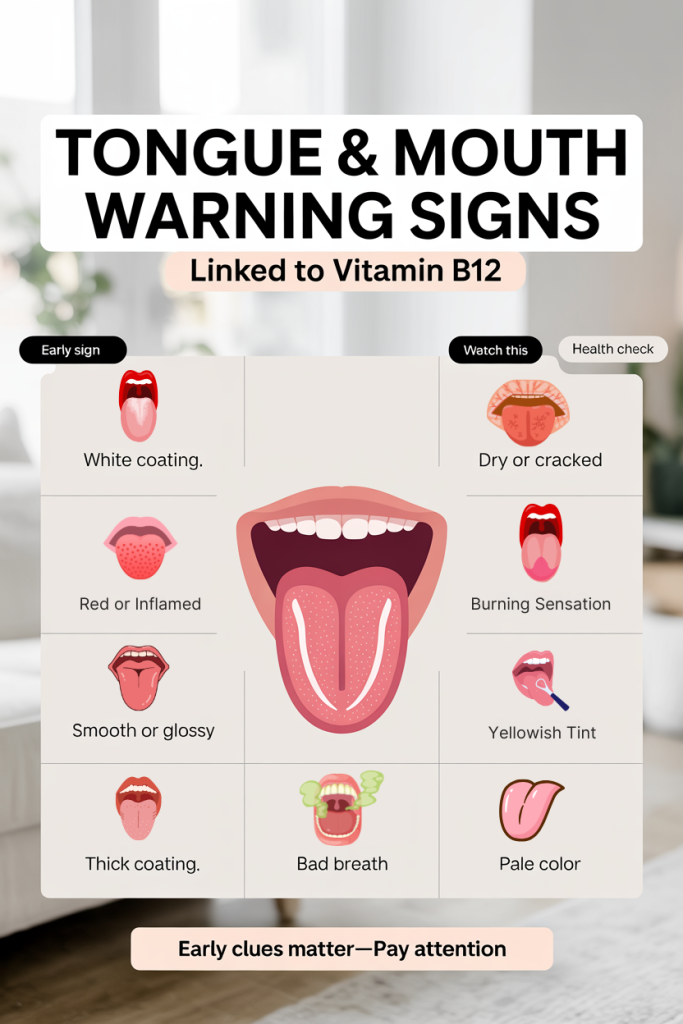
Atrophic glossitis, often called a smooth, glossy tongue, is one of the hallmark oral findings associated with vitamin B12 deficiency. Instead of the normal textured surface studded with filiform papillae, the tongue looks smooth, polished, and sometimes bright red. Patients commonly report increased sensitivity, discomfort when eating spicy or acidic foods, and a noticeable change in the tongue’s appearance when they look in a mirror.
Why it happens: Vitamin B12 is essential for DNA synthesis and cellular turnover. When levels fall, rapidly renewing cells of the oral mucosa can’t maintain their normal structure, causing papillae to atrophy. That loss of papillae creates the characteristic smooth, shiny surface. Atrophic glossitis often coincides with mucosal pallor from anemia or with other mucosal changes such as ulcerations.
What to watch for: The change may develop gradually. Early on, only the tips and lateral borders are involved: later, the entire dorsal surface may appear depapillated. The surface can be tender and show a high sheen when saliva coats the tongue.
Other causes to consider: Iron deficiency anemia, folate deficiency, oral candidiasis (which can be wiped off in some cases), Sjögren’s syndrome, and some autoimmune conditions can produce similar appearances. Nutritional deficiencies often coexist, so it’s common to see mixed pictures.
When to act: If you or someone you care for develops a smooth, painful, or hypersensitive tongue, we’d recommend checking a complete blood count and serum B12 (or methylmalonic acid if B12 is equivocal). Early replacement reverses mucosal changes in many patients within weeks to months.
Beefy Red Tongue
The term “beefy red tongue” describes a glossy, intensely red dorsum that looks inflamed. It’s frequently reported in textbooks as a classic sign of severe B12 deficiency and is particularly noticeable against normally paler oral tissues. The color can be startling: deep, uniform erythema without the normal granular texture.
Pathophysiology: B12 deficiency leads to both mucosal atrophy and increased vascular visibility as papillae thin or disappear. Microvascular dilation and thin overlying mucosa combine to produce the vivid red hue. The degree of redness sometimes correlates with the severity of deficiency but not always, individual vascular responses vary.
Symptoms and functional impact: Beyond appearance, a beefy red tongue can be tender, sensitive during eating, and associated with burning sensations. Taste alterations often coexist. Patients may complain that their tongue seems swollen or raw even when no edema is apparent.
Distinguishing features: Unlike inflammatory infections that produce focal white plaques or patches, beefy redness from B12 deficiency tends to be diffuse and uniform. If there are pustules, ulcers, or fever, infection should be considered. Local irritants (hot foods, tobacco) can also redden the tongue temporarily.
Next steps: Because a beefy red tongue is a visible cue that’s highly suggestive of deficiency, we recommend prompt B12 testing and clinical correlation for anemia or neurologic symptoms. Empiric short-term topical soothing (e.g., bland mouth rinses, avoiding irritants) is reasonable while pursuing diagnostics.
Burning Sensation Or Tongue Pain (Glossodynia)
Glossodynia, a burning, stinging, or aching pain of the tongue, is a frequent complaint among people with vitamin B12 deficiency. Unlike pain from ulcers or infections, the burning often lacks visible lesions in early stages and may be worse at night or when eating hot, acidic, or spicy foods.
Why the burning occurs: Vitamin B12 is crucial for maintaining peripheral nerve health. Deficiency can cause small-fiber neuropathy affecting the chorda tympani and lingual nerves, leading to dysesthesia or a persistent burning sensation. Concurrent mucosal atrophy makes the lingual surface more vulnerable to irritation, amplifying perceived pain.
Clinical clues: Patients typically describe a constant, superficial burning across the tip and sides of the tongue. It may be accompanied by tingling, numbness, or altered taste. Examination can be deceptively normal early on, we must rely on the history and consider B12 testing when other common causes aren’t found.
Other potential causes: Chronic candidiasis, lichen planus, reflux-related oral burning, xerostomia, and psychogenic burning mouth syndrome can simulate glossodynia. A useful approach is to assess for objective mucosal changes, review medications, and screen for diabetes or thyroid dysfunction.
Management considerations: If B12 deficiency is confirmed, replacement therapy often reduces burning within weeks, though neuropathic pain can persist longer and might need adjunctive treatments (e.g., low-dose tricyclics or gabapentin) under medical supervision. Meanwhile, we recommend gentle oral care, avoidance of irritants, and topical soothing agents like bland rinses or artificial saliva for dryness.
Pale Or Ashen Tongue From Anemia
A pale or ashen tongue often reflects underlying anemia, which commonly accompanies B12 deficiency. Instead of the healthy pink tone, the tongue appears washed-out, with reduced vascularity visible through thinner mucosa.
Mechanism: Vitamin B12 deficiency causes megaloblastic anemia by impairing DNA synthesis in erythroid precursors, resulting in fewer, larger, and often dysfunctional red blood cells. Reduced hemoglobin and lower tissue oxygenation cause mucosal pallor, the tongue is a convenient, visible place to spot this early.
Assessment tips: We look for uniform pallor across the tongue, sometimes accompanied by general mucosal pallor (gums, inside of the lips, conjunctiva). In severe cases, patients report fatigue, breathlessness on exertion, or lightheadedness. Correlating the oral exam with a full CBC helps confirm the suspicion.
Differential diagnoses: Acute blood loss, chronic disease anemia, iron deficiency, and other nutritional deficits can produce pale mucosa. Some people naturally have paler oral mucosa without systemic anemia.
Action steps: If the tongue looks pale and symptoms suggest anemia, we recommend immediate bloodwork (CBC with indices, reticulocyte count, serum B12, folate, iron studies). Treating B12-related anemia with replacement corrects pallor over weeks as hematopoiesis normalizes.
Swollen Or Enlarged Tongue (Inflammatory Macroglossia)
Macroglossia, a visibly enlarged or swollen tongue, can be subtle or obvious. In the context of B12 deficiency, inflammation, edema, and muscular changes may create the sense of bulk or fullness. Patients sometimes report difficulty speaking clearly, swallowing, or fitting the tongue comfortably in the mouth.
Pathologic basis: Chronic mucosal inflammation from atrophy and secondary irritation can lead to edema. Also, longstanding deficiency may produce neuromuscular dysfunction that alters tongue tone, making it seem enlarged. Coexisting glossitis with diffuse inflammation contributes to this presentation.
Clinical features: We’ll often notice exaggerated lateral borders or a tongue that contacts the teeth, causing scalloping. Speech may be slurred, and chewing or swallowing can feel awkward. True macroglossia should raise concern for systemic causes as well, so context matters.
Other causes to consider: Hypothyroidism, amyloidosis, acromegaly, Down syndrome, allergic reactions, angioedema, and infections can cause tongue enlargement. Medication-induced edema is another consideration.
What to do: Evaluate for airway compromise if enlargement is acute or progressive. In non-urgent settings, check B12 and thyroid function, review medications, and consider imaging or ENT referral if the cause is unclear. B12 replacement may reduce inflammatory swelling over weeks to months if deficiency is the driver.
Loss Of Papillae (Depapillation) Leading To A Slick Surface
Depapillation refers to the partial or complete loss of filiform papillae, producing a slick, often velvety-looking tongue surface. This finding overlaps with atrophic glossitis but emphasizes the mechanistic loss of papillary structures.
Why depapillation occurs: Filiform papillae are highly proliferative epithelial structures dependent on normal nutrition and cell turnover. Vitamin B12 deficiency disrupts DNA synthesis, so the papillae fail to regenerate and progressively thin or disappear. The result is a smooth, sometimes slightly ulcerated surface that lacks the usual textured appearance.
How to detect it: On inspection, the dorsal tongue looks unusually even and smooth with fewer raised papillary projections. Lighting helps, when the tongue is extended toward bright light, the loss of microtexture becomes evident. Gentle scraping or examination will not reveal the usual filiform ridges.
Confounders: Mechanical trauma (brushing too hard), thermal injury, chronic irritation from dental appliances, and topical medications can cause localized depapillation. Fungal infections may also alter papillary architecture but typically produce additional signs like white pseudomembranes.
Management: When we see depapillation, we assess for other mucosal changes and systemic symptoms. Serum B12 testing is appropriate. Nutritional counseling and replacement therapy often permit papillary regrowth over several weeks: complete recovery depends on the duration and severity of deficiency.
Fissured Or Cracked Tongue
A fissured or cracked tongue shows deep grooves or grooves across the dorsal surface. While fissures can be anatomic variants in many people, new or worsening fissuring can be linked to nutritional deficiencies like vitamin B12 deficiency and concurrent mucosal atrophy.
Mechanism and appearance: Loss of papillae and thinning of mucosa make the tongue more susceptible to fissuring. Reduced saliva production or altered oral microbiome in deficiency states can worsen fissures, allowing debris to collect and increasing the risk of secondary inflammation or infection.
Clinical significance: Isolated, longstanding fissures with no symptoms are often benign. But when fissures appear alongside pain, burning, bad breath, or localized swelling, they may signal an underlying process such as B12 deficiency. Deep fissures can trap food and foster bacterial or fungal overgrowth, producing discomfort and halitosis.
Distinguishing from other causes: Geographic tongue (benign migratory glossitis) produces transient map-like patches rather than stable deep fissures. Trauma, xerostomia, fungal infections, and systemic syndromes (e.g., Melkersson–Rosenthal) can also cause or worsen fissured tongues.
Care and follow-up: Good oral hygiene, gentle tongue cleaning, and managing dry mouth help. If fissuring is new or accompanied by other mucosal or systemic signs, we check B12 and other nutritional markers. Addressing deficiency often improves mucosal resilience and reduces fissuring over months.
Numbness, Tingling, Or Paresthesia Of The Tongue
Paresthesia, numbness, tingling, or pins-and-needles sensations, can affect the tongue in vitamin B12 deficiency and often signals early neurologic involvement. Unlike purely mucosal problems, paresthesia reflects nerve dysfunction and deserves attention because neurologic changes may persist if not treated promptly.
Pathophysiology: Vitamin B12 is vital for myelin maintenance and neuronal metabolism. Deficiency can damage peripheral nerves (including those serving the tongue) and lead to altered sensation. The lingual nerve and related small fibers are susceptible: patients describe numb patches, intermittent tingling, or a general loss of tactile sensitivity on the tongue.
Clinical context: We always assess for other neurologic signs, numbness or tingling in hands and feet, gait instability, weakness, or cognitive changes, because B12 neuropathy is often multisite. Sensory testing (light touch, pinprick) may reveal diminished sensation localized to the tongue or elsewhere.
Alternative explanations: Diabetes, traumatic nerve injury (dental procedures), shingles, and certain medications (e.g., chemotherapy agents) can cause lingual paresthesia. Distinguishing features include timing (post-procedure vs. progressive), distribution, and associated systemic signs.
Management priorities: Prompt measurement of serum B12 (and methylmalonic acid if available) is essential. If deficiency is confirmed, parenteral or high-dose oral B12 replacement should begin quickly to prevent progression. Symptomatic treatments for neuropathic pain may be necessary while neurologic recovery proceeds, which can take months.
Altered Taste, Metallic Taste, Or Loss Of Taste (Dysgeusia/Ageusia)
Taste disturbances, including a metallic taste, reduced taste sensitivity (hypogeusia), or complete loss of taste (ageusia), are common complaints with vitamin B12 deficiency. These changes can significantly affect appetite, nutrition, and quality of life.
Why taste changes occur: Taste perception depends on healthy taste buds, intact lingual nerves, and a functioning oral mucosal environment. B12 deficiency can impair taste bud renewal via disrupted cell turnover and also damage the chorda tympani and glossopharyngeal nerves via neuropathy. Together, these changes alter taste sensations or produce aberrant metallic tastes.
Clinical presentation: Patients may report that foods taste “off,” metallic, or blunted. Sweet, salty, bitter, and sour perceptions may be unevenly affected. Dysgeusia can be a subtle early sign, it sometimes precedes obvious mucosal changes or overt anemia.
Other potential causes: Medications (antibiotics, antihypertensives), zinc deficiency, oral infections, dental issues, smoking, and COVID-19 or other viral illnesses can cause taste disturbances. We evaluate medication lists, recent infections, and nutritional status when taste changes arise.
Practical approach: When taste alteration is new and unexplained, we include B12 testing in the workup, especially if any other tongue changes or neurologic symptoms are present. Addressing B12 deficiency may restore normal taste over weeks to months, though the timeline varies.
Conclusion
The tongue is an accessible and revealing window into systemic health. In our experience, the combination of a smooth or beefy red tongue, burning sensations, paresthesia, taste changes, and pallor should raise a high index of suspicion for vitamin B12 deficiency, especially when multiple signs appear together. Early recognition matters: timely B12 testing and replacement can reverse many mucosal and neurologic changes and prevent long-term sequelae.
If you notice any of the signs we described, particularly new-onset burning, numbness, significant color change, or loss of papillae, we recommend a prompt evaluation with blood tests (CBC, serum B12, and methylmalonic acid if available) and a clinical review of medications, dietary patterns, and risk factors like gastric surgery or autoimmune gastritis. For confirmed deficiency, we support following evidence-based replacement strategies and monitoring symptoms: mucosal recovery often begins within weeks, but neurologic improvement may take longer.
Watching the tongue isn’t a substitute for medical care, but it’s a useful early-warning tool. Focusing and acting early, we can catch vitamin B12 deficiency before it causes irreversible damage.