
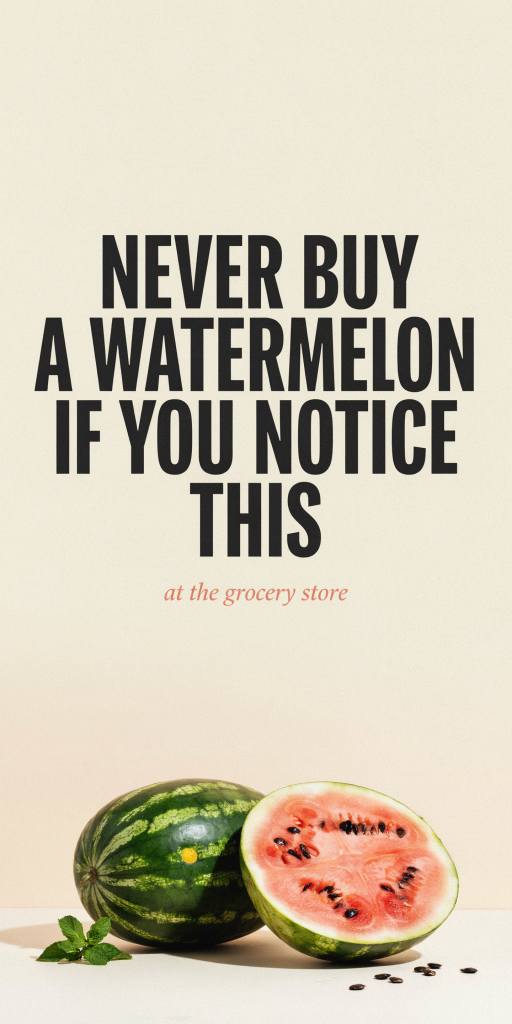
Never Buy a Watermelon if You Notice This at the Grocery Store
Watermelon looks the same on the outside whether it’s perfectly ripe or completely flavorless. That’s the problem. Most people grab one based on size or gut feel, get it home, cut it open, and find pale, watery flesh with no sweetness at all.
The good news is that a ripe, flavorful watermelon leaves behind several clear signals — and so does a bad one. You just have to know what to look for.
The Field Spot Is the First Thing to Check
Flip the watermelon over. On the underside, there should be a creamy yellow or orange-yellow patch where the melon rested on the ground while it ripened in the sun.
- Deep yellow or orange-yellow — the watermelon had time to fully ripen. This is what you want.
- White or pale yellow — it was picked too early. The flesh inside will be bland and lacking sweetness.
- No field spot at all — it likely never touched the ground long enough to ripen properly, or it was picked prematurely.
This is the single most reliable indicator of a good watermelon, and most shoppers never even turn it over.
The Webbing Tells You Something Too
Look for patches of brown, rough webbing on the outer skin — it almost looks like scarring. Counterintuitively, more webbing is a good sign. It indicates that bees pollinated the flower repeatedly, which leads to a sweeter fruit inside.
A smooth, unblemished watermelon with no webbing at all is often less sweet than one that looks a little rough on the surface.
Check the Shape — Uniformity Matters
A ripe watermelon should be symmetrical and uniform in shape — round melons should be round, oblong ones should be consistently oblong with no lumps or irregular bumps.
Irregular shapes can indicate uneven water distribution during growth, which affects both texture and flavor. Flat sides or obvious deformities are worth noting, though they aren’t automatic dealbreakers on their own.
The Dull Surface Is What You Want
A shiny watermelon skin is actually a red flag. When a watermelon is ripe and ready, its surface has a matte, dull finish. A bright, shiny exterior usually means it was picked before it was ready.
This one catches people off guard because we instinctively associate shiny produce with freshness. With watermelons, it works the opposite way.
The Tail Tells You If It Sat Long Enough
If the watermelon still has its stem attached — the little dried curly tail at one end — check whether it’s completely dried out and brown.
- Dry, brown, and shriveled — the watermelon was left on the vine long enough to fully ripen before harvest. Good sign.
- Green or still moist-looking — it was cut from the vine too early.
No stem at all makes this check impossible, but the field spot and surface tests still apply.
The Red Flags to Walk Away From
Regardless of anything else, put it back if you see:
- A fully white or absent field spot
- Shiny, almost waxy-looking skin
- Soft spots or areas that give under light pressure
- Visible cracks or splits near the stem end
- A green or undried stem
Any one of these alone isn’t necessarily a dealbreaker, but two or more in combination means the watermelon is either underripe, overripe, or structurally compromised inside.
The Knock Test — Use It Last, Not First
You’ve probably heard that you should knock on a watermelon and listen for a hollow sound. This method works, but it’s the least reliable of everything listed here and takes practice to calibrate correctly.
A ripe watermelon does produce a deep, hollow thud rather than a dull, dense thump. But the difference is subtle, and it varies by size and thickness of the rind. Use it as a secondary confirmation after you’ve already checked the field spot, surface, and stem — not as your primary test.
The Bottom Line
The field spot check takes five seconds and costs you nothing. Flip it over before you commit. Back that up with a quick look at the surface finish, the webbing, and the stem, and you’ll bring home a watermelon that’s actually worth cutting open.

