Eat 150g of Protein Without Counting Every Gram—Here’s the Simple Formula
Eating 150 grams of protein a day can feel intimidating if you imagine tallying every gram at every meal. But what if you could hit that target reliably using a simple, repeatable formula and common visual cues—no obsessive counting required? In this post I’ll walk you through an easy-to-follow system, practical meal-building strategies, sample day templates, and a set of recipes and meal ideas (with ingredients and step-by-step instructions) so you can implement this plan starting today. Friendly, realistic, and science-minded—this is the way to make high protein easy and sustainable.
Why aim for 150 g of protein?
High protein intakes are beneficial for many people:
– Support muscle growth and repair (important with exercise).
– Preserve lean mass during weight loss.
– Increase satiety and help regulate appetite.
– Support recovery, strength, and metabolic health.
150 g is a commonly used target for active people, those building muscle, or individuals who need higher protein for satiety and metabolism. Whether you’re strength training, managing body composition, or simply want to feel fuller between meals, 150 g is an achievable, practical goal when you plan smartly.
The simple formula (so you don’t count every gram)
Here is the simple formula that replaces gram-by-gram math:
- Pick a portion unit you can eyeball: a palm-sized portion of cooked lean protein ≈ 25–30 g protein.
- Aim for 5–6 palm-sized protein portions per day to reach roughly 125–180 g (most people will center around 150 g).
- If you rely more on plant proteins, add one extra palm portion or a cupped-hand scoop (legumes, grains, tofu) because plant sources often contain slightly less protein per volume.
In short:
– 6 palm-sized portions of protein ≈ 150 g (give or take), OR
– 4 palm portions + 2 protein-dense snacks (e.g., Greek yogurt, whey, tuna) ≈ 150 g.
This converts precise counting into a repeatable, visual habit: see a palm-sized piece of protein, you’ve scored one portion.
Palm, fist, and thumb guides (visual cues)
- Palm of hand (cooked lean meat, fish, tofu): ~25–30 g
- Fist (cooked beans, rice, quinoa): ~12–20 g depending on food
- 1/2 cup Greek yogurt or cottage cheese: ~10–20 g (varies by brand)
- 1 large egg: ~6–7 g
- 1 scoop whey protein: ~20–25 g
Use your own hand as a measuring tool—accurate enough for daily practical use and fast.
How to build meals that hit the target without counting
Here are practical strategies to translate the formula into your day:
- Breakfast: Include one palm portion + one small protein boost (e.g., Greek yogurt or eggs).
- Lunch and dinner: Each should include 1–2 palm portions (or one palm + hearty plant protein).
- Snacks: Make them protein-dense—Greek yogurt, cottage cheese, protein shake, or a tuna packet.
- If you favor plant-based proteins, plan an extra palm portion or combine multiple plant sources within meals (e.g., beans + quinoa).
Meal frequency options (pick one that fits you)
- 3 meals: Aim for ~40–50 g protein per meal (two palm portions + a protein snack or shake).
- 4 meals/snacks: Aim for ~30–40 g per sitting (one palm + a dense snack).
- 6 smaller meals/snacks: Aim for ~25 g each (one palm-sized portion).
Choose whichever fits your schedule; the visual portion approach keeps it simple.
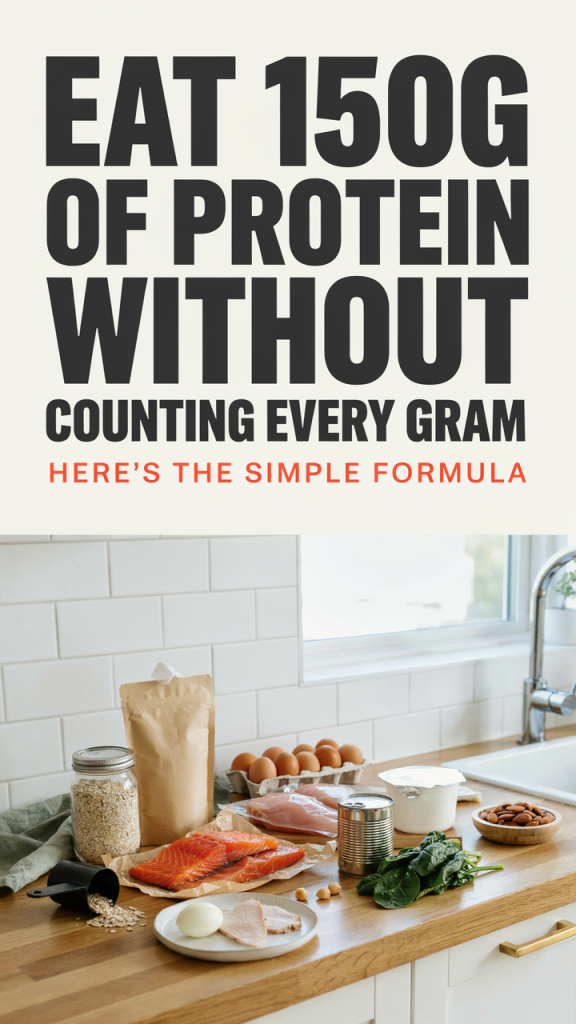
High-protein staples to keep on hand
Make these part of your routine so assembling protein-rich meals becomes automatic:
– Cooked chicken breast, turkey, lean beef
– Canned tuna or salmon packets
– Greek yogurt, cottage cheese
– Eggs and egg whites
– Whey, casein, or plant-based protein powder
– Tofu, tempeh, edamame
– Lentils, chickpeas, black beans
– Quinoa and high-protein grains
– Nuts and seeds (in moderation)
– Cheese slices and slices of cold cuts (low-sugar, minimally processed)
Sample day templates (no gram counting required)
Below are three sample days that use the palm-and-snack formula. Each meal idea below includes a short ingredients list and instructions so you can recreate them easily.
Sample Day A — Simple 3-Meal Focus
Breakfast
– Ingredients:
– 3 eggs
– 1 cup Greek yogurt
– 1/2 cup berries
– 1 tablespoon chia seeds
– Instructions:
1. Scramble or fry the eggs in a non-stick pan.
2. Serve eggs with a bowl of Greek yogurt topped with berries and chia seeds.
3. Eat both—the eggs are one palm portion, yogurt is a protein boost.
Lunch
– Ingredients:
– 1 palm-sized cooked chicken breast (sliced)
– Large salad greens (mixed)
– 1/2 cup cooked quinoa
– Olive oil and vinegar
– Instructions:
1. Toss the greens and quinoa in a bowl.
2. Top with sliced chicken and dressing.
3. The chicken provides one-to-two palm portions, quinoa adds plant protein.
Dinner
– Ingredients:
– 1 palm-sized salmon fillet (cooked)
– Steamed broccoli
– 1 sweet potato
– Instructions:
1. Bake or pan-sear salmon until cooked through.
2. Steam broccoli and roast or microwave the sweet potato.
3. Plate and enjoy—salmon is a dense protein portion.
Sample Day B — 4-Meal Balanced
Breakfast
– Ingredients:
– 1 scoop whey protein
– 1 banana
– 1 tablespoon nut butter
– 1 cup almond milk
– Instructions:
1. Blend whey, banana, nut butter, and milk until smooth.
2. Drink as a protein-rich breakfast.
Midday Snack
– Ingredients:
– 1 container (170 g) Greek yogurt
– 1 tablespoon honey
– Instructions:
1. Spoon yogurt into a bowl, drizzle honey.
2. Enjoy.
Lunch
– Ingredients:
– 1 palm-sized turkey sandwich (2 slices whole-grain bread, turkey slices)
– Leafy greens, tomato
– Instructions:
1. Assemble sandwich with turkey and veggies.
2. Eat with a side salad for extra volume.
Dinner
– Ingredients:
– 1 palm-sized lean steak or tofu steak
– Roasted vegetables
– 1/2 cup cooked farro
– Instructions:
1. Grill or sear steak/tofu.
2. Serve with roasted vegetables and farro.
Sample Day C — On-the-go with Snacks
Breakfast
– Ingredients:
– Overnight oats: 1/2 cup oats, 1/2 cup Greek yogurt, 1/2 cup milk
– 1 tablespoon almond butter
– Instructions:
1. Combine oats, yogurt, and milk in a jar.
2. Stir in almond butter and refrigerate overnight.
Snack
– Ingredients:
– 1 can tuna in water
– 6 whole-grain crackers or cucumber slices
– Instructions:
1. Open tuna, mix with a dash of lemon and pepper.
2. Eat with crackers or cucumber slices.
Lunch
– Ingredients:
– 1 palm-sized chicken wrap (whole-wheat tortilla, sliced chicken)
– Mixed greens and salsa
– Instructions:
1. Fill tortilla with chicken and greens.
2. Roll and eat on the go.
Dinner
– Ingredients:
– Stir-fry: 1 palm-sized shrimp or tofu portion, mixed vegetables, 1/2 cup cooked brown rice
– Instructions:
1. Stir-fry protein and vegetables with a splash of soy sauce.
2. Serve over rice.
Recipes & Meal Ideas (explicitly listed with ingredients and steps)
Below are practical recipes and full meal ideas you can use weekly. Each is presented with ingredients (bulleted) and instructions (numbered).
1) High-Protein Berry Yogurt Bowl
- Ingredients:
- 1 cup full-fat or low-fat Greek yogurt
- 1/2 cup mixed berries
- 1 tablespoon chia seeds
- 1 tablespoon sliced almonds
- Optional: a drizzle of honey
- Instructions:
- Spoon Greek yogurt into a bowl.
- Top with berries, chia seeds, and almonds.
- Drizzle honey if desired and enjoy.
2) Tuna-Quinoa Power Bowl
- Ingredients:
- 1 can (120–150 g) tuna in water, drained
- 1 cup cooked quinoa
- 1 cup mixed greens
- 1/2 cup cherry tomatoes, halved
- 1 tablespoon olive oil
- Lemon juice, salt, pepper
- Instructions:
- Combine quinoa and mixed greens in a bowl.
- Flake tuna over the top and add tomatoes.
- Drizzle olive oil and lemon, season to taste, and toss.
3) Simple Chicken Stir-Fry (saves time)
- Ingredients:
- 1 palm-sized boneless skinless chicken breast, sliced
- 2 cups mixed stir-fry vegetables (fresh or frozen)
- 1 tablespoon sesame oil
- 1–2 tablespoons low-sodium soy sauce
- 1/2 cup cooked brown rice
- Instructions:
- Heat sesame oil in a pan; add chicken and cook until browned.
- Add vegetables and soy sauce; stir-fry until vegetables are tender.
- Serve over brown rice.
4) Lentil + Egg Savory Bowl (vegetarian)
- Ingredients:
- 1 cup cooked lentils
- 2 large eggs
- 1/2 avocado, sliced
- 1 tablespoon olive oil
- Salt, pepper, and smoked paprika
- Instructions:
- Warm lentils in a saucepan with olive oil and seasonings.
- Fry or poach two eggs.
- Serve eggs over lentils, top with avocado slices.
5) Protein Smoothie (quick, portable)
- Ingredients:
- 1 scoop protein powder (whey or plant-based)
- 1 cup milk or milk alternative
- 1/2 cup frozen berries
- 1 tablespoon nut butter
- Ice cubes (optional)
- Instructions:
- Combine all ingredients in a blender.
- Blend until smooth and drink immediately.
6) Cottage Cheese Snack Jar
- Ingredients:
- 1 cup cottage cheese
- 1/4 cup chopped cucumber
- 1/4 cup cherry tomatoes, halved
- 1 tablespoon chopped herbs (dill or chives)
- Salt and pepper
- Instructions:
- Spoon cottage cheese into a jar or bowl.
- Top with cucumber, tomatoes, and herbs; season to taste.
- Refrigerate until ready to eat.
7) Black Bean & Chicken Burrito Bowl
- Ingredients:
- 1 palm-sized cooked chicken breast, sliced
- 1/2 cup canned black beans, rinsed
- 1/2 cup cooked brown rice
- Salsa, lettuce, and a squeeze of lime
- Instructions:
- Layer rice, beans, and chicken in a bowl.
- Top with salsa and lettuce. Squeeze lime over everything and eat.
8) Tofu & Edamame Stir Bowl (vegan)
- Ingredients:
- 1 palm-sized firm tofu, cubed
- 1/2 cup shelled edamame (cooked)
- 2 cups mixed greens or steamed vegetables
- 1 tablespoon soy sauce
- Instructions:
- Pan-fry tofu until golden, add soy sauce.
- Stir in edamame and steamed vegetables.
- Serve warm.
9) Steak & Veg Plate (earlier dinner)
- Ingredients:
- 1 palm-sized lean steak (sirloin or flank)
- 1 cup roasted Brussels sprouts
- 1 small baked potato
- Instructions:
- Season and grill or pan-sear steak to desired doneness.
- Roast Brussels sprouts in the oven until caramelized.
- Bake potato until tender and serve together.
Each of these quick recipes/ideas follows the palm-portion logic: one main protein source per plate plus supporting protein-dense components. Use them interchangeably to keep variety while staying on target.
Batch-cooking and prepping tips to simplify hitting 150 g
- Cook chicken breasts, lean ground turkey, or tofu in bulk once or twice per week.
- Portion into palm-sized containers so grabbing a portion is automatic.
- Pre-cook beans and grains and store in separate containers to mix-and-match.
- Pre-portion yogurt, cottage cheese, and snack packets of tuna for quick protein boosts.
- Use frozen shrimp, edamame, and mixed vegetables to accelerate meal assembly.
Troubleshooting common issues
- Low appetite? Spread protein across more meals and prioritize liquid or soft proteins (smoothies, yogurts).
- Vegetarian/vegan: double up on plant protein combinations (tofu + edamame, lentils + quinoa) and consider a plant protein powder.
- Boredom with flavors: rotate sauces and herbs (chimichurri, salsa, tahini, soy-ginger) to keep meals appealing.
- Cost concerns: canned tuna, eggs, legumes, and frozen chicken are affordable protein options.
Final tips: making it stick
- Start Monday with a simple plan: prepare two palm-sized protein portions (e.g., two cooked chicken breasts) and a few snack containers of Greek yogurt.
- Use the palm rule daily. If you can visualize 6 palm portions across your day, you’ll land near 150 g without logging a single gram.
- Keep one “emergency” protein snack (protein bar, a pouch of salmon, or a small protein shake) in your bag for busy days.
- Track your habits for a week: note how many palm portions you consume rather than grams. Adjust if you consistently fall short.
Conclusion
Hitting 150 g of protein a day doesn’t require spreadsheets, food scales, or obsessive counting. Use the palm-sized portion method, aim for 5–6 visual protein portions per day, and choose convenient protein-dense snacks to fill gaps. Plan meals around one clear protein component, batch-cook to reduce friction, and rotate simple recipes—like the ones above—to stay satisfied and consistent. With a little routine and the simple formula you learned here, 150 g becomes achievable, sustainable, and even enjoyable. Start today: pick a sample day, prepare a few palm portions, and see how effortless high-protein eating can be.