If Your Grocery Store Does This With the Produce, Walk Away
Most people evaluate the grocery store they shop at based on price, location, and how long the checkout lines run. Almost nobody looks at the produce section as a diagnostic tool.
They should.
The way a grocery store handles its produce tells you more about that store’s overall standards than almost anything else on the floor. Produce is perishable, high-maintenance, and easy to cut corners on in ways that aren’t immediately obvious to the average shopper. A store that does it right tends to do everything else right. A store that cuts corners here is cutting corners elsewhere too.
Here’s what to look for — and what to walk away from.
They Mist the Produce Constantly but Never Rotate It
Water misters over the vegetable display look like freshness. They are not always freshness.
Misting is a legitimate practice for keeping leafy greens and certain vegetables from wilting under store lighting and dry air. Done correctly, it works fine. Done as a substitute for actually rotating stock, it’s a way of making old produce look hydrated and appealing while it slowly deteriorates underneath.
The tell is what happens at the bottom of the display. If a store is misting without rotating, the produce at the bottom and back of the pile has been sitting in accumulated cold water, getting waterlogged, developing soft spots, and beginning to mold — while the top layer looks dewy and fresh.
Pull something from the middle or bottom of a misted display. If it’s significantly softer, darker, or wetter than the top layer, the store is using the misters to mask age rather than preserve quality.
The Produce Is Displayed Under Warm or Colored Lighting
Walk up to the produce section and pay attention to the lighting directly over the display.
Many grocery stores use warm-toned or colored lighting over produce — slightly yellow, slightly rosy — because it makes everything look more vibrant and appealing. Tomatoes look redder. Peaches look warmer. Greens look more saturated.
It also makes it significantly harder to spot yellowing, browning, and other signs of age that would be obvious under neutral light.
A store using heavily colored lighting over produce is not doing it for your benefit. It is doing it because it sells more produce that would otherwise sit or get pulled. If you notice the colors in the produce section look noticeably richer and more saturated than they do once you get the items into natural light or under the white fluorescents in the rest of the store, that’s the lighting working against you.
They Trim and Repackage Old Produce Without Marking It Down
This one is common and almost never talked about.
When produce starts to turn, a responsible store pulls it from the display, discounts it clearly, and moves it to a markdown section. Some stores do this consistently and honestly — you’ll find a bin of bananas with brown spots priced at thirty cents, or a bag of slightly soft apples marked down for quick sale.
Other stores trim the bad parts off, repackage what’s left, and put it back on the shelf at full price with a new sticker date.
This is most common with bell peppers, mushrooms, lettuce, and pre-packaged salad mixes. Watch for produce in packaging that looks slightly off — a container that’s more full than usual, a bag that’s been resealed, a sticker that doesn’t match the format of the other labels in that section. These are signs of repackaging.
It’s also worth noting: when you see a markdown bin, that’s actually a good sign. It means the store is being transparent about age rather than hiding it. A store with no markdown produce at all either has extraordinary turnover — possible but rare — or is doing something else with the product that’s turning.
The Display Is Packed Too Tight
A produce display that’s stacked high and packed dense looks abundant. It’s also a red flag.
Overpacking causes bruising throughout the pile as the weight of the top layers presses down on everything beneath. It traps heat and moisture between items, accelerating mold and decay. And it makes proper rotation nearly impossible — staff can’t easily pull old product from the bottom without dismantling the whole display, so they don’t.
Compare this to a well-run produce section where items have some room, displays aren’t stacked past a reasonable height, and you can actually see and access individual pieces without digging. That’s not a store with less product — that’s a store managing its produce the way produce is supposed to be managed.
If the apple display is a four-foot pyramid and you have to excavate to find one that isn’t bruised from the pressure of everything above it, the display itself is the problem.
Pre-Cut Produce Sits Too Long in Open Containers
Pre-cut fruit and vegetables — melon chunks, pineapple spears, sliced peppers, salad bar items — should be treated with significantly more scrutiny than whole produce.
Once the skin is broken, the clock accelerates. Cut surfaces oxidize, moisture escapes, and bacteria have direct access to the flesh. A whole watermelon sitting in a warm display is a problem. A tray of pre-cut watermelon chunks sitting in the same conditions is a significantly larger one.
Look for:
- Liquid pooling in the bottom of the container — the fruit is breaking down and weeping moisture
- Dried or darkened edges on cut surfaces — the product has been sitting long enough to desiccate
- Any off smell when you lean close — fermentation starts quickly on cut fruit and is obvious once it begins
- Lids that are fogged or have heavy condensation — a sign of temperature mismanagement
A well-run store keeps pre-cut produce consistently cold, rotates it frequently, and pulls it well before it reaches the visual warning signs above. If the pre-cut section looks like it’s been sitting since this morning and nobody has touched it, that’s a store that treats prepared produce as an afterthought.
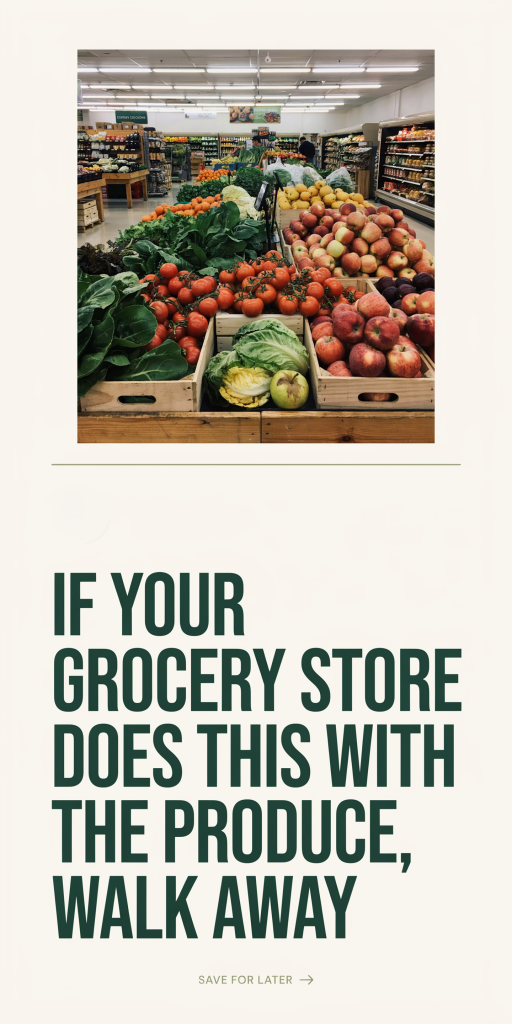
There Is No Clear Separation Between Old and New Stock
Watch what happens when a store employee restocks a produce display.
The correct method is straightforward: pull the older product forward, put the new product in the back, so customers naturally reach the older items first and nothing gets buried indefinitely. It’s called rotation, and it’s basic produce management.
Some stores skip it entirely. New product goes directly on top of or in front of old product. The old product gets pushed to the back or bottom where it sits until it’s unsalable. You end up reaching for what looks fresh — the new product on top — while perfectly good older product goes to waste underneath, or worse, the old product is what you’re grabbing because it’s at the front and the new delivery is already stacked behind it.
You can sometimes catch this by looking at the variance within a single display. If some of the apples look noticeably fresher and firmer than others in the same bin, there’s a rotation problem. A properly managed display should be relatively uniform because old and new product are being cycled through honestly.
The Markdown Bin Is a Dumping Ground, Not a Discount Section
A markdown bin done right is a genuine service. Produce that’s a day or two from its peak, priced honestly, clearly labeled — that’s a store treating its customers like adults and giving them the option to use something quickly at a fair price.
A markdown bin done wrong is where produce goes to die.
If the markdown section of a store is consistently full of items that are already well past usable — soft beyond saving, moldy, split, or fermented — the store is using it as a delay tactic rather than an honest discount practice. Instead of pulling and disposing of unsalable product, they’re moving it to the bin and leaving the decision to the customer.
The markdown bin should have produce that is visibly slightly past prime but still entirely usable. If what’s in there is already garbage, the store’s threshold for what leaves the main display is set too high.
The Produce Section Smells Off
This one is simple and often overlooked because people don’t think of smell as a store-evaluation tool.
A well-managed produce section has a clean, fresh, faintly earthy smell — the natural fragrance of fresh vegetables and fruit. It should not smell like anything in particular, other than generically fresh.
A produce section with stock management problems smells different. There’s an undertone — faintly sweet in a fermenting way, or damp and musty, or vaguely like compost. It’s not always strong, but once you’re paying attention to it you’ll notice it immediately in stores that have a problem.
The smell is coming from product that’s turning somewhere in the display, in the stock room, or in the drains under the display cases. A store that lets enough produce deteriorate to create an ambient smell in the section has a systemic problem, not an occasional one.
What a Well-Run Produce Section Actually Looks Like
For contrast, here’s what you’re looking for in a store that takes this seriously:
Displays that aren’t overpacked, with product that has room to breathe. Rotation that’s visibly happening — you’ll sometimes catch staff pulling old product forward or restocking from the back. A markdown section that has genuinely usable product priced honestly. Pre-cut produce that’s cold, fresh-smelling, and not sitting in liquid. Neutral lighting that doesn’t make everything look artificially vibrant. A section that smells clean.
None of this is complicated. It’s just basic standards applied consistently, and the stores that do it tend to be the same stores where the meat counter, the deli, and the prepared food section are also managed well.
The Bottom Line
The produce section is the easiest place in a grocery store to evaluate how that store actually operates. You don’t need to check the back of house or talk to anyone — just walk in, look at the displays, smell the air, and watch how the staff handles restocking.
A store that manages produce honestly is a store that has standards. A store that uses lighting tricks, skips rotation, and lets the markdown bin fill with garbage is telling you exactly what it thinks of the people shopping there.