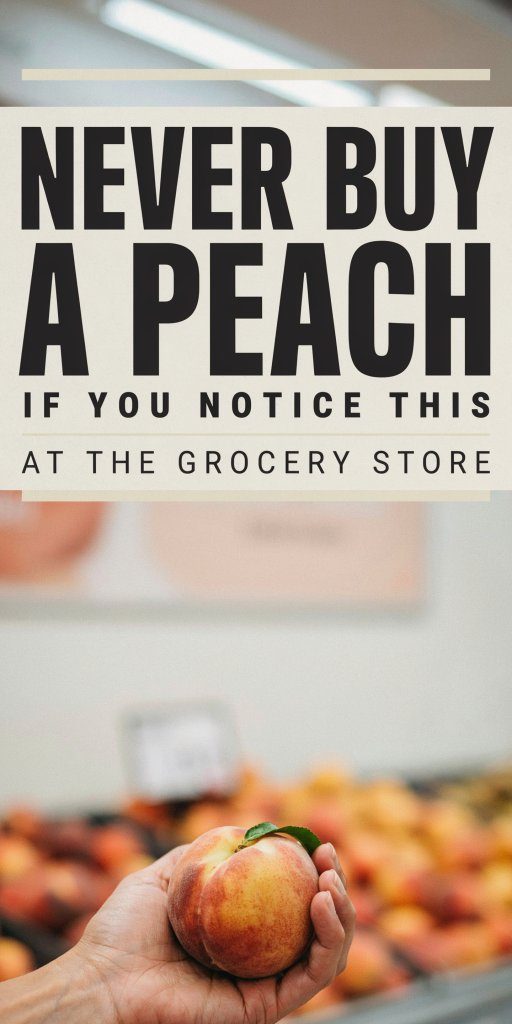
Never Buy a Peach if You Notice This at the Grocery Store
Peaches have one of the shortest windows of any fruit in the grocery store. Buy them at the wrong stage and you’re either waiting days for something edible or throwing away mush by Thursday. Buy them right and you have two or three days of some of the best fruit of the summer.
The problem is that most grocery store peaches are picked hard for shipping, which means the ones on display have a wide range of ripeness packed into what looks like a uniform pile. Here’s how to sort through it.
Start With the Smell — This One Matters More Than Anything
A ripe peach announces itself. If you walk up to the display and can smell peaches from a foot away, that’s a good sign the batch is at or near peak ripeness.
Pick one up and smell it at the stem end, the same way you would a mango. A ripe peach has a deep, sweet, floral fragrance that is unmistakably peachy. It shouldn’t be subtle.
- Strong, sweet fragrance — ripe and ready, or very close
- Faint smell — not quite there yet, needs a day or two on the counter
- No smell at all — picked too early, likely never developed the sugar content needed for real flavor
- Fermented or overly sweet in a cloying way — already past peak and breaking down inside
A peach with no fragrance is one of the most reliable disappointments in the produce section. No matter how good it looks, the smell test doesn’t lie. If you can’t smell it, don’t buy it expecting flavor.
The Squeeze — Gentle and Deliberate
Use your palm, not your fingertips. Fingertip pressure bruises peaches almost instantly, and a bruised peach deteriorates from that spot faster than you’d think.
Cup the peach in your hand and apply light, even pressure.
- Firm but with just a little give near the stem end — ideal for buying now and eating in one to two days
- Rock solid all over — underripe, will need three or more days to develop, and may never reach full flavor if it was picked too early
- Soft and giving all over — ripe right now, eat today or tomorrow
- Mushy in any spot — that area is already breaking down. Even if the rest feels fine, don’t buy it.
The stem end softens first on a peach. If the fruit gives slightly there but is still firm at the shoulders and bottom, it’s in a good buying window.
Color: What It Can and Can’t Tell You
Peach color is more useful than mango color but still needs to be read carefully.
The background color — not the red blush — is what matters. Look past the dramatic red and pink tones and find the underlying ground color of the skin.
- Creamy yellow or golden ground color — ripening properly, good sign
- Green ground color — underripe, picked too early
- Fully red with no visible ground color — the blush is a sun exposure indicator, not a ripeness indicator. A peach can be fully red and completely unripe.
The red blush that makes peaches look appealing in the display tells you how much sun that side of the fruit received on the tree. It has almost nothing to do with how sweet or ripe the peach is. Growers and shippers know this looks good to consumers, which is why the reddest side always faces up in the display.
Look at the less photogenic side of the peach — the ground color there is more honest.
Check the Skin for Wrinkling
Like mangoes, peaches show their age in the skin. A fresh, well-conditioned peach has taut, smooth skin. As it ages past peak or loses moisture, the skin begins to pucker and pull slightly, particularly around the stem end and along the crease.
Light wrinkling near the stem can be acceptable if the fragrance is still clean and strong — it just means the peach is very ripe and needs to be used today. Wrinkling across the whole surface is a sign the fruit has been sitting too long and is declining rather than ripening.
The Stem End Dimple
Look at the small indentation at the stem end of the peach. On a well-ripened peach it looks slightly open, settled, and natural. On an underripe peach it often looks tight, green-tinged, or closed.
This is a minor check compared to smell and squeeze, but combined with the other signals it adds useful confirmation. A green or very tight stem dimple on an otherwise firm, scentless peach is a strong signal it was picked too early.
Watch the Crease
Every peach has a natural seam running from stem to base. Run your thumb lightly along it.
If the crease area is significantly softer than the rest of the peach, the fruit is ripening unevenly — common in peaches that spent too long in cold storage. The flesh along the seam breaks down first, which means you’ll cut into what looks like a decent peach and find a soft, discolored streak running through the center.
A peach that feels uniformly firm or uniformly giving is better than one where the crease is dramatically softer than the surrounding flesh.
The Red Flags to Walk Away From
Put it back if you notice:
- No fragrance whatsoever, regardless of how good it looks
- A green ground color under the blush
- Soft or mushy spots anywhere on the surface
- Heavy wrinkling across most of the skin
- A fermented or off smell at the stem end
- Visible mold at the stem dimple or crease
- A crease that’s dramatically softer than the rest of the fruit
The Grocery Store Problem With Peaches Specifically
It’s worth being honest about something: grocery store peaches are structurally compromised compared to what a peach can actually be.
Most commercial peaches are picked at hard maturity — firm enough to survive the handling, packing, and transport process — and then ripened off the vine. A peach that ripens on the tree develops sugars and aromatics in a way that a picked-early peach never fully replicates, no matter how long it sits on your counter.
This doesn’t mean grocery store peaches are a lost cause. It means your expectations should be calibrated, and it means the smell test becomes even more important — a peach that developed real fragrance despite being picked early is a better specimen than most.
If you have access to a farmers market during peak peach season, that’s where tree-ripened peaches show up. The difference in flavor is significant enough that it’s worth planning around.
How to Ripen Them at Home
If you bought firm peaches, leave them stem-side down at room temperature. Stem-side down reduces bruising on the most delicate part of the fruit and helps them ripen more evenly.
A paper bag speeds things up — add a banana or apple to introduce ethylene gas if you want to accelerate further.
Once they give to gentle pressure and smell right, move them to the refrigerator. Eat them within a day or two of refrigerating — cold storage buys time but doesn’t improve a peach, and the texture starts to suffer after a few days in the cold.
Never refrigerate a peach that hasn’t ripened yet. Cold temperatures halt the process and can cause the flesh to develop a mealy, cottony texture it will not recover from — a condition called chilling injury that is irreversible once it sets in.
The Bottom Line
Smell it first. If there’s nothing there, move on. If it smells right, squeeze gently with your palm, check the ground color under the blush, and look at the skin for wrinkling. A peach that passes all four checks is as good a guarantee as the grocery store can offer. One that fails the smell test isn’t worth buying regardless of everything else.