10 Nerve And Brain Signs Of B12 Deficiency You Might Miss — What To Watch For
Vitamin B12 often flies under the radar until symptoms become unmistakable. Yet many people, especially older adults, people on restrictive diets, and those with GI conditions, develop subtle nerve and brain signs long before a diagnosis is made. In this guide we’ll walk through the neurological and neuropsychiatric warning signs of B12 deficiency that commonly get missed, why they happen, and when to push for testing or specialist referral in 2026. We’ll use practical examples, explain how symptoms evolve, and give clear signals that should prompt action. Our goal is to help you recognize red flags early so you and your clinician can prevent irreversible nerve damage and cognitive decline.
How Vitamin B12 Affects The Nervous System And Brain Function
Vitamin B12 (cobalamin) is a linchpin nutrient for several neural processes. At a biochemical level B12 is essential for DNA synthesis, myelin formation, and methylation reactions that regulate neurotransmitter production and neuronal repair. When B12 is low, these systems falter: myelin sheaths thin or degenerate, slowing nerve conduction and increasing vulnerability to injury: methylation deficits alter levels of serotonin, dopamine, and norepinephrine: and homocysteine rises, which is linked to vascular and neurotoxic effects.
Clinically, those changes translate into two overlapping phenotypes: peripheral nervous system dysfunction (paresthesias, loss of vibration/position sense, neuropathic pain) and central nervous system involvement (cognitive slowing, mood changes, gait instability). The pattern and tempo depend on severity and duration. Acute severe deficiency may produce rapid neurologic decline, but most people experience a gradual, insidious onset that’s easier to miss.
Risk factors we often see include pernicious anemia (autoimmune loss of intrinsic factor), gastric surgery or atrophic gastritis, long-term use of proton pump inhibitors or metformin, strict vegan diets without supplementation, and malabsorptive conditions like celiac disease. Age matters: gastric acid production and absorption capability drop with age, making older adults particularly susceptible.
Understanding these mechanisms helps explain why early recognition matters. Myelin loss can become irreversible if deficiency persists. That’s why recognizing the early nerve and brain signs of B12 deficiency, and acting on them, is one of the most preventable ways to avoid chronic neurologic disability.
Numbness, Tingling, And Altered Sensation In Hands And Feet
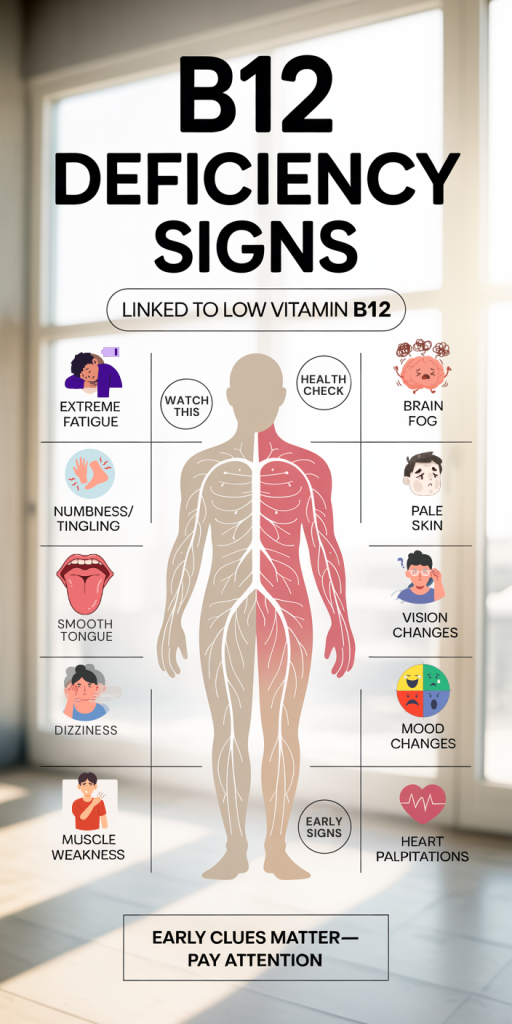
One of the most common and often first-noticed signs of B12 deficiency is altered peripheral sensation. Patients frequently describe numbness, pins-and-needles, burning, or “crawling” sensations that start in the toes and fingers and slowly move inward, a classic stocking-and-glove distribution. Early on these sensations can be intermittent and mild, so they’re easy to dismiss as poor circulation, repetitive strain, or simply aging.
On exam we often find decreased vibration and position sense in the feet, reduced ankle reflexes, and an impaired ability to detect light touch. These findings reflect degeneration of the dorsal columns and large sensory fibers, structures that depend heavily on intact myelin. Small-fiber neuropathy (sharp burning pain, temperature dysregulation) can also occur, but large-fiber involvement is a hallmark when B12 is the primary culprit.
Why do we miss this? Symptoms can be asymmetric, vague, or attributed to more familiar conditions (diabetes, lumbar spine disease). Patients may also normalize gradual loss of sensation. Importantly, sensory loss increases fall risk and decreases manual dexterity: a patient who says they “can’t feel the edge of a stair” or who drops objects repeatedly should trigger us to consider B12 testing.
Practical tip: If sensory symptoms are present alongside risk factors (e.g., metformin use, vegan diet, gastric surgery), order serum B12 and related tests (methylmalonic acid [MMA] and homocysteine) rather than assuming a peripheral neuropathy of another cause. Early replacement often reverses paresthesia and sensory deficits, but prolonged deficiency can leave residual numbness or neuropathic pain.
Balance, Gait Changes, And Difficulty With Coordination
Gait disturbance and impaired coordination are frequent but underappreciated manifestations of B12 deficiency. Damage to the dorsal columns and corticospinal tracts, structures responsible for proprioception and motor control, produces a sensory ataxia that commonly presents as unsteady walking, a wide-based gait, or difficulty in heel-to-toe walking.
Patients often report tripping more, feeling unsteady in low-light conditions, or noticing that their legs feel “wobbly.” On neurological testing we’ll see a positive Romberg sign (worsening balance with eyes closed), reduced joint position sense at the toes, and sometimes spasticity or hyperreflexia if corticospinal tracts are involved. These signs distinguish B12-related ataxia from purely vestibular disorders where vertigo and nystagmus dominate.
Clinically, gait changes have outsized importance because they bear directly on safety and independence. Falls due to untreated B12 deficiency can lead to fractures and loss of mobility. Unfortunately, clinicians sometimes misattribute balance changes to osteoarthritis, peripheral neuropathy from diabetes, or normal aging, delaying diagnosis.
We recommend targeted screening in patients who develop new unsteadiness, particularly when accompanied by sensory symptoms or cognitive changes. If testing confirms deficiency, timely B12 repletion often improves coordination and reduces fall risk: but, the longer the deficiency continues, the less complete the recovery. Pairing B12 therapy with physical therapy focused on balance and proprioception speeds functional gains and reduces lingering disability.
Cognitive Changes: Memory Loss, Confusion, And Brain Fog
Cognitive symptoms from B12 deficiency range from subtle ‘brain fog’ to frank memory impairment and confusion. Our patients commonly describe difficulty concentrating, slower thinking, trouble finding words, or an inability to follow conversations, changes that can be mistaken for stress, sleep problems, or early dementia. The cognitive profile is often mixed: processing speed and executive function are affected early, while memory and attention problems become more prominent with progression.
At a neural level, impaired methylation and elevated homocysteine can harm white matter integrity and cerebral vasculature, contributing to cognitive slowing and increased risk of vascular injury. Neuroimaging in prolonged deficiency may show diffuse white matter changes: clinically, these correlate with slower mental processing and reduced multitasking ability.
Because cognitive complaints are common in primary care and geriatric settings, differentiating B12-related cognitive issues from other causes is critical, and possible, if we know what to look for. We discuss early detection, differential clues, and thresholds for referral below. But the key practical point: always include B12 (and MMA/homocysteine when needed) in the workup of new cognitive symptoms, especially when risk factors are present or when neurological signs coexist.
Early Signs Of Cognitive Decline To Spot At Home
There are subtle cognitive changes family members or caregivers can spot before formal testing. Watch for:
- Increasing difficulty managing finances or following recipes that were previously routine.
- Repeatedly misplacing items or forgetting recent conversations while older memories remain intact.
- Trouble following TV plots, reading comprehension declines, or asking the same question multiple times.
- Noticeable decline in multitasking, getting lost when trying to complete two steps at once.
- Changes in sleep-wake rhythm or daytime somnolence that interferes with attention.
These early signs aren’t diagnostic on their own, but when paired with physical symptoms like numbness or gait disturbance they raise suspicion for a neurologic contributor such as B12 deficiency. We encourage caregivers to document examples (dates, frequency) to present to clinicians, concrete evidence helps prompt appropriate lab work and quicker intervention.
Simple bedside checks we use include clock-drawing and brief recall tasks: poor performance combined with neurological signs should trigger serum B12 and MMA testing. Because cognitive impairment from B12 deficiency can partially reverse with treatment, particularly if caught early, these home observations matter.
Mood And Psychiatric Symptoms: Depression, Irritability, And Personality Change
Psychiatric and mood disturbances are frequently overlooked manifestations of B12 deficiency. Patients can present primarily with symptoms of depression, heightened irritability, apathy, or even acute behavioral change, without obvious neurologic deficits. Because these presentations are often evaluated by mental health professionals, B12 deficiency can be missed unless we screen for metabolic causes.
From a pathophysiological standpoint, impaired methylation affects synthesis and regulation of neurotransmitters essential for mood stability. Elevated homocysteine is also associated with depression and worse cognitive outcomes. Clinically, we’ve seen patients whose depressive symptoms partially or substantially improve after B12 repletion, particularly when deficiency coexists with mood disorder.
Differentiating B12-related mood symptoms from primary psychiatric illness can be challenging. Clues favoring a metabolic contribution include late-onset depression, poor response to antidepressants, concurrent cognitive or sensory symptoms, and the presence of risk factors for deficiency. In such cases, B12 testing should be part of the psychiatric workup.
When deficiency is confirmed, we coordinate care: initiate appropriate B12 replacement and work closely with psychiatry for medication adjustments and psychotherapy as needed. While B12 correction often improves mood symptoms, some patients require ongoing psychiatric treatment. Importantly, hastily labeling a patient with a primary psychiatric disorder without checking for reversible causes risks delaying effective metabolic treatment.
Autonomic Signs: Dizziness, Palpitations, And Bladder Or Bowel Dysfunction
Autonomic nervous system involvement is a less recognized but important feature of B12 deficiency. Autonomic fibers can be affected alongside somatic nerves, producing symptoms such as orthostatic dizziness, palpitations, urinary urgency or retention, constipation, or erectile dysfunction. These signs may appear subtle and be attributed to cardiovascular or urologic causes, delaying consideration of a neurogenic etiology.
Orthostatic symptoms arise when small autonomic fibers fail to regulate vascular tone on standing. Patients might report lightheadedness when getting out of bed, or they may notice palpitations and near-fainting. Bladder dysfunction can range from urgency and frequency due to detrusor overactivity to incomplete emptying if sacral pathways are compromised. Severe cases risk urinary retention with recurrent infections.
Because autonomic symptoms cross multiple specialties, we encourage clinicians to take a broader neurologic history when patients present with unexplained orthostasis, bladder/bowel complaints, or sexual dysfunction. Simple bedside tests, orthostatic vitals, post-void residual assessment, and focused neurologic exam, can reveal clues that point toward B12 deficiency.
Treatment involves addressing the deficiency with timely B12 replacement and symptomatic management: fluid and salt adjustments, compression stockings, or medications for orthostatic hypotension: behavioral strategies and pelvic-floor therapy for bladder dysfunction. Early recognition improves autonomic outcomes, delayed treatment risks persistent dysfunction and reduced quality of life.
Conclusion
Vitamin B12 deficiency remains a common, treatable cause of neurologic and psychiatric illness, yet it’s frequently missed because symptoms are subtle or attributed to other causes. We’ve outlined ten nerve and brain signs to watch for in 2026: altered sensation, balance and gait changes, cognitive slowing and memory problems, mood and personality shifts, and autonomic dysfunction. The unifying lesson is that these signs often cluster: when sensory, motor, cognitive, or mood symptoms appear together, especially in someone with known risk factors, we should act promptly.
Practically, that means testing serum B12 with reflex MMA/homocysteine when appropriate, starting replacement without undue delay when deficiency is likely, and coordinating follow-up with neurology, psychiatry, or physical therapy as needed. Early detection not only reverses symptoms in many cases but also prevents irreversible nerve damage. Let’s keep B12 deficiency high on our differential: doing so preserves function, reduces falls, and protects cognition, outcomes we all value.