
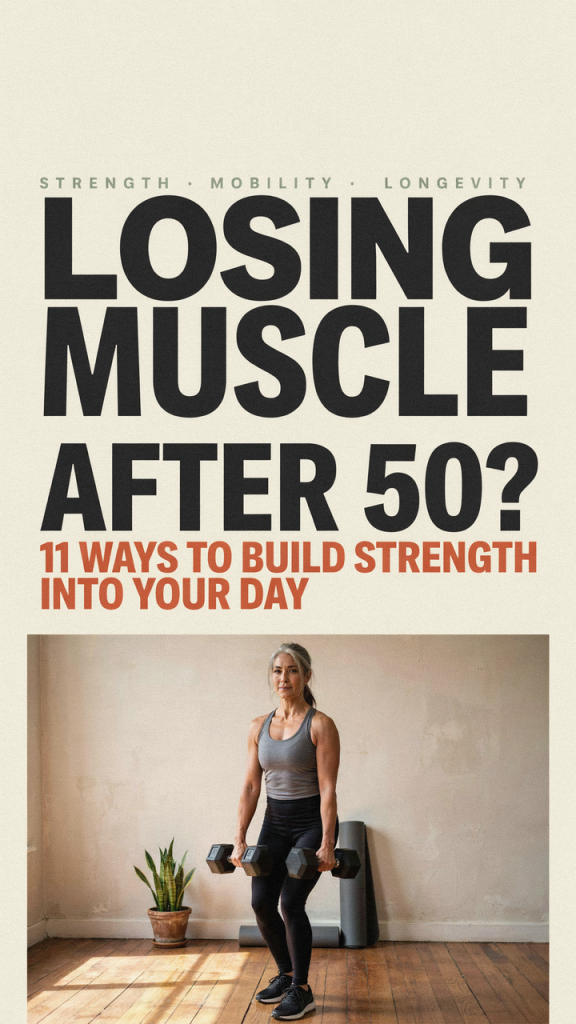
Losing Muscle After 50? 11 Ways to Build Strength Into Your Day
Losing Muscle After 50? 11 Ways to Build Strength Into Your Day
Introduction
If you’re over 50 and noticing that your clothes fit differently, your balance feels a little shakier, or everyday tasks feel harder, you’re not imagining it—age-related muscle loss (sarcopenia) is real. The good news: it’s not inevitable. With consistent, smart changes, you can rebuild strength, preserve independence, reduce injury risk, and feel more capable every day.
This article gives you 11 practical, science-friendly ways to build strength into your day. Each item is actionable and realistic for busy lives and varied fitness levels. Whether you’re returning to exercise after a break, managing arthritis, or simply want to age well, these strategies will help you move stronger and feel better.
Why strength matters after 50
Muscle mass and strength begin to decline subtly in midlife if unaddressed. Strength affects metabolism, bone density, joint health, balance, and the ability to perform daily activities (carrying groceries, climbing stairs, getting up from a chair). The goal isn’t to become a bodybuilder—it’s to maintain functional strength, preserve independence, and improve overall health.
11 Ways to Build Strength Into Your Day
Below are exactly 11 practical ways to add strength-building to your routine. Treat them as a menu: pick several that fit your life and build from there.
1. Do short resistance sessions 3 times a week
Consistency matters more than duration. Aim for 2–3 focused strength sessions per week, 20–40 minutes each.
- Focus: full-body moves (squats, hinges, pushing, pulling, core).
- Reps and sets: 2–4 sets of 6–12 reps for most moves; choose a weight/resistance that makes the last 2–3 reps challenging.
- Progression: increase resistance or add a set when exercises become easy.
Sample mini-session (20 minutes):
1. Bodyweight or goblet squats — 3 sets of 8–12 reps
2. Push-ups (wall/knee/full) — 3 sets of 6–12 reps
3. Bent-over dumbbell row — 3 sets of 8–12 reps
4. Plank (or dead bug) — 3 x 20–40 seconds
2. Prioritize protein across the day (with a simple recipe)
Protein supports muscle repair and growth. Aim for 20–40 grams of protein at each main meal, and include a protein-rich snack if appetite allows. Here’s a quick, easy smoothie you can add to breakfast or after a short workout.
High-Protein Berry-Oat Smoothie (serves 1)
Ingredients:
– 1 cup unsweetened almond milk (or milk of choice)
– 1/2 cup Greek yogurt (plain, 2% or whole)
– 1 scoop (about 20–25 g) whey or plant-based protein powder (optional but helpful)
– 1/2 cup frozen mixed berries
– 1/4 cup rolled oats
– 1 tablespoon chia seeds or ground flax
– 1 small banana (fresh or frozen)
– Ice as needed
Instructions:
1. Add the almond milk and yogurt to a blender.
2. Add the protein powder, berries, oats, chia seeds, and banana.
3. Blend until smooth, adding ice for desired thickness.
4. Taste and adjust sweetness with a small drizzle of honey if needed. Drink within 1–2 hours of blending for best texture.
Why it works: This drink gives a balance of protein, carbs, and healthy fats to support recovery and keep you full. Swap ingredients to suit preferences or dietary needs.
3. Move more—sneak strength into daily tasks
Not all strength work needs gym time. Turn daily chores into micro workouts:
– Carry groceries in two trips using both arms to balance load.
– Do calf raises while waiting for the kettle.
– Take stairs briskly and aim to do one flight multiple times a day.
– Sit-to-stand: do 10 deliberate sit-to-stand reps from a chair every few hours to strengthen hips and legs.
These small, frequent efforts accumulate and reinforce functional strength for real life.
4. Use progressive overload—track and nudge the challenge
Muscle adapts when it’s challenged. Keep a simple log (paper or phone) and gradually increase one of these every 1–2 weeks:
– Weight or resistance
– Reps per set
– Sets per exercise
– Time under tension (slow down the lowering phase)
– Frequency of sessions
Example: If you do 2 sets of 8 push-ups comfortably, try adding a third set or slowing the eccentric (lowering) phase to 3–4 seconds.
5. Combine balance and mobility with strength work
Strength without mobility can be limiting. Add brief mobility and balance moves:
– 5–10 minutes of dynamic warm-up before strength work (leg swings, shoulder circles).
– Balance drills: single-leg stands (30 seconds per side), heel-to-toe walk.
– Mobility: hip openers, thoracic rotations, ankle mobility drills.
These reduce fall risk and let you perform strength moves safely and effectively.
6. Short, intense options: try high-intensity intervals with strength focus (modified)
If cleared by your doctor, brief high-intensity intervals with resistance can be time-efficient. Example: 10-minute EMOM (every minute on the minute):
– Minute 1: 10 kettlebell swings or Romanian deadlifts (moderate weight)
– Minute 2: 8–10 push-ups or dumbbell presses
– Repeat 5 rounds
Modify intensity and rest to match fitness level. The goal is short, purposeful work rather than exhaustion.
7. Build protein-forward meals—one simple bowl recipe
Consistent meals that combine protein, vegetables, and healthy carbs make it much easier to maintain muscle. Here’s a balanced, easy-to-assemble dinner idea.
Salmon & Quinoa Strength Bowl (serves 2)
Ingredients:
– 2 salmon fillets (4–6 oz each)
– 1 cup cooked quinoa
– 2 cups mixed greens or baby spinach
– 1 cup roasted vegetables (broccoli, bell pepper, zucchini)
– 2 tablespoons olive oil (divided)
– 1 lemon (half for juice, half for slices)
– Salt, pepper, and 1 teaspoon dried oregano or thyme
– Optional: 2 tablespoons toasted pumpkin seeds or chopped walnuts
Instructions:
1. Preheat oven to 400°F (200°C). Toss chopped vegetables with 1 tablespoon olive oil, salt, and pepper. Roast for 15–20 minutes.
2. While vegetables roast, season salmon with salt, pepper, and oregano. Drizzle with remaining olive oil and a squeeze of lemon.
3. Bake salmon on a lined sheet for 10–12 minutes, until cooked through.
4. To assemble bowls: divide quinoa, greens, and roasted vegetables between two bowls. Top each with a salmon fillet.
5. Finish with lemon slices and sprinkle seeds or nuts for extra protein and crunch.
Why it works: Salmon delivers high-quality protein and omega-3 fats that support muscle health and inflammation control. Quinoa adds plant-based protein plus carbs for recovery.
8. Use resistance bands and bodyweight—easy, portable options
You don’t need a gym. Resistance bands, adjustable dumbbells, or even bodyweight training are excellent and low-cost. Bands provide variable resistance and are gentle on joints—great for shoulder and hip work.
Sample band circuit:
1. Banded squat — 3 x 10
2. Banded row — 3 x 12
3. Banded glute bridge — 3 x 12
4. Banded lateral walk — 2 x 15 steps each way
Carry a band in your bag for hotel rooms or travel.
9. Focus on compound movements that give the biggest return
Compound (multi-joint) exercises tax several muscle groups and give more functional benefit per minute:
– Squat or sit-to-stand
– Hinge (deadlift, Romanian deadlift)
– Push (push-up, chest press)
– Pull (row, lat pulldown)
– Carry (farmer carry)
Prioritize these moves in your sessions, then add single-joint work if desired. Compound movements improve balance, coordination, and daily function.
10. Consider supplements and key nutrients—fuel recovery smartly
Whole foods come first, but some nutrients are particularly helpful for older adults:
– Protein supplement (whey or plant) to hit per-meal protein targets.
– Vitamin D: low levels are linked with muscle weakness; check your levels and supplement if deficient.
– Creatine monohydrate: evidence supports improved strength and muscle mass gains in older adults when combined with resistance training—consult your healthcare provider.
– Omega-3s (fish oil): may support muscle protein synthesis and reduce inflammation.
Always check with your doctor before starting new supplements, especially if you have medical conditions or take medications.
11. Build routine, community, and realistic goals
Habits and social support keep you consistent:
– Schedule workouts in your calendar like any appointment.
– Find a class, partner, or trainer who understands older adult needs.
– Set measurable short-term goals: add 5 lb to a dumbbell, do 10 unassisted squats, take stairs without stopping.
– Celebrate small wins—consistency compounds into strength.
Overcoming common barriers
- Joint pain: reduce range, use isometrics, try lower-impact options (swimming, cycling), and prioritize mobility.
- Time: use micro-sessions (5–10 minutes) and accumulate 2–3 mini workouts throughout the day.
- Motivation: set meaningful goals tied to daily life (play with grandchildren, garden longer, travel independently).
- Fear of lifting: start with bodyweight and bands, learn form with a certified trainer, and progress slowly.
Safety tips before you start
- If you have chronic conditions (heart disease, uncontrolled blood pressure, severe osteoporosis), check with your doctor first.
- Warm up for 5–10 minutes and cool down with gentle stretching or mobility work.
- Prioritize pain-free movement; mild muscle soreness is normal, sharp joint pain is not.
- Use correct form—quality reps are more valuable than high reps with poor technique.
Tracking progress without overcomplicating
Keep it simple:
– Note the exercise, weight, sets, and reps.
– Track functional wins: number of stairs climbed, how you rose from a low chair, or length of brisk walk.
– Reassess every 4–6 weeks and adjust loads or exercises.
Realistic expectations
Muscle and strength gains are slower with age but they absolutely happen. Expect gradual improvements over months—more energy, better balance, easier daily tasks, and measurable strength increases when you’re consistent.
Conclusion
Losing muscle after 50 can feel discouraging, but it’s reversible and controllable. These 11 strategies give you a practical roadmap: prioritize resistance work, spread protein across the day, use compound movements, add mobility and balance, and create routines that fit your life. Small, consistent steps—short workouts, protein-rich meals, micro-movements during the day, and gradual progression—add up to meaningful strength gains.
Pick two or three strategies from this list and commit to them for six weeks. Track progress, adjust as needed, and celebrate improvements. With the right approach, you’ll move stronger, reduce injury risk, and enjoy greater independence and vitality for years to come. Keep going—you’re building more than muscle; you’re building resilience for the life you want to live.
