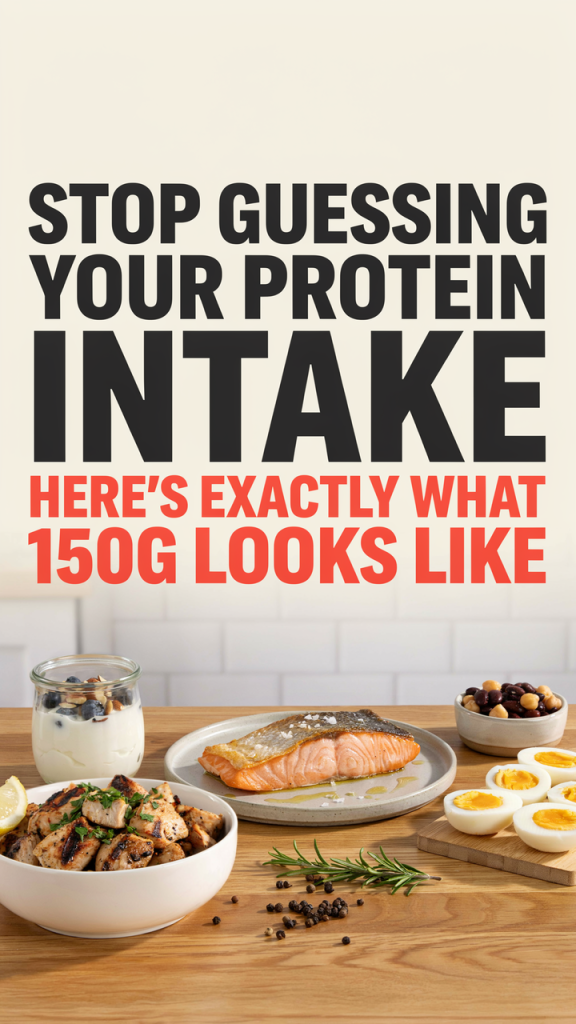
Stop Guessing Your Protein Intake—Here’s Exactly What 150g Looks Like
Introduction
If you’ve ever stared at your plate wondering whether your meal “counts” toward your daily protein goal, you are not alone. Many people — from weekend warriors and busy professionals to strength athletes — aim for a round number like 150 grams of protein a day but struggle to visualize what that actually looks like on real plates, in grocery stores, or between workouts. This guide stops the guesswork. We’ll break down what 150g of protein looks like in everyday foods, give clear sample day plans that add up to 150g, provide practical recipes with exact ingredient and instruction lists, and share tips and snack ideas so you can reach your target consistently and enjoyably.
Why 150g? Who needs it and why it matters
- Protein builds and repairs muscle, supports immune function, and helps regulate hormones and appetite.
- For many active people, athletes, and people aiming to maintain or build lean mass, 150g per day is a realistic and practical target. Depending on body weight, that often falls into the range of about 1.6–2.2 g/kg for those lifting or doing regular strenuous activity.
- 150g is also a helpful, round number for people tracking macros or planning meals — it’s high enough to support recovery and satiety but manageable across 3–6 meals.
Quick reference: approximate protein per common foods (useful for visualization)
Note: these are approximate cooked/ready-to-eat values to make planning simple. Always check packaging/nutrition labels for precise values.
- Cooked chicken breast, 100g — ~31 g protein
- Cooked salmon, 100g — ~25 g protein
- Cooked lean beef, 100g — ~26 g protein
- Large egg — ~6 g protein
- Nonfat Greek yogurt, 1 cup (245g) — ~23 g protein
- Whey protein powder, 1 scoop (30g) — ~24 g protein
- Cooked lentils, 1 cup (198g) — ~18 g protein
- Cooked quinoa, 1 cup (185g) — ~8 g protein
- Firm tofu, 100g — ~8 g protein
- Cottage cheese, 1/2 cup (113g) — ~14 g protein
- Milk, 1 cup (240ml) — ~8 g protein
- Almonds, 1 oz (28g) — ~6 g protein
- Peanut butter, 2 tbsp — ~8 g protein
How to visualize 150g of protein — concrete food equivalents
To make 150g tangible, here are some straightforward single-food equivalences (approximate):
- 150g of cooked chicken breast ≈ 46.5 g protein (about one large chicken breast + a bit)
- 150g of cooked salmon ≈ 37.5 g protein
- 500g Greek yogurt (about 2 cups) ≈ 46 g protein
- 6 scoops whey protein ≈ 144 g protein (obviously not recommended to get all protein from powder)
- 1.5 cups cooked lentils ≈ 27 g protein
- 3.5 eggs ≈ 21 g protein
Use these as building blocks — most days you’ll combine several items rather than rely on one food.
Exactly what a 150g day looks like — 3 realistic sample days (each totals ~150 g)
Below are three sample day plans with the protein math spelled out. Each includes at least one recipe — ingredients listed and instructions numbered — so you can recreate them easily.
Sample Day 1 — Balanced omnivore (Total ≈ 150 g)
Breakfast — Greek Yogurt Power Bowl (≈ 41 g protein)
– Greek yogurt (3/4 cup / 185 g) — ~17 g
– Whey protein powder (1 scoop / 30 g) — ~24 g
Total breakfast protein ≈ 41 g
Recipe: Greek Yogurt Power Bowl
– Ingredients:
– 3/4 cup (185 g) nonfat Greek yogurt
– 1 scoop (30 g) whey protein powder (vanilla or unflavored)
– 1/2 cup mixed berries (optional)
– 1 tbsp chia seeds or crushed nuts (optional)
– Instructions:
1. Stir the protein powder thoroughly into the Greek yogurt until smooth.
2. Top with berries and chia seeds or nuts.
3. Eat immediately or pack in a container for work.
Lunch — Grilled Chicken & Quinoa Salad (≈ 39 g protein)
– Cooked chicken breast (100 g) — ~31 g
– Cooked quinoa (1 cup / 185 g) — ~8 g
Total lunch protein ≈ 39 g
Recipe: Grilled Chicken & Quinoa Salad
– Ingredients:
– 100 g cooked chicken breast, sliced
– 1 cup cooked quinoa
– 1 cup mixed salad greens
– 1/2 cup cherry tomatoes, halved
– 1/4 cucumber, sliced
– 1 tbsp olive oil + lemon juice, salt, pepper
– Instructions:
1. Combine quinoa, greens, tomatoes, and cucumber in a bowl.
2. Top with sliced chicken.
3. Drizzle olive oil and lemon juice, then season to taste and toss.
Snack — Cottage Cheese + Peanut Butter (≈ 18 g protein)
– Cottage cheese (1/2 cup) — ~14 g
– Peanut butter (1 tbsp) — ~4 g
Total snack protein ≈ 18 g
Dinner — Lean Beef Stir-Fry (≈ 52 g protein)
– Cooked lean beef (200 g) — ~52 g
– Veggies and a small serving of brown rice or none for calories
Total dinner protein ≈ 52 g
Recipe: Quick Lean Beef Stir-Fry
– Ingredients:
– 200 g lean beef strips
– 1 cup mixed stir-fry vegetables (peppers, broccoli, onion)
– 1 tbsp soy sauce or tamari
– 1 tsp olive oil
– Optional: 1/2 cup cooked brown rice (adds ~2.5–3 g protein)
– Instructions:
1. Heat oil in a skillet over medium-high heat.
2. Add beef and sear for 3–4 minutes until browned; remove and set aside.
3. Add veggies and cook until tender-crisp.
4. Return beef to the pan, add soy sauce, toss to warm and serve.
Sample Day 2 — Plant-forward (Total ≈ 150 g)
Breakfast — Protein Smoothie (≈ 37 g protein)
– Whey protein (1 scoop) — ~24 g
– Milk (1 cup) — ~8 g
– Rolled oats (1/2 cup) — ~5 g
Total breakfast protein ≈ 37 g
Recipe: Breakfast Protein Smoothie
– Ingredients:
– 1 scoop whey protein powder (30 g)
– 1 cup milk (dairy or fortified plant milk)
– 1/2 cup rolled oats
– 1 banana and ice
– Instructions:
1. Place all ingredients in a blender.
2. Blend until smooth.
3. Pour into a glass and enjoy.
Lunch — Hearty Lentil Bowl (≈ 44 g protein)
– Cooked lentils (2 cups) — ~36 g
– Firm tofu (100 g) — ~8 g
Total lunch protein ≈ 44 g
Recipe: Hearty Lentil Bowl
– Ingredients:
– 2 cups cooked lentils
– 100 g firm tofu, cubed
– 1 cup sautéed greens (spinach or kale)
– 1 tbsp olive oil, salt, pepper, spices to taste
– Instructions:
1. Sauté tofu cubes in a skillet with a little oil until golden.
2. Warm lentils and combine with sautéed greens.
3. Top with tofu and season; serve warm.
Snack — Greek Yogurt + Almonds (≈ 20 g protein)
– Nonfat Greek yogurt (1 cup) — ~23 g (you can halve to hit ~12 g and add almonds for balance)
For our plan: use 1/2 cup Greek yogurt (~11–12 g) + 1 oz almonds (~6 g) + 1 tbsp peanut butter (~4 g) ≈ 21–22 g — we’ll list a practical combination:
– 1/2 cup Greek yogurt — ~12 g
– 1 oz almonds — ~6 g
– 1 tbsp peanut butter — ~4 g
Total snack protein ≈ 22 g (rounded to plan)
Dinner — Tempeh & Quinoa Stir-Fry (≈ 47 g protein)
– Tempeh (200 g) — ~38 g
– Cooked quinoa (1 cup) — ~8 g
Total dinner protein ≈ 46 g
Recipe: Tempeh & Quinoa Stir-Fry
– Ingredients:
– 200 g tempeh, cubed
– 1 cup cooked quinoa
– 1 cup mixed vegetables (snap peas, bell pepper)
– 1 tbsp soy sauce, 1 tsp sesame oil
– Instructions:
1. Sear tempeh cubes in a skillet with sesame oil until browned.
2. Add vegetables and cook until tender-crisp.
3. Stir in cooked quinoa and soy sauce to warm through; serve.
Sample Day 3 — Egg-forward & fish (Total ≈ 150 g)
Breakfast — Savory Omelette + Toast (≈ 34 g protein)
– 3 large eggs — ~18 g
– 3 egg whites — ~11 g
– 1 slice whole-grain toast — ~4 g
Total breakfast protein ≈ 33 g
Recipe: Veggie Egg White Omelette with Toast
– Ingredients:
– 3 whole eggs + 3 egg whites
– 1/2 cup chopped vegetables (spinach, tomato, bell pepper)
– 1 slice whole-grain bread
– Salt and pepper, 1 tsp oil or cooking spray
– Instructions:
1. Whisk eggs and egg whites; season.
2. Heat skillet, cook veggies briefly, pour eggs in and cook until set.
3. Fold, serve with toasted bread.
Lunch — Tuna Salad Wrap (≈ 42 g protein)
– Tuna (canned in water, drained, 150 g) — ~34 g
– Greek yogurt or mayo + wrap (wrap adds ~4–6 g)
Total lunch protein ≈ 40–42 g
Recipe: Tuna Salad Wrap
– Ingredients:
– 150 g canned tuna in water, drained
– 2 tbsp Greek yogurt or light mayo
– 1 whole-grain wrap
– Lettuce, cucumber, pepper to taste
– Instructions:
1. Mix tuna and yogurt/mayo.
2. Spread on wrap, add veggies, roll and serve.
Snack — Hard-Boiled Eggs + Apple (≈ 12 g protein)
– 2 large eggs — ~12 g
Dinner — Baked Salmon + Lentils (≈ 63 g protein)
– Baked salmon (200 g) — ~50 g
– Cooked lentils (1/2 cup) — ~9 g
Total dinner protein ≈ 59 g -> adjust salmon to 225 g for ~56 g and lentils 1/2 cup for ~9 g -> combined ~65 g. To hit 150g total, we’ll use 200 g salmon (~50 g) + 1 cup lentils (~18 g) would overshoot, so choose 200 g salmon (50 g) + 1/2 cup lentils (9 g) = 59 g. Given earlier totals (33 + 42 + 12 + 59 = 146), add a small cottage cheese nightcap (1/4 cup = ~7 g) would bring it to ~153. Small rounding differences are normal. The key is you can adjust a tablespoon of peanut butter or a 10g protein snack to fine-tune.
Recipe: Simple Baked Salmon with Lemon
– Ingredients:
– 200 g salmon fillet
– Lemon slices, salt, pepper, 1 tsp olive oil
– 1/2 cup cooked lentils (for serving)
– Instructions:
1. Preheat oven to 200°C/400°F.
2. Place salmon on foil, drizzle oil, season, add lemon.
3. Bake 12–15 minutes until cooked through; serve with warmed lentils.
Tips for hitting 150g without feeling stuffed
- Spread the protein: Aim for 3–5 protein-focused meals/snacks — 30–50g each — rather than one huge protein-heavy meal.
- Use a protein powder strategically: A scoop provides 20–25g quickly, ideal for shakes or stirred into yogurt.
- Choose high-protein staples: Greek yogurt, cottage cheese, canned tuna, chicken breast, lean beef, tofu, tempeh, lentils.
- Add protein to snacks: Hard-boiled eggs, almonds, high-protein yogurts, or a small whey smoothie.
- Volume vs. density: If calories are a concern, favor lean proteins (chicken breast, fish, egg whites) and balance with fibrous veggies for volume.
- Meal prep and portions: Cook and portion protein in bulk (e.g., 150–200g portions of chicken or salmon) to reduce daily decision fatigue.
- Adjust to hunger and goals: If you’re losing weight or gaining muscle, tweak calorie and protein distribution while keeping total protein close to target.
Tracking tools and measurement tips
- Digital food scales: The most accurate way to measure cooked meat and portions. A simple kitchen scale removes guesswork.
- Nutrition apps: MyFitnessPal, Cronometer, and similar apps let you log foods and see protein totals. Use them for a week to learn your patterns.
- Package labels: For packaged foods (yogurt, cottage cheese, tempeh), always check the label — manufacturers vary.
- Visual cues: A deck-of-cards sized cooked chicken breast is roughly 100–120g cooked (≈31–37 g protein). A palm-sized fillet is a useful on-the-go estimate.
- Weigh once, eyeball later: Weigh portions during meal prep a few times to get a sense of what 100–150g portions look like in your favorite foods.
20 High-Protein Snacks (quick grab-and-go ideas you can use to top up protein)
- Hard-boiled eggs (1–2 eggs)
- Cottage cheese (1/2 cup)
- Nonfat Greek yogurt (1 cup)
- Whey protein shake (1 scoop + water or milk)
- Canned tuna (seasoned, 100 g)
- Edamame (1 cup shelled)
- Beef or turkey jerky (check low-sugar versions)
- String cheese or low-fat cheese stick
- Roasted chickpeas (1 cup)
- Sliced turkey breast roll-ups
- Protein bars (choose low-sugar, >15 g protein)
- Almonds (1 oz) + a slice of lean turkey
- Peanut butter (2 tbsp) on whole-grain toast
- Hummus (1/2 cup) with raw veggies (adds some protein)
- Tempeh or tofu skewers (100 g tempeh = ~19 g)
- Cottage cheese with fruit and seeds
- Smoked salmon on rye crackers
- Pumpkin seeds (1/4 cup)
- Lentil salad (1 cup cooked lentils)
- Protein pudding made with protein powder and Greek yogurt
FAQs — common questions about a 150g target
Q: Is 150g too much protein?
A: It depends on your weight, activity level, and goals. For an active 70–95 kg person, 150g often sits within recommended ranges for muscle maintenance and growth. For smaller, less active people, 150g may exceed needs. Consult a registered dietitian for personalized guidance.
Q: Will high protein harm my kidneys?
A: In healthy people, high-protein diets are generally safe. People with preexisting kidney disease should consult their healthcare provider.
Q: Can I hit 150g on a vegetarian or vegan diet?
A: Yes — with planning. Use lentils, tofu, tempeh, seitan, dairy or fortified plant milks (if lacto-vegetarian), legumes, nuts, seeds, and concentrated sources like protein powders.
Conclusion
No more guesswork: 150 grams of protein a day can be visualized, planned, and enjoyed without turning meals into a clinical exercise. Use the sample days above as templates, choose the recipes you like, and tweak portions to fit your calorie needs and schedule. Invest in a kitchen scale for precision, and keep convenient high-protein snacks on hand to bridge gaps. With consistent small choices — a scoop of whey, a palm-sized chicken breast, a cup of Greek yogurt — you’ll hit 150g reliably, feel fuller longer, recover faster, and power through your day with confidence. You’ve got this — now go build your plate.